Learn acupressure from books: how to choose one, how to read it, and the limits of self-study
Lương Y (traditional healer) Tống Văn Huynh · Tong Gia Acupoint Wellness (Huyệt Đạo Tống Gia) · 09/11/2026
A book to learn acupressure worth using should show the points along each meridian, how to measure cun, how to apply pressure, and a contraindications section. A book helps you remember point names; but hand pressure and reading the body by “the signs show outside, the organs lie inside” must be practised with a guide, as at Tong Gia.
Questions learners often ask about learning acupressure from books
Is learning acupressure from books enough, and when do I need a teacher to correct my hands?
Books are not enough: they show locations and principles, but pressure and angle need a teacher correcting your hands from the start. Books help with meridians, muscles and the Eastern idea that outer signs reflect inner organs. Tống Gia teaches wellness care, not medical services; lasting pain or numbness needs a medical check first. Free trial class on Sunday mornings at căn T16-21 khu Manhattan, Vinhomes Grand Park, TP. Thủ Đức; Zalo/WhatsApp +84 917 945 259.
What should an acupressure book include?
There are a great many books on acupoints, from textbooks used at traditional medicine colleges to popular “do acupressure yourself at home” titles. When flipping through one, check these 5 sections:
- Foundation theory: yin and yang, the five elements, the zang-fu organs and the meridians at a basic level. Without this, you only remember isolated points.
- Acupoint diagrams along the meridians: front, back and side views, with bone and muscle landmarks clearly marked.
- How to measure in cun: body cun (based on the fingers of the person receiving care) and dividing segments by bone landmarks.
- How to apply pressure: rubbing, kneading, pressing and stroking, with the pressure and duration.
- Contraindications: pregnant women, areas of damaged skin, and people with acute conditions who need to see a doctor.
Any book promising “press one point and the illness is gone” or “instant pain relief” should go back on the shelf. Wellness acupressure is health care that helps you relax; it does not replace seeing a doctor.
In what order should beginners read?
Many people buy a book and jump straight to the “points for insomnia and back pain” section. Reading that way makes it easy to misremember and to skip the safety part. The order Tong Gia suggests to students:
- Read the meridian section to learn where the 12 main meridians run. The article 12 main meridians and their pathways sums this up.
- Learn how to measure cun and practise measuring on your own hand.
- Learn about 20–30 common points first; see the basic acupoints beginners should learn.
- Read the contraindications carefully before laying hands on anyone else.
- Only then move on to combining points for each care need.
What can a book help with, and what can it not?
| What a book helps with | What a book cannot replace |
|---|---|
| Remembering point names and meridians | Feeling whether your pressure is just right or too strong |
| Understanding basic Eastern medicine theory | Finding the right point on heavier and slimmer bodies |
| Looking things up when you forget | Reading the reactions of the person receiving care as you work |
| Learning anytime at low cost | Knowing when you must stop |
An acupoint in a book is a dot of ink. An acupoint on a real body is a small area with its own feel: slightly hollow, slightly tender, or with a taut muscle fibre. This part can only be learned by hand. At Tong Gia, students also learn to read the back through therapeutic-style massage with spinal nerve-reflex balancing and to observe complexion through Y Tướng Học (face reading for wellness), two things popular acupressure books almost never cover.
How do you combine books with classes?
- Read the theory beforehand, practise with your hands in class, then look things up in the book at home.
- Write notes straight into the book about whatever the instructor corrects in your hand technique.
- Practise locating points on family members after each session and compare with the diagrams in the book.
- Read more from the acupoint library series, such as Túc Tam Lý (ST36, 足三里) and Khí Hải (CV6, 气海), for step-by-step measuring explained in plain language.
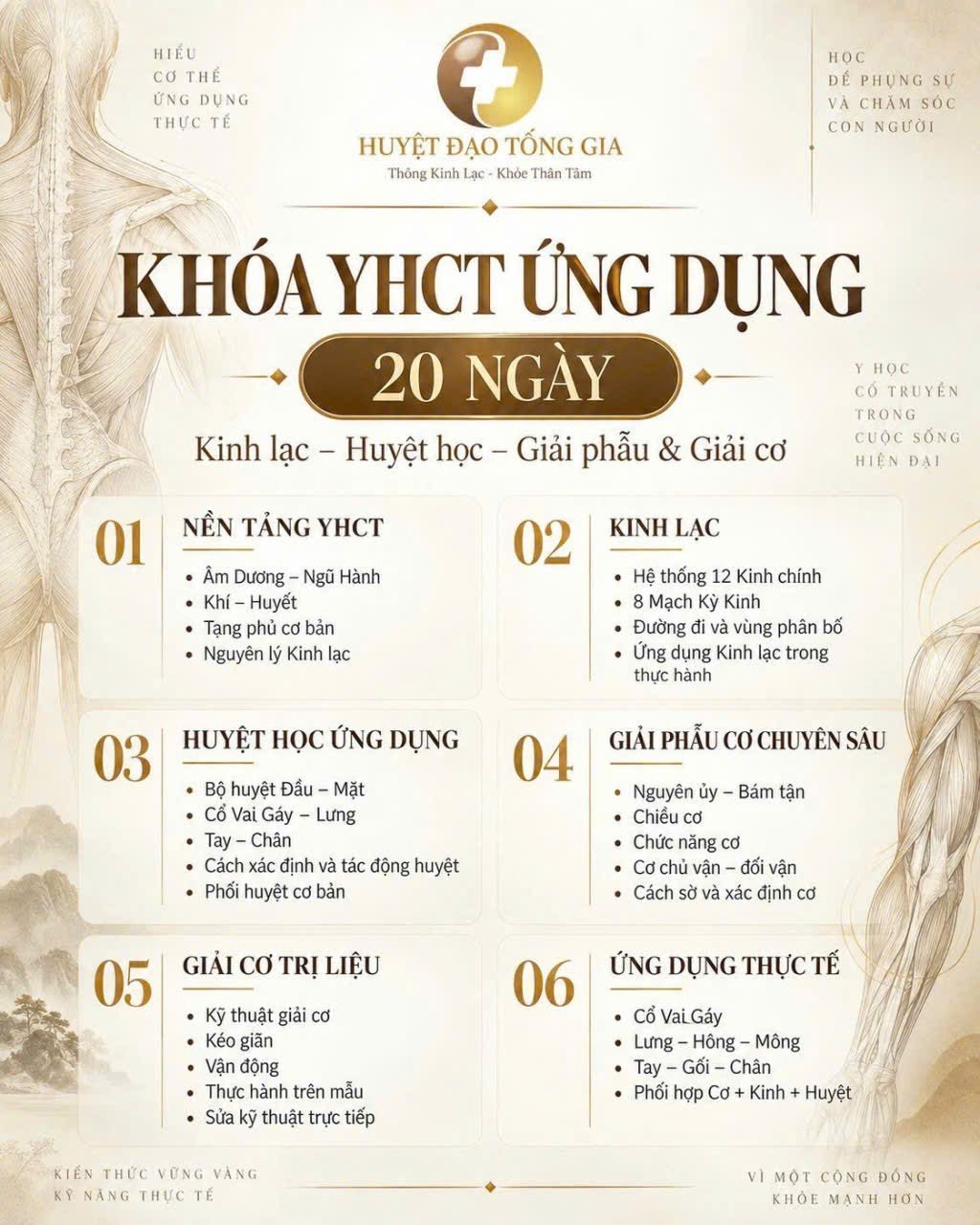
If you are only learning to care for your parents, a good book plus a few guided practice sessions is enough to start safely. If you are learning to work in the trade, you need a more structured path; see the massage and acupressure course.
Where can you learn acupressure with hands-on guidance?
At Tong Gia, Lương Y Tống Văn Huynh teaches the class in person; students receive materials for each part and practise on real people during the session. People who have studied books on their own for years can also come to a trial class to check how they locate points.
How to register
The weekly Sunday-morning trial class, 9:00–12:00, and the free Sunday Y Tướng Học session are open to newcomers, at căn T16-21 khu Manhattan, Vinhomes Grand Park, TP. Thủ Đức (Thu Duc City, Ho Chi Minh City). Register for a trial class or call the training hotline 0917 945 259.
Frequently asked questions
What should an acupressure book include? Basic meridian theory, acupoint diagrams along the meridians, how to measure cun, how to apply pressure, and a contraindications section.
Can you learn acupressure on your own from books? You can learn the theory and point names. Hand pressure, finding points on a real body and knowing when to stop need practice with someone guiding you.
In what order should beginners read an acupressure book? Meridians first, then measuring cun, 20–30 common points, the contraindications, and only then combining points.
Can you trust acupressure books that promise to make illness disappear? No. Wellness acupressure is health care that helps you relax; it does not replace seeing a doctor.
Which kind of acupressure book should beginners choose? Choose one that covers all 5 parts: basic meridian theory, point charts along the meridians, how to measure cun, how to apply pressure, and contraindications, from traditional medicine and pharmacy textbooks to popular books. If a book promises “press one point and the illness is gone”, put it down.
Related articles
- 30 basic massage techniques learners should know: learn them in groups, not as a list of names
- 8 principles of spinal wellness massage: the rules of the hands for Tong Gia learners
- How much pressure in acupressure: gauging force by how the receiver feels
- Hands for wellness massage: soft hands, hard hands and 6 things you must train
- All articles about learning the trade
Reserve a free Sunday-morning trial class or ask about the learning path: message Zalo 0917 945 259.

Founder of Tong Gia Acupoint Wellness (Huyệt Đạo Tống Gia), with more than 13 years in Eastern wellness practice, Y Tướng Học (face reading for wellness) and spinal nerve-reflex balancing. Lương Y's story
417 customers have reviewed Tong Gia on Google Maps
Reviews are written by customers themselves on Google; tap to read them before you visit.
Huyệt Đạo Tống Gia Quận 12
225 Dương Thị Mười, Phường Tân Chánh Hiệp (District 12, Ho Chi Minh City). 8:00 – 19:00 daily.
See reviews on Google MapsHuyệt Đạo Tống Gia Quận 9
Căn T16-21 khu Manhattan, Vinhomes Grand Park, Phường Long Bình (Thủ Đức City, Ho Chi Minh City). 9:00 – 20:00 daily.
See reviews on Google MapsWant to be observed in person?
A 90-minute session starts with observation, and only then moves on to muscle release and acupressure on the right areas. Two branches: District 12 and Vinhomes Grand Park.