Hands for wellness massage: soft hands, hard hands and 6 things you must train
Lương Y (traditional healer) Tống Văn Huynh · Tong Gia Acupoint Wellness (Huyệt Đạo Tống Gia) · 13/11/2026
What do hands for wellness massage need? Sensitivity, just-enough pressure, warmth, softness, short nails and cleanliness. Dry, stiff hands can still be trained by avoiding harsh chemicals and extreme heat or cold, and drilling the fingers daily. Tong Gia Acupoint Wellness (Huyệt Đạo Tống Gia) in Ho Chi Minh City teaches this from the "role of the hands" slide.
Questions learners often ask about what hands need for wellness massage
I'm over 30 with dry, stiff hands and want to learn wellness massage in Thu Duc for work. Can hands like mine learn it?
Yes, they can. The curriculum calls dry, stiff hands "hard hands" (khổ thủ): they need more practice, they are not ruled out. Fingertips are rich in touch receptors, and steady training makes them more sensitive. Lương Y Tống Văn Huynh teaches at Vinhomes Grand Park, Thu Duc City, with a Sunday-morning trial class; Zalo 0917 945 259.
I work at a spa in District 9. How should I keep my nails and skin so I don't lose feel during massage?
Cut your nails short and file them smooth so the soft fingertip pad touches the skin first; avoid soaking your hands in cleaning chemicals for long, wash with mild soap and moisturise after each shift. In Eastern medicine the Liver shows in the nails, so nails also reflect your sleep. Tong Gia teaches this in class at Vinhomes Grand Park.
After years of massage in Ho Chi Minh City my fingers go numb at night. Should I keep training my hands or see a doctor?
Take fewer clients, rest your hands and get checked at a medical facility, because numb fingers at night can be linked to neck nerve roots or the carpal tunnel. Wellness massage is not a medical profession. Tong Gia teaches how to drive pressure from the body to spare the hands; ask about the schedule on Zalo 0917 945 259.
The class starts with spreading both hands
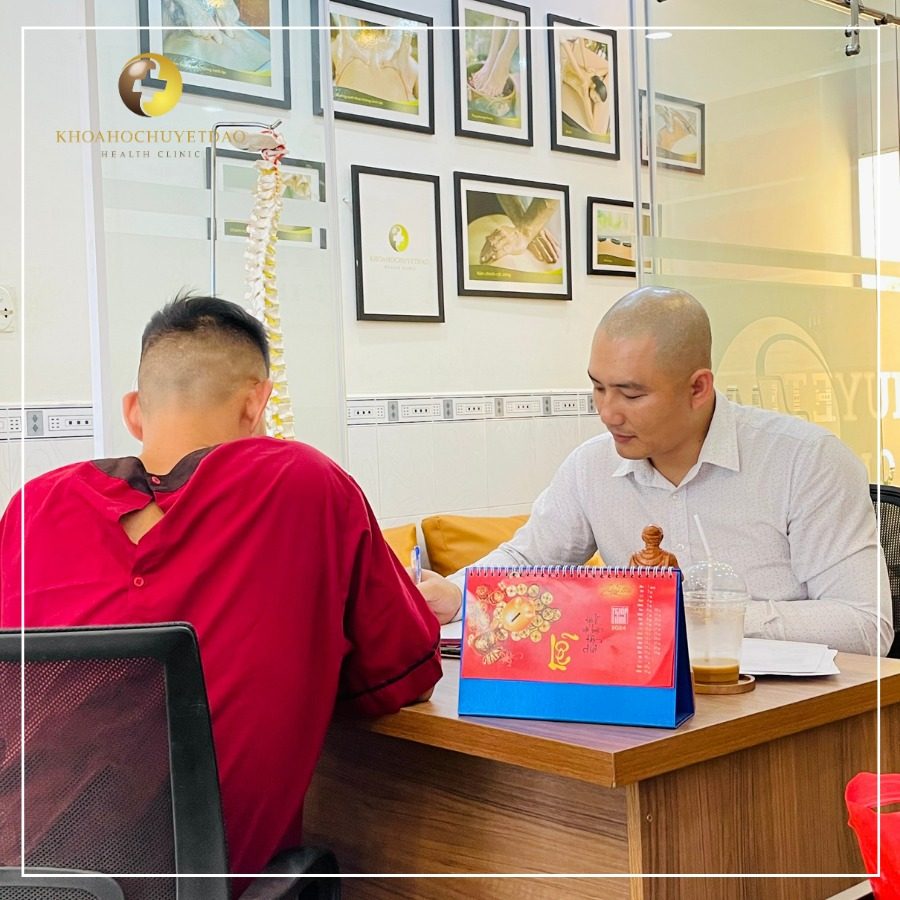
Before learners place their hands on a practice partner's back, Lương Y Tống Văn Huynh walks around the room and asks everyone to spread both hands. He lifts each pair of hands to look: warm or cold, palms dry or soft, nails long or short, any scratches. One learner's hands are ice-cold from just washing; he tells her to rub her palms together until they are warm before touching anyone. That is how the question what do hands for wellness massage need gets answered in the very first minute.
What the "role of the hands" slide says
The curriculum of the spinal nerve-reflex balancing wellness massage method states it plainly: the hands are the practitioner's most important tool, and no device has replaced them yet. The method uses only the hands, mainly the fingertips, the palms and the pad of the thumb, to work on the head and the spine. It asks three things of the practitioner: the hands must be sensitive and refined; avoid contact with very high or very low temperatures and harsh chemicals; train the feel of the hands every day.
The slide also sorts hands into two kinds. Soft hands (cam thủ) are supple, thick and warm, well suited to bodywork. Hard hands (khổ thủ) are dry and stiff and need more practice. This is not a gift of nature: hard hands can still be trained.
What hands for wellness massage need: six things
1. Feel
In Western medicine, the fingertips have a dense concentration of touch receptors, which is why the curriculum uses the soft fingertip pads to read four objective factors: skin temperature, the cushioning muscle layer, the shape of the vertebrae and the client's sensations. How to train this feel is covered in the article sensing hands in wellness massage.
2. Just-enough pressure
Pressure goes from light to strong across five levels, from one finger to whole-body strength, and it comes from the body, not from tensing the wrist. Tense hands lose their feel. How to channel pressure to spare the wrists is covered in wrist pain after years of massage.
3. Warmth
Cold hands on a back make the skin contract, the client shivers, and the muscles beside the spine tense up just when you need to read them. Rub your palms warm before touching; between clients wash your hands in warm water, not water that is too cold or too hot.
4. Softness
Dry, calloused, cracked skin makes the hands hard to glide and hard to feel with. Limit long soaks in cleaning water, wear gloves for household chores with chemicals, and moisturise after each shift. This is exactly what the slide says: avoid harsh chemicals to keep the hands sensitive.
5. Nails
Cut nails short and file them smooth so the soft fingertip pad touches the skin first, not the nail edge. Long nails both scratch the client's skin and mask your feel. In Eastern medicine the Liver shows in the nails: pink, firm nails mean Liver blood is sufficient; practitioners look at their own nails to see how they are sleeping and eating.
6. Clean
Wash your hands before and after every client with mild soap and dry them; take off rings and bracelets; if a hand has an open wound, cover it fully or let someone else do the session.
Finger drills every day
- Morning: roll the wrists, open and close the hands, spread each finger apart and bring it back.
- Hold your palm just above a practice partner's skin and compare warm areas with cool ones before touching.
- Place your fingertips along the partner's spinous processes, close your eyes, count each vertebra and compare the one above with the one below.
- Evening: soak your hands in warm water, rub between your fingers and moisturise.
In Eastern medicine the Liver governs the tendons and the Spleen governs the four limbs; late nights and rushed meals leave the hand tendons tired easily. Keeping your sleep is also keeping your hands.
How Lương Y Tống Văn Huynh teaches learners to look after working hands
With more than 13 years in the profession and hundreds of learners trained, Lương Y Tống Văn Huynh, founder of Tong Gia, reminds the class: „A practitioner's hands must be warm before they touch, soft before they press and clean before anyone talks about skill.“ In class, every time pairs switch, the person lying down says whether their partner's hands are warm or cold, soft or stiff. That way hard hands learn what to train, and soft hands learn what to keep.
When to advise a client to see a doctor, and when you must see one yourself
When your hands find an unusually hot, red area or a strange lump, or the client feels sharp pain or numbness spreading down the arms or legs, stop and advise the client to get checked at a medical facility. For practitioners: wrist pain lasting several weeks, numb fingers at night, a grip that keeps weakening, or inflamed, cracked, bleeding skin on the hands means taking fewer clients, resting your hands and getting checked. Tong Gia is wellness and health care, not a medical service.
Which level covers this?
Keeping, placing and using the hands with the right pressure is practised from the first hands-on sessions; about 70% of class time is practice on real people. Using the fingertips to read the four objective factors on the spine is studied in depth in the Specialist Course (L3). Read more about the teacher: Lương Y Tống Văn Huynh.
How to sign up
Newcomers can join the Sunday-morning trial class, 9:00–12:00, with no fee, and the Sunday Y Tướng Học (face reading for wellness) class, at căn T16-21 khu Manhattan, Vinhomes Grand Park, TP. Thủ Đức (unit T16-21, Manhattan block, Thu Duc City). Lương Y reviews your hand skills at the trial class and suggests a suitable level. Tong Gia does not promise jobs or income after the course. Book a trial class or call the training hotline 0917 945 259.
Frequently asked questions
What do hands for wellness massage need? They need to be sensitive, use just-enough pressure, and be warm, soft, short-nailed and clean, plus daily training of the feel of the hands.
How are soft hands and hard hands different? Soft hands (cam thủ) are supple, thick and warm, well suited to bodywork. Hard hands (khổ thủ) are dry and stiff; they can still learn but need more practice.
Why warm your hands before touching a client? Cold hands make the client's skin contract and the muscles beside the spine tense up, so it is hard to read the right area to work on.
Where in Ho Chi Minh City can I learn to train my hands for wellness massage? At Tong Gia, căn T16-21 khu Manhattan, Vinhomes Grand Park, TP. Thủ Đức (Thu Duc City). Trial class Sunday 9:00–12:00 with no fee, hotline 0917 945 259.
Related articles
- 30 basic massage techniques learners should know: learn them in groups, not as a list of names
- 8 principles of spinal wellness massage: the rules of the hands for Tong Gia learners
- How to use the right pressure in acupressure: measuring force by how the receiver feels
- Protecting a massage practitioner's hands: keeping your hands fit for a long career
- All articles about learning the trade
Reserve a free Sunday-morning trial class or ask about the learning path: message Zalo 0917 945 259.

Founder of Tong Gia Acupoint Wellness (Huyệt Đạo Tống Gia), with more than 13 years in Eastern wellness practice, Y Tướng Học (face reading for wellness) and spinal nerve-reflex balancing. Lương Y's story
417 customers have reviewed Tong Gia on Google Maps
Reviews are written by customers themselves on Google; tap to read them before you visit.
Huyệt Đạo Tống Gia Quận 12
225 Dương Thị Mười, Phường Tân Chánh Hiệp (District 12, Ho Chi Minh City). 8:00 – 19:00 daily.
See reviews on Google MapsHuyệt Đạo Tống Gia Quận 9
Căn T16-21 khu Manhattan, Vinhomes Grand Park, Phường Long Bình (Thủ Đức City, Ho Chi Minh City). 9:00 – 20:00 daily.
See reviews on Google MapsWant to be observed in person?
A 90-minute session starts with observation, and only then moves on to muscle release and acupressure on the right areas. Two branches: District 12 and Vinhomes Grand Park.