Chronic pain client psychology: what wellness massage learners need to understand to care for long-term aches correctly
Lương Y (traditional healer) Tống Văn Huynh · Tong Gia Acupoint Wellness (Huyệt Đạo Tống Gia) · 13/11/2026
Clients with long-term aches usually arrive tired, doubtful, hoping for a quick fix and already tensed up. A practitioner needs to ask carefully, listen, make no promises and explain using the client's own spine. At Tong Gia Acupoint Wellness (Huyệt Đạo Tống Gia), learners are also taught to advise clients with lasting pain to see a doctor.
Questions learners often ask about the psychology of clients with long-term aches
I'm a massage practitioner in District 12. Clients with long-term back pain are often doubtful and distrustful. How should I talk to them?
Ask carefully, hear the whole story and make no promises. After reading skin temperature, the cushioning muscle layer and the shape of the vertebrae, show the client the stiff area on their own back. Tong Gia Acupoint Wellness teaches practitioners to say clearly that this is wellness care, not a replacement for seeing a doctor; for long-lasting pain, advise the client to get checked.
Clients with long-lasting aches hope one session will make it go away. How should a new massage practitioner in Ho Chi Minh City answer?
Be honest from the start: a care session helps the muscles relax and feel more comfortable, with no promise that the pain will go away. According to the Tong Gia Acupoint Wellness curriculum, pain shows up in one place but its root is often somewhere else. For long-lasting pain, or numbness and weakness that keep increasing, advise the client to see a doctor at a medical facility.
Where in Thu Duc can I learn to handle the psychology of clients with long-term aches, and at which level?
Learn at Tong Gia Acupoint Wellness, unit T16-21, Manhattan zone, Vinhomes Grand Park, Thu Duc City, taught by Lương Y Tống Văn Huynh. Communicating with clients is taught at L2, and reading the spine by hand in the Specialist Course (L3); beginners start at L1 for 1.500.000đ. Sunday-morning trial session, Zalo 0917 945 259.
Is it safe to massage family members myself, and which signs mean they need a medical check?
Gentle massage for family is safe if you avoid pressing hard on bones, hot swollen joints and the front of the neck. Eastern observation reads complexion, since outer signs reflect inner organs. Lasting pain, numbness, weakness, fever or red swelling means a medical facility first; Tống Gia teaches wellness care only. Classes: căn T16-21 khu Manhattan, Vinhomes Grand Park, TP. Thủ Đức; Zalo/WhatsApp +84 917 945 259.
A back that tenses up before the hands even touch it
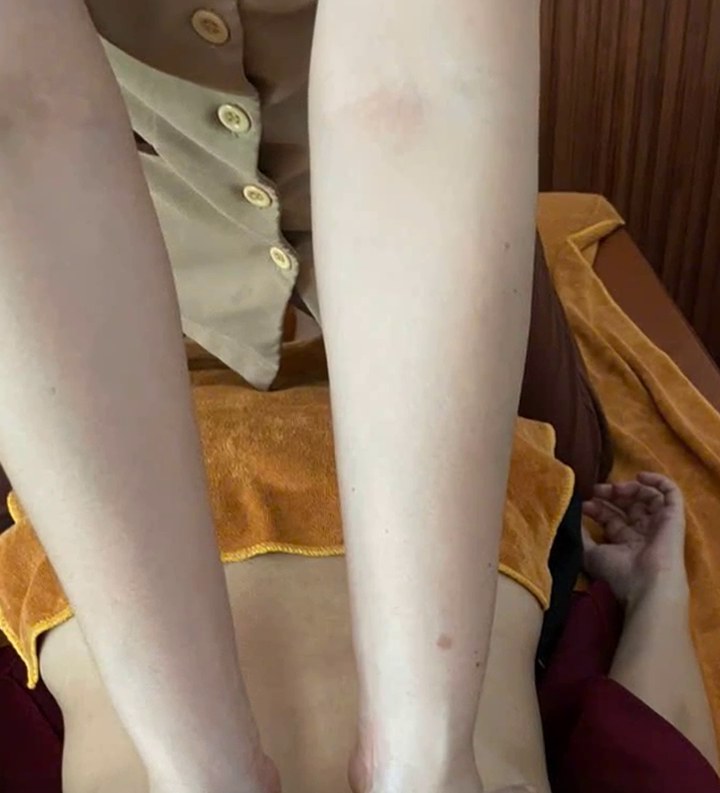
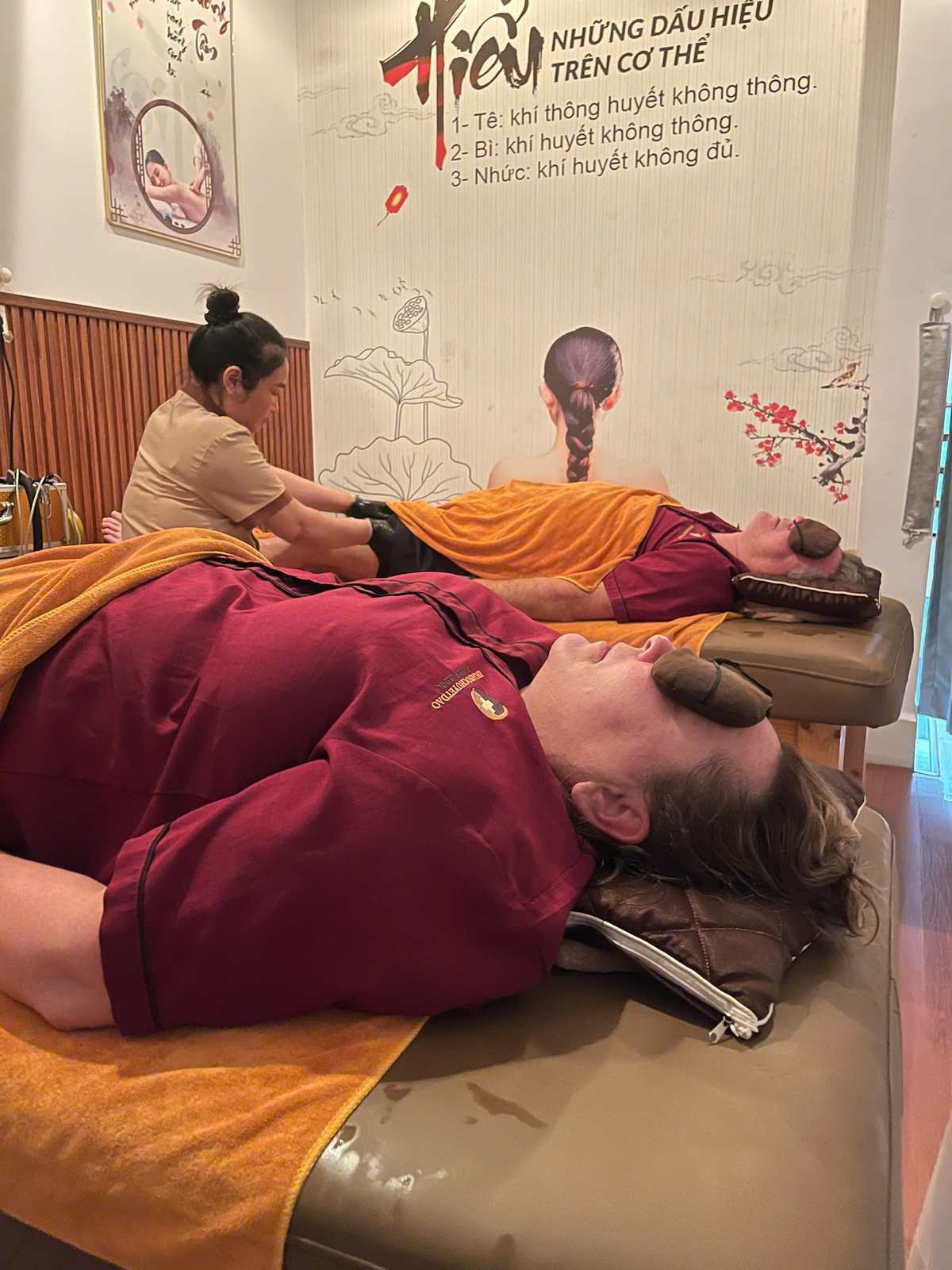
During practice at Vinhomes Grand Park, a practice partner's back can go stiff the moment they lie down. The learner rushes to add pressure. Lương Y Tống Văn Huynh holds the learner's hands back and tells them to talk first: how long the aches have lasted, where the person has already been, what they are worried about. Many people with long-term aches tense up partly because they are used to waiting for the pain. Understanding the psychology of clients with long-term aches is the first step, before any technique.
Clients with long-term aches usually show 4 traits
Tiredness
Lasting pain disrupts sleep, and poor sleep in turn makes people tolerate pain less well. Clients arrive worn out and not keen to talk.
Doubt
Many have tried many places and heard many promises, so whatever they hear, they only half believe it.
Hoping for fast results
The flip side of doubt is hoping one session will make it all go away. Both lead to disappointment unless you say clearly from the start what a care session can and cannot do.
Bracing the body
The body is used to protecting the painful area: shoulders lifted, belly braced, short breaths, a stiff back even when the pressure is still light.
Why long-term pain makes people tense up: the spine and Eastern medicine views
Anatomically, the spinal cord sits inside the spinal canal, and the nerve roots exit on both sides through the gaps between the vertebrae. When an area hurts for a long time, the muscles around it contract to guard it; over time this becomes a lumpy, stiff cushioning muscle layer, and that stiff, contracted area itself causes discomfort. The cycle of pain – bracing – pain keeps repeating.
Eastern medicine adds another layer. The curriculum notes that long-lasting anger and pent-up frustration lead to Liver qi stagnation, making a person irritable, easily annoyed and unable to relax. Kidney deficiency often comes with aching in the lower back, tired knees and fatigue after standing for long. The idea running through the whole Tong Gia curriculum: pain appears in one place, but its root often lies elsewhere, in imbalanced organs, in misaligned vertebrae, in an unhealthy way of living.
What a practitioner does with clients who have long-term aches: 5 steps in order
- Ask: where it aches, for how long, when it gets worse, whether they have seen a doctor, which health condition they are being monitored for. Write it on the client card.
- Listen to the end: let the client tell the whole story, without interrupting and without rushing to say "I can fix this".
- Make no promises: do not say a few sessions will make it go away, do not promise numbers. Say clearly that a care session helps the muscles relax and feel more comfortable; finding the cause is the job of a medical facility.
- Explain using the spine: after reading the 4 objective factors (skin temperature, cushioning muscle layer, shape of the vertebrae, sensation), show the client which area is warmer, which is stiffer, which side differs from the other. Clients trust what they can feel more than what they are told.
- Support habits: suggest going to bed early (the Kidney section of the curriculum says before 11 pm), sitting with a straight back, not hunching for long periods, getting up for light movement during the day, and walking at a comfortable pace for about 30 minutes daily.
See also the 4 objective factors when reading the spine by hand and client communication skills for practitioners.
During the session: what is safe and what not to do
- Start light and follow the 5 pressure levels; if the client tenses up, go back one level.
- Focus only on excited areas; never work directly on inhibited areas (cool, slack, low sensation).
- Do not press hard just so the client feels it "working"; people with long-term pain easily feel more tired after a session.
- Do not state conclusions such as "you have a herniated disc" or "you have degeneration".
- Do not advise clients to stop being monitored at a medical facility; clients following a doctor's instructions should keep following them.
Caring for the psychology of clients with long-term aches is therefore not about sweet talk; it is about staying within the right limits and telling the truth.
Lương Y Tống Văn Huynh teaches learners to listen to people with long-term pain
With more than 13 years in the profession and more than 10 years of volunteer work, Lương Y Tống Văn Huynh has met many people living with lasting pain. He teaches learners: „People who have hurt for years do not need one more promise; they need to be heard to the end and to see their own pain show up on their own spine.“ In class, learners practise asking before placing their hands, then explaining what their hands have read in simple words, without naming any illness.
When you must advise a client to see a doctor
For clients with lasting aches, advising a medical check is mandatory, not an optional extra line. A wellness care session does not replace a medical check. This applies especially when pain has lasted for weeks without a clear cause, numbness or weakness in the limbs keeps increasing, pain spreads down the leg, or pain comes with fever, weight loss, bladder problems, chest pain, shortness of breath, or gets worse at night. If the client has not been checked yet, advise them to visit a medical facility first. Tong Gia Acupoint Wellness offers wellness care, not a medical service.
Which level teaches this?
Client communication and the 90-minute session routine are taught in L2 Basic Vocational. Reading the 4 objective factors on the spine and the Muscle – Bone – Joint group (areas C5–C7, L1–L5, S1–S5) are taught in the Specialist Course (L3). Beginners start from L1 Foundation, 1.500.000₫. Read more about the teacher: Lương Y Tống Văn Huynh.
Learning massage to care for a family member with long-term aches
Many readers of this article are not practitioners but sons and daughters whose parents have ached for years. What practitioners need to understand about these clients also applies at home: people in long-term pain often brace in advance, lose heart easily and fear more pain. When you work on a loved one, start with very light pressure, ask more than you do, keep sessions to 20–30 minutes, and never promise it will be "gone after a few times". If pain worsens at night, numbness or weakness grows, or there is weight loss, take them for a check-up before continuing. Tong Gia's L1 class (1,500,000 VND) teaches daily wellness care and a few safe self-care points for families.
Further reading on this topic: Wellness massage ethics: 7 principles to keep your clients, your craft and yourself · Child massage for parents: should you learn it, and how to stroke your child gently and safely · acupressure massage at home: meridians, pressure and safety
How to sign up
The trial class on Sunday morning, 9:00–12:00, with no fee, and the Sunday Y Tướng Học (face reading for wellness) class are open to beginners, at căn T16-21 khu Manhattan, Vinhomes Grand Park, TP. Thủ Đức (unit T16-21, Manhattan block, Thu Duc City). Lương Y looks at your hand skills during the trial class and then suggests a suitable level. Tong Gia does not promise jobs or income after the course. Book a trial class or call the training hotline 0917 945 259.
Frequently asked questions
What is the psychology of clients with long-term aches usually like? They are usually tired, doubtful because they have tried many places, hoping for a fast fix and already tensed up when they lie down. A practitioner needs to understand these four traits before applying pressure.
Should you promise a client with long-term pain that a few sessions will make it go away? No. Only say clearly that a care session helps the muscles relax and feel more comfortable; finding the cause is the job of a medical facility.
Why do clients with long-term pain tense up during massage? The body is used to protecting the painful area, so the muscles contract to guard it and over time become a stiff cushioning layer. Eastern medicine also looks at Liver qi stagnation and Kidney deficiency that come with lasting aches.
Do clients with lasting aches need a medical check? Yes, this is mandatory. A wellness care session does not replace a medical check, especially when numbness or weakness keeps increasing, pain spreads, or pain comes with fever, weight loss or gets worse at night.
What should I learn first to massage family members? Learn to ask before touching, soften muscles with light pressure, a few safe self-care points, and the signs that mean a medical check-up is needed. Tong Gia teaches this in L1 Introduction, with a free Sunday morning trial.
Related articles
- 30 basic massage techniques learners should know: learn them in groups, not as a list of names
- 8 principles of spinal wellness massage: the rules of the hands for Tong Gia learners
- How much pressure in acupressure: gauging force by how the receiver feels
- Hands for wellness massage: soft hands, hard hands and 6 things you must train
- All articles about learning the trade
Reserve a free Sunday-morning trial class or ask about the learning path: message Zalo 0917 945 259.

Founder of Tong Gia Acupoint Wellness (Huyệt Đạo Tống Gia), with more than 13 years in Eastern wellness practice, Y Tướng Học (face reading for wellness) and spinal nerve-reflex balancing. Lương Y's story
417 customers have reviewed Tong Gia on Google Maps
Reviews are written by customers themselves on Google; tap to read them before you visit.
Huyệt Đạo Tống Gia Quận 12
225 Dương Thị Mười, Phường Tân Chánh Hiệp (District 12, Ho Chi Minh City). 8:00 – 19:00 daily.
See reviews on Google MapsHuyệt Đạo Tống Gia Quận 9
Căn T16-21 khu Manhattan, Vinhomes Grand Park, Phường Long Bình (Thủ Đức City, Ho Chi Minh City). 9:00 – 20:00 daily.
See reviews on Google MapsWant to be observed in person?
A 90-minute session starts with observation, and only then moves on to muscle release and acupressure on the right areas. Two branches: District 12 and Vinhomes Grand Park.