Massage course in Vietnam: how long until you can do it for family, for clients and to open your own shop
Lương Y (traditional healer) Tống Văn Huynh · Tong Gia Acupoint Wellness (Huyệt Đạo Tống Gia) · 25/10/2026
Quick summary: How long a massage course in Vietnam takes before you can really do the work has no single answer for everyone, because it depends on your goal, your background and how many hours you practise on real people with someone correcting your hands. The right yardstick is skill: when you can carry out a whole session with even pressure, read the reactions of the person lying down and know when to stop, then you can say you are able to do it. At Tong Gia, Lương Y watches your hands in the trial class and then suggests a suitable level.
Questions learners often ask about how long a therapeutic-style massage course takes
What safety points should I know before opening a home-based massage business?
Safety covers three areas: ask about each client's condition first, keep pressure correct, and keep towels and beds clean. Class teaches anatomy to avoid risky zones like the front of the neck and the back of the knee, and the Eastern reading of outer signs of the inner organs. Lasting pain needs a medical facility first; this is wellness care, not a medical service. Free Sunday-morning trial at Vinhomes Grand Park, TP. Thủ Đức; Zalo/WhatsApp +84 917 945 259.
I want to learn massage in Thu Duc but am only free on weekends. How long will it take?
Weekend-only study takes longer than an intensive schedule, and each level's length is explained by the consultant at enrolment; skill is measured in practice hours. The Thu Duc class spends about 70% of time on real people, covering muscle anatomy and the Eastern outer-inner principle. Lasting pain needs a medical facility first; this is wellness care, not a medical service. Taught by traditional practitioner Tống Văn Huynh at Vinhomes Grand Park, TP. Thủ Đức; Zalo/WhatsApp +84 917 945 259.
How long to learn therapeutic-style massage: why there is no single number
This is the question Tong Gia hears most often before someone signs up. The honest answer is: nobody can say exactly until they have seen your hands at work. Two people in the same class, with the same number of sessions, can end up at very different skill levels.
The reasons come down to three things:
- Your goal: working on family members, working on clients in a shop, or opening your own place. Each goal calls for a different level of "able to do it".
- Your background: people who have worked in nails, spa or hair washing are usually more used to dealing with clients and using their hands than people with no such experience.
- Practice hours with someone correcting you: hands only improve when they are placed on many different bodies and someone points out the mistake right there and then.
So instead of asking how long a massage course takes before you can do the work, ask: what does "able to do it" mean, to what level, and how will I know I have got there?
Three levels of "able to do it", by goal
Level 1: able to do it for your family
You know a few basic rubbing and kneading moves, a few safe self-care acupoints, use moderate pressure and know the situations where you should not do it. This level does not need a long routine, but the safety part must be solid. The article learn massage for elderly parents at home goes deeper into this path.
Level 2: able to do it for clients
Paying clients expect something quite different. You must carry a whole session from start to finish, keep the pressure even from the first minute to the last, communicate with the client, and work on many types of people: thin people, very muscular people, older people, people who are very sensitive to pain.
Level 3: able to do it to open a shop
Beyond hand skills, an owner must be able to teach staff, keep the routine consistent across practitioners and understand how the business runs. This is the longest level, and the owner's own hand skill is the foundation.
Six signs that your hands are "able to do it"
Wherever you study, you can check yourself against this list:
- Your hands can tell tight muscle from normal muscle, from tendon and from bone, without looking.
- Even pressure throughout the session: not strong at the start and fading at the end, not heavy one moment and light the next.
- You go through the whole routine without forgetting a step, without stopping to remember what comes next.
- You can read the reactions of the person lying down: holding their breath, tensing their shoulders or flinching are signs you are pressing too hard.
- Your hands are not worn out after a session, because you have learned to use your body weight instead of just finger strength.
- You know when to say no: you recognise a case outside your scope and advise the person to see a doctor.
The sixth sign is often underrated but is actually the most important. Tong Gia is a wellness care service that supports relaxation by hand; it is not a medical service. If the person being cared for has long-lasting pain, numbness or weakness that keeps getting worse, an underlying illness, or has just had a fall, the practitioner must advise them to get checked at a medical facility and not push on with the session.
What makes your hands improve faster or slower
Faster
- Study regularly, without long breaks between sessions.
- Go home and repeat the moves on family members straight away, and note down where you still feel unsure so you can ask.
- Practise on many different people, not just one fixed partner.
- Have a teacher standing beside you who corrects your posture and pressure the moment it goes wrong.
Slower
- Learning mostly from videos, with little time hands-on with real people.
- Classes that are too crowded for the teacher to get round to each person.
- Rushing to use strong pressure before your hands can feel the muscle.
- Cramming many techniques at once without getting any of them solid.
Questions to ask any class about study time
If a place immediately answers "this many sessions and you are ready to work" without asking anything about you, ask a few more questions:
- Of that time, how much is practice on real people?
- What happens if my hands are still not steady at the end of the course?
- Who confirms that a student is able to do the work?
- What kind of document do I get after the course, and what is its legal standing? Ask reception about this directly before paying any fees.
A place that promises a short course together with a promise of work or income is one you should think about carefully. Tong Gia does not promise work or income after the course. If you need to move fast because of your own circumstances, the article fast-track massage course in Vietnam looks at what you should and should not expect.
How study time is worked out at Tong Gia
Tong Gia does not give a one-size-fits-all number. Lương Y Tống Văn Huynh, founder of Tong Gia with more than 13 years in Eastern wellness practice, looks at each person's hands in the trial class and then suggests a suitable level on the 4-level vocational path:
- L1 Introduction to Y Tướng Học (1.500.000đ): reading complexion, the Five Elements body types, the 3 zones of the face, daily wellness habits, a few safe self-care acupoints. Matches the "for your family" level.
- L2 Core Trade: muscle release, acupressure for the neck-shoulder-upper back, the back and the legs; Tong Gia's standard 90-minute session routine; communicating with clients. Matches the "for clients" level.
- L3 Specialist: spinal nerve-reflex balancing, advanced Y Tướng Học.
- L4 Master and Transfer: transferring the routine, SOPs, how to train staff. Matches the "open a shop" level.
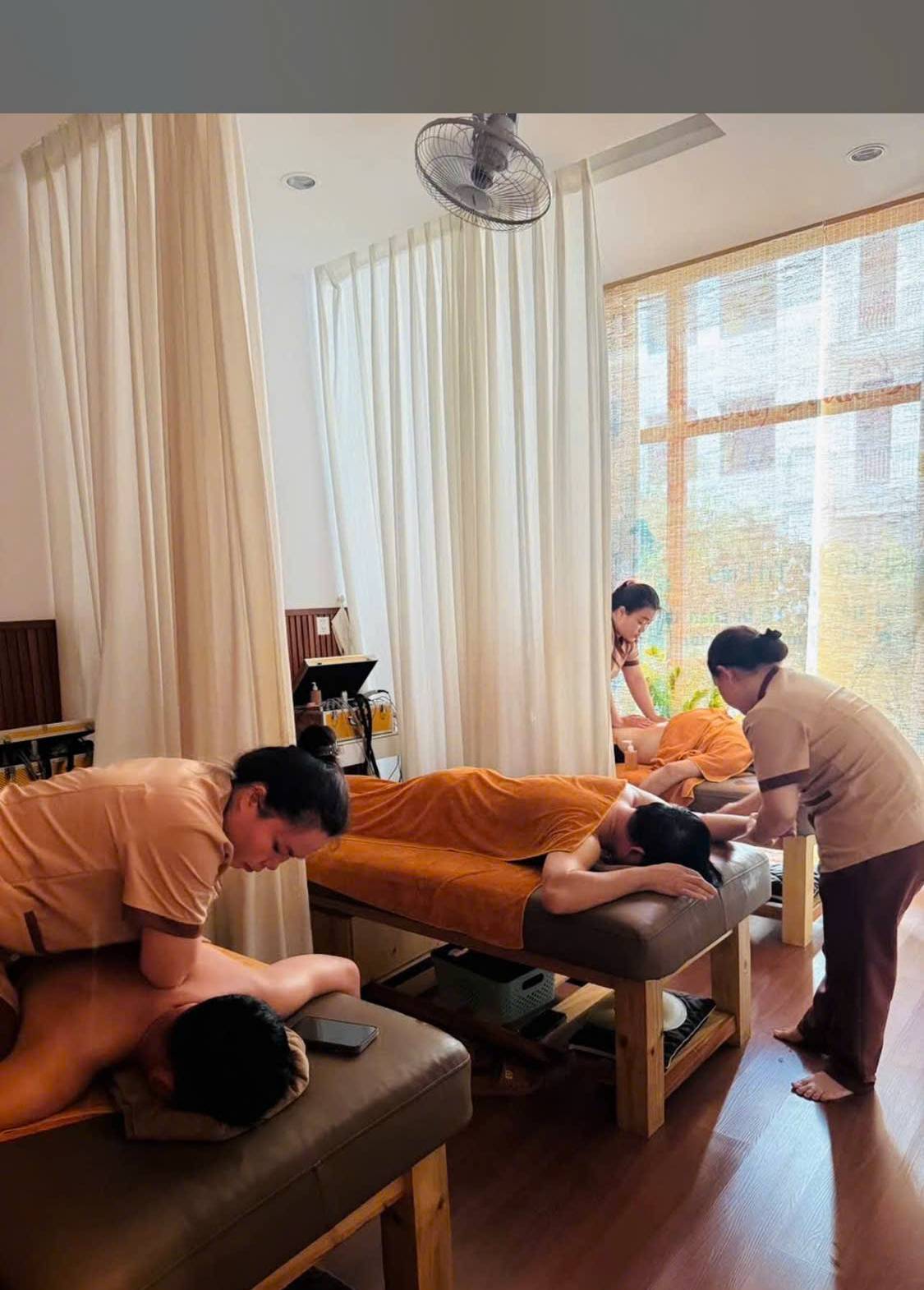
Tuition for L2 to L4, the number of sessions and the duration are given by an advisor when you register. About 70% of class time is practice on real people, classes are small, and Lương Y coaches each person individually.
The teaching rests on two pillars: Y Tướng Học, to read the outer signs and understand the organs before laying hands on anyone, and therapeutic-style massage with spinal nerve-reflex balancing, where every reading taken from the face is checked again by hand along the spine. The sooner a learner practises this cross-checking, the sooner their hands develop "eyes". Full programme details are on the massage course in Vietnam page.
Further reading on this topic: Advanced massage course in Vietnam for practitioners: what to learn so clients come back
How to sign up
If you want to know how long it will take you personally to learn massage well enough to do the work, the most accurate way is to let a teacher watch your hands. The free trial class runs 9:00 to 12:00 every Sunday morning, with 10 places per session, at Căn T16-21 khu Manhattan, Vinhomes Grand Park, Phường Long Bình, TP. Thủ Đức (Thủ Đức City, Ho Chi Minh City).
The L1 Introduction to Y Tướng Học class runs on a set schedule. Register via hotline 0917 945 259.
Frequently asked questions
I live in Ho Chi Minh City: how long does a massage course take before I can actually work? There is no single number. It depends on your goal, your background and how many hours you practise on real people with someone correcting your hands. At Tong Gia, Lương Y watches your hands in the trial class and then suggests a suitable level.
How can I tell for myself that my massage skills are good enough for paying clients? When you can carry a whole session without forgetting a step, keep the pressure even throughout, read the reactions of the person lying down, and know which cases to turn down and advise to see a doctor.
Does a complete beginner take longer to learn therapeutic-style massage than someone who has worked in nails or spa? People who are used to dealing with clients and using their hands usually pick it up faster, but what really decides it is studying regularly and practising a lot on real people.
Does Tong Gia tell you the number of sessions in advance? Tuition for L2 to L4, the number of sessions and the duration are given by an advisor when you register. Message Zalo 0917 945 259 to ask for details.
How long does it take to learn massage well enough for family? Safe care for family members can usually be learned within an introductory level if you practise daily. Working with clients needs more practice hours and hand correction; the advisor gives the number of sessions per level when you register.
Related articles
- What is acupressure? Principles, limits and a structured path to learning acupressure
- Acupressure vs acupuncture: how they differ, and what people outside the healthcare field should learn
- Acupressure vs massage: how they differ, and where learners should start
- Acupoint map of the human body: how to read it and in what order to learn it
- All articles about learning the trade
Reserve a free Sunday-morning trial class or ask about the learning path: message Zalo 0917 945 259.

Founder of Tong Gia Acupoint Wellness (Huyệt Đạo Tống Gia), with more than 13 years in Eastern wellness practice, Y Tướng Học (face reading for wellness) and spinal nerve-reflex balancing. Lương Y's story
417 customers have reviewed Tong Gia on Google Maps
Reviews are written by customers themselves on Google; tap to read them before you visit.
Huyệt Đạo Tống Gia Quận 12
225 Dương Thị Mười, Phường Tân Chánh Hiệp (District 12, Ho Chi Minh City). 8:00 – 19:00 daily.
See reviews on Google MapsHuyệt Đạo Tống Gia Quận 9
Căn T16-21 khu Manhattan, Vinhomes Grand Park, Phường Long Bình (Thủ Đức City, Ho Chi Minh City). 9:00 – 20:00 daily.
See reviews on Google MapsWant to be observed in person?
A 90-minute session starts with observation, and only then moves on to muscle release and acupressure on the right areas. Two branches: District 12 and Vinhomes Grand Park.