Acupoint map of the human body: how to read the meridian map and what order to learn it in
Lương Y (traditional healer) Tống Văn Huynh · Tong Gia Acupoint Wellness (Huyệt Đạo Tống Gia) · 07/11/2026
An acupoint map is a chart of the meridians and acupoint locations: 12 main meridians running symmetrically on both sides of the body, plus the 2 vessels, Ren and Du, running along the midline of the front and the back. Beginners should read it one body area at a time and measure in cun on a real body. Tong Gia Acupoint Wellness teaches this way of reading from L1.
What does an acupoint map include?
Open an acupoint map and you will see many coloured lines running from head to foot and from the trunk out to the fingers. Each line is a meridian, and each dot on a line is an acupoint. You can read it in three layers:
- 12 main meridians: 6 on the arms and 6 on the legs, each linked to an organ system, for example the Liver, Kidney and Stomach meridians.
- 2 midline vessels: the Ren vessel runs down the middle of the chest and abdomen at the front; the Du vessel runs along the spine at the back.
- Extra points: points with their own names that do not lie on the 14 lines above.
The map is an orientation tool. It tells you which area a point is in and which bony landmark it sits next to. Finding the exact point, however, takes hands on a real person.
How to read an acupoint map without getting lost
- Read the meridian name first, then the point name: once you know which meridian a point belongs to, you remember which line it lies on.
- Find the bony landmarks: a good map always shows landmarks such as the ankle bones, the kneecap or the 7th cervical vertebra. Points are measured from these landmarks.
- Understand the cun unit: a cun is a unit measured on the body of the person being worked on, for example the width of the middle joint of their thumb. Tall and short people have different cun, so you do not measure with a ruler.
- Mirror both sides: the 12 main meridians are symmetrical left and right; maps usually draw only one side.
How to use cun is explained in detail in the article what a finger cun is and how to measure acupoints.
Learn the acupoint map by body area
Instead of learning a whole meridian from start to end, beginners remember more easily by learning the areas they will work on most:
- Head, face and neck: points around the hairline at the nape, both sides of the neck, and between the eyebrows.
- Shoulders and back: points on both sides of the spine on the Bladder meridian, each linked to an organ system, and the Du vessel in the middle.
- Hands and forearms: points such as Hợp Cốc (LI4, 合谷), Ngoại Quan (TE5, 外关) and Liệt Khuyết (LU7, 列缺).
- Lower legs and feet: Túc Tam Lý (ST36, 足三里), Tam Âm Giao (SP6, 三阴交), Thái Xung (LR3, 太冲), Dũng Tuyền (KI1, 涌泉).
Each point in the training site's acupoint library has its own article, for example the Túc Tam Lý point (ST36) or the Tam Âm Giao point (SP6). If you are not sure which point to start with, read the basic acupoints beginners should learn.
Common beginner mistakes when learning from a map
- Trusting the picture more than the hands: a drawing is a simulation; on a real person, a point is usually a small hollow or a gap between tendon and bone that you have to feel for.
- Learning too many names: remembering 300 names but being unable to find 10 points on a real person is not yet useful.
- Skipping safety: the map does not say when not to press. Pregnant women, skin with wounds and people with underlying conditions call for caution; long-lasting pain or increasing numbness and weakness means seeing a doctor at a medical facility.
From map to hands: how Tong Gia teaches
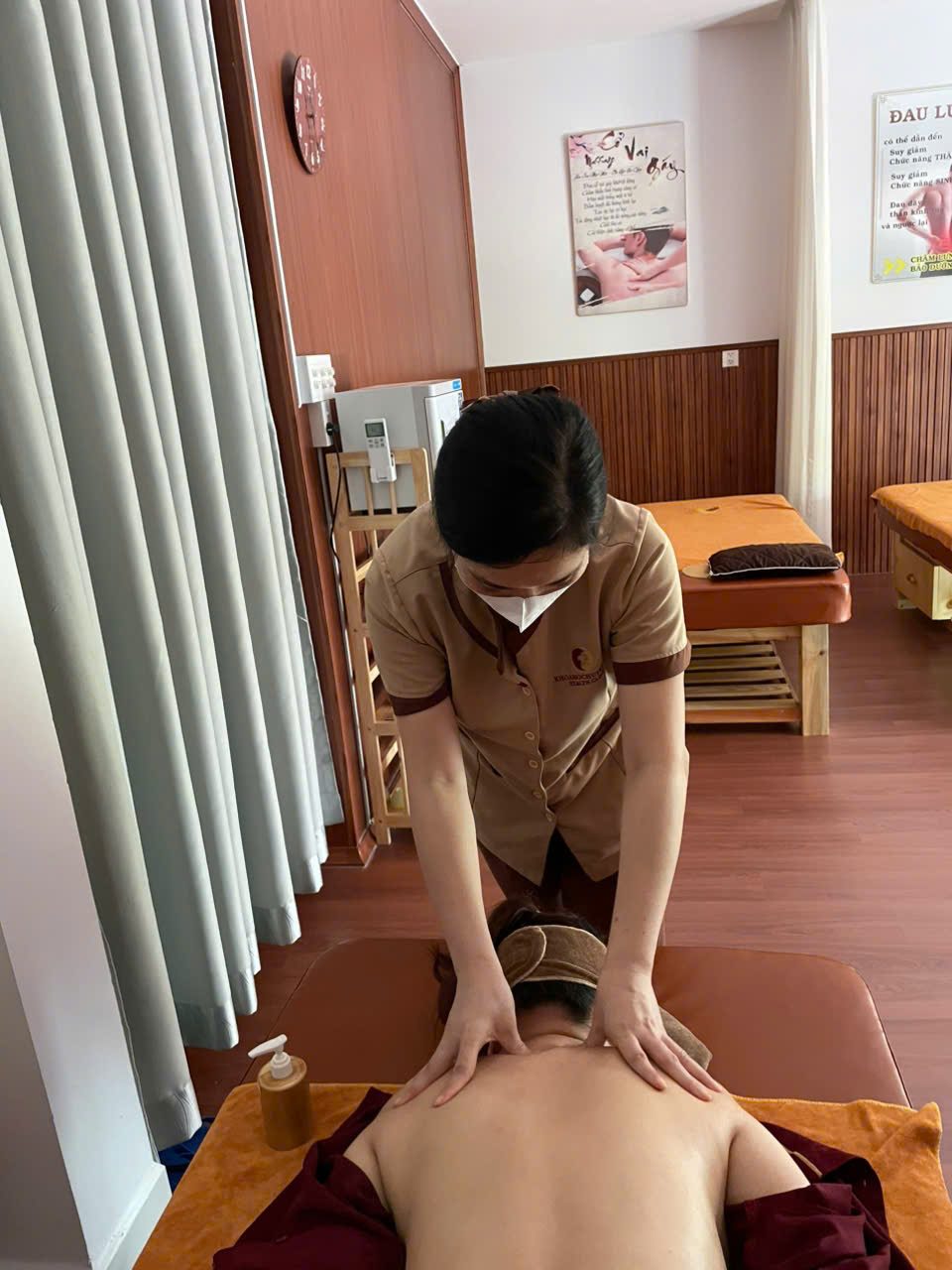
At Tong Gia, Lương Y Tống Văn Huynh teaches learners to use the acupoint map like a road map, while the actual journey is practised on real people. About 70% of class time is practice in pairs, with Lương Y guiding each person to adjust their finger position.
The map is also connected to the two pillars of study. Through Y Tướng Học (face reading for wellness), learners observe facial colour and body shape to picture which organ system needs attention. Through spinal nerve-reflex balancing, learners read the back by hand, because the points on both sides of the spine are linked to each organ system. Every observation from the face is cross-checked by hand on the spine.
Beginners start at level L1 Introduction (1.500.000đ) and learn a few safe self-care points. The maps for the neck and shoulders, back and legs are studied in depth at level L2. Tong Gia does not promise jobs or income after the course.
How to sign up
The Sunday-morning trial class, 9:00–12:00 every week, and the free Sunday Y Tướng Học session are the open schedule for newcomers, at căn T16-21 khu Manhattan, Vinhomes Grand Park, TP. Thủ Đức (Thu Duc, Ho Chi Minh City). Register for a trial class or call the training hotline 0917 945 259.
Questions learners often ask
Where can I find a clear acupoint map and learn how to use it?
Any standard chart of the 12 main meridians plus the Ren and Du vessels will do; the hard part is using it. Points are measured in cun on a real body, using bone landmarks and the muscles beneath. Huyệt Đạo Tống Gia teaches map reading from L1, in person. Wellness care only. Free Sunday morning trial 9:00–12:00; Zalo/WhatsApp +84 917 945 259.
Frequently asked questions
How many meridians are on the human acupoint map? There are 12 main meridians running symmetrically on both sides and 2 vessels, Ren and Du, running down the middle of the trunk, plus extra points outside the meridians.
Is an acupoint chart different from an acupoint map? Both names refer to the same drawing of meridians and acupoint locations on the human body.
Where should I start learning the acupoint map? Learn by the areas you will work on most, such as the neck and shoulders, back, hands and feet, and practise measuring in cun on real people.
Can I press points myself just by looking at an acupoint map? You can find a few safe self-care points, but the drawing is only for orientation; to work on other people you should learn with someone guiding your hands.
Related articles
- What is acupressure? Principles, limits and a structured path to an acupressure course in Vietnam
- How acupressure differs from acupuncture, and what people outside medicine should learn
- Acupressure vs massage: how they differ, and where learners should start
- Parents worried what people will say if their child learns massage: what to talk about before class starts
- All articles about learning the trade
Reserve a free Sunday-morning trial class or ask about the learning path: message Zalo 0917 945 259.

Founder of Tong Gia Acupoint Wellness (Huyệt Đạo Tống Gia), with more than 13 years in Eastern wellness practice, Y Tướng Học (face reading for wellness) and spinal nerve-reflex balancing. Lương Y's story
417 customers have reviewed Tong Gia on Google Maps
Reviews are written by customers themselves on Google; tap to read them before you visit.
Huyệt Đạo Tống Gia Quận 12
225 Dương Thị Mười, Phường Tân Chánh Hiệp (District 12, Ho Chi Minh City). 8:00 – 19:00 daily.
See reviews on Google MapsHuyệt Đạo Tống Gia Quận 9
Căn T16-21 khu Manhattan, Vinhomes Grand Park, Phường Long Bình (Thủ Đức City, Ho Chi Minh City). 9:00 – 20:00 daily.
See reviews on Google MapsWant to be observed in person?
A 90-minute session starts with observation, and only then moves on to muscle release and acupressure on the right areas. Two branches: District 12 and Vinhomes Grand Park.