Acupressure vs massage: how they differ, and where to start if you want to learn the trade
Lương Y (traditional healer) Tống Văn Huynh · Tong Gia Acupoint Wellness (Huyệt Đạo Tống Gia) · 04/11/2026
Quick answer: Acupressure vs massage: massage works on whole areas of muscle with rubbing, gliding and kneading, while acupressure uses the fingertips to press individual fixed points along the meridians of traditional Eastern practice. If you want to learn the trade, you do not have to pick one: a good session usually releases the muscles first, and only then moves on to acupressure. At Tong Gia, both are taught together in a 4-level vocational ladder.
Questions learners often ask about acupressure vs massage
At 35, is it too late to retrain in acupressure massage, and how long does it take?
No, 35 is not too late; adults are often calmer and understand clients better, and learning time depends on practice hours. Class teaches massage to soften muscles first and acupressure second, based on anatomy and the Eastern idea that outer signs reflect the inner organs. Lasting pain needs a medical facility first; this is wellness care, not a medical service. Taught by traditional practitioner Tống Văn Huynh at Vinhomes Grand Park, TP. Thủ Đức; Zalo/WhatsApp +84 917 945 259.
How acupressure and massage differ
Many people who want to learn the trade ask Tong Gia: “Should I study massage or acupressure?” The question is understandable, because the two words are often used interchangeably on the market. But for practitioners they are two different layers of skill, and it is worth understanding them clearly before choosing a course.
- Area worked: massage works on whole areas of muscle: the entire back, the shoulders, the legs. Acupressure works on individual small points, each with its own name and location.
- Movements: massage uses the palm, forearm and thumb to rub, glide, knead and stroke. Acupressure uses the fingertips to press, circle and hold the pressure for a few breaths.
- Background knowledge: massage requires understanding muscles, tendons and posture. Acupressure also requires knowledge of the meridians and how to measure points in cun (thốn, body inches).
- What the receiver feels: massage usually gives a spreading sense of relaxation; acupressure gives a tight, achy feeling at one point that then gradually eases.
Why they should not be learned separately
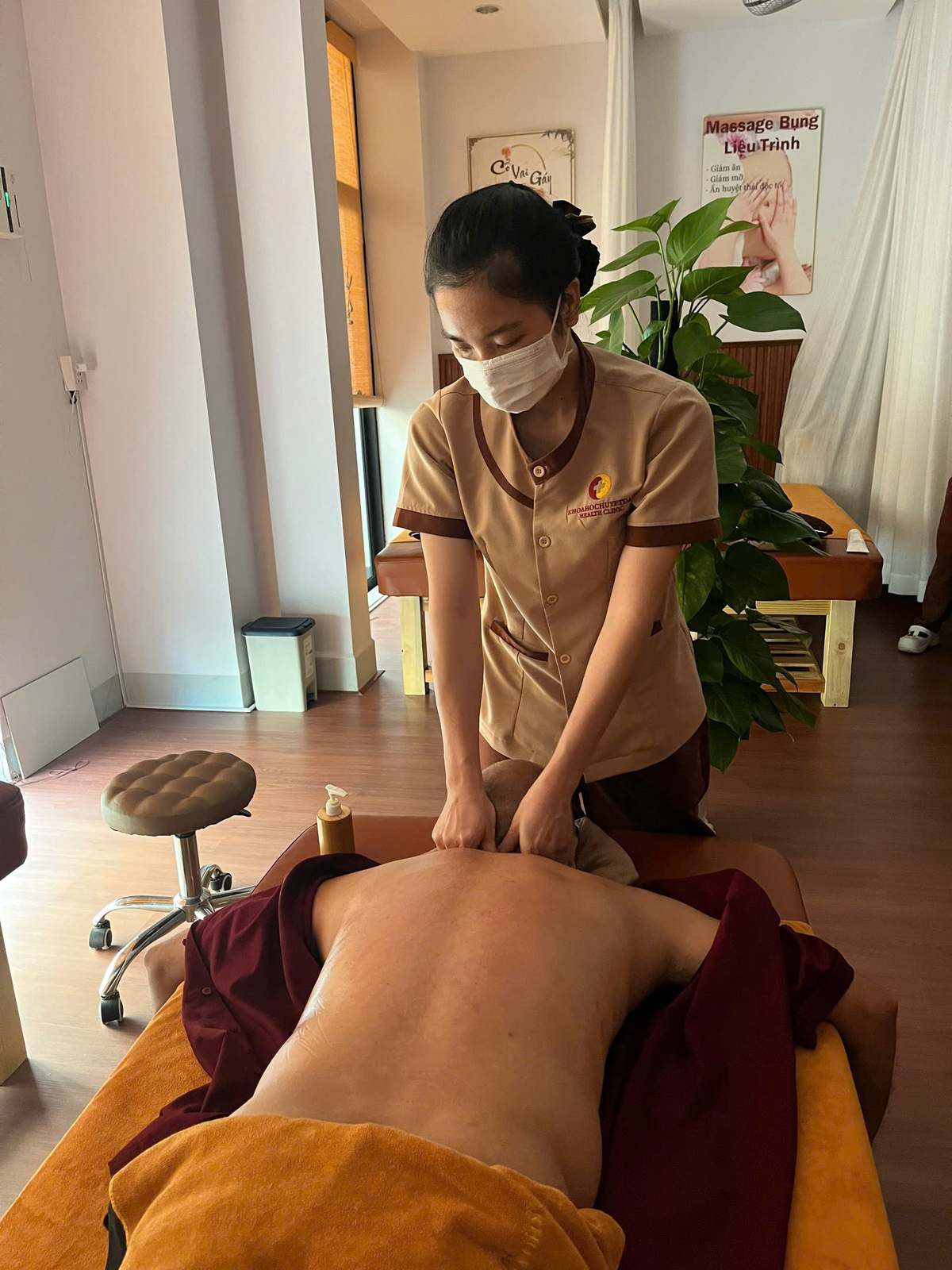
When the muscles are still tight, pressing straight into a point easily hurts the receiver and makes them tense up. So a session at Tong Gia usually follows this order: observe, feel along the spine by hand, release the muscles until they soften, and only then apply acupressure. Someone who only knows massage but not the points finds it hard to work deeply. Someone who has memorised the points but whose hands cannot yet release muscle usually gives stiff sessions and ends up with tired hands.
The body is the house, the points are the doors, qi and blood are the wind. Massage is like airing out the whole house; acupressure is like opening the right door. Only when both are done is the session complete.
Where beginners should start
- Learn to observe and feel by hand: look at posture and complexion, and feel along the spine to find which areas are tense.
- Learn basic muscle release: neck and shoulders, back, legs, and how to apply pressure with your body weight instead of finger strength.
- Learn a few commonly used points: locate them accurately using the receiver's own cun, and press in the right direction with the right pressure. See the article what a finger cun is and how to measure acupoints.
- Put it together into one routine: know how to begin, how to finish, and when to stop.
Questions to ask when choosing a class
- Does the class teach muscle release first and then acupressure, or only memorising a list of points?
- How much of the time is hands-on practice on real people?
- Who teaches, and do they coach each learner individually?
- Does the class teach when you must not work on someone?
At Tong Gia, about 70% of class time is hands-on practice on real people. Classes are small, and Lương Y Tống Văn Huynh, with more than 13 years in Eastern wellness practice, coaches each learner individually. L2 Basic Trade teaches muscle release and acupressure for the neck and shoulders, back and legs within Tong Gia's standard 90-minute routine. Read more in learning massage and acupressure for a more detailed learning path.
Massage softens the muscle, acupressure picks the point: both read the same map
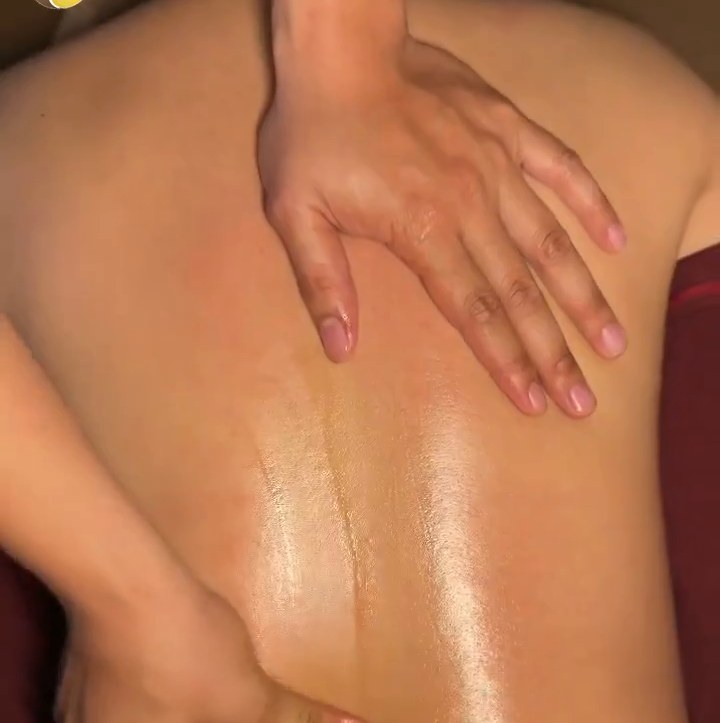
Massage follows the muscle layers: the upper trapezius at the neck and shoulders, and the erector spinae running along both sides of the spine from the neck down to the lower back. Acupressure picks points on those same muscles. For example, along the erector spinae lie Phế Du (BL13, 肺俞) at the level of T3, Tâm Du (BL15, 心俞) at T5, Can Du (BL18, 肝俞) at T9 and Thận Du (BL23, 肾俞) at L2. Someone who only learns massage knows which area is tense. Someone who learns both also knows which spinal nerve segment that tense area lies next to and, in Eastern tradition, which organ it relates to.
That is why Tong Gia teaches the two together. A client is tight between the shoulder blades and breathes shallowly: massage softens the muscles from T1 to T4 first, then Phế Du is pressed in small circles. A client has a tired lower back, ringing ears and dry hair: warm the L1 to L3 area first, then press Thận Du. This is relaxation care. Pain referred from an organ, such as flank and lower-back pain with fever, must be examined by a doctor.
Limits every learner must remember
Tong Gia offers hands-on wellness care, not a medical service. For lasting pain, numbness or weakness that keeps getting worse, or an underlying illness, see a doctor at a medical facility; people learning the trade must also know when not to work and advise the client to see a doctor.
How to sign up
The Sunday-morning trial class, 9:00–12:00 every week, and the free Sunday Y Tướng Học (face reading for wellness) session are both held at căn T16-21 khu Manhattan, Vinhomes Grand Park, TP. Thủ Đức (unit T16-21, Manhattan zone, Thủ Đức City, Ho Chi Minh City). Lương Y assesses your hand skills at the trial class and then suggests the right level. Sign up for a trial class or call the training hotline 0917 945 259.
Frequently asked questions
Which is easier to learn, acupressure or massage? Muscle-release massage is usually easier to start with because it works on whole areas of muscle. Acupressure also needs knowledge of the meridians and how to measure points, so it should be learned once your hands are used to muscle release.
Do I need to learn massage before acupressure? You should. Pressing straight into a point while the muscle is still tight easily causes pain, so at Tong Gia learners practise muscle release first and then acupressure.
Is acupressure a type of massage? Acupressure is one technique within Eastern massage and acupressure (xoa bóp bấm huyệt) that works on individual points; massage works on whole areas of muscle. The two usually go together in one session.
Where can I learn acupressure and massage in Thủ Đức? Tong Gia teaches both in a 4-level vocational ladder at Vinhomes Grand Park, Thủ Đức City, with a trial class on Sunday mornings.
Related articles
- What is acupressure? Principles, limits and a structured path to an acupressure course in Vietnam
- Acupressure vs acupuncture: how they differ, and what people outside the healthcare field should learn
- Acupoint map of the human body: how to read the meridian map and what order to learn it in
- Parents worried what people will say if their child learns massage: what to talk about before class starts
- All articles about learning the trade
Reserve a free Sunday-morning trial class or ask about the learning path: message Zalo 0917 945 259.

Founder of Tong Gia Acupoint Wellness (Huyệt Đạo Tống Gia), with more than 13 years in Eastern wellness practice, Y Tướng Học (face reading for wellness) and spinal nerve-reflex balancing. Lương Y's story
417 customers have reviewed Tong Gia on Google Maps
Reviews are written by customers themselves on Google; tap to read them before you visit.
Huyệt Đạo Tống Gia Quận 12
225 Dương Thị Mười, Phường Tân Chánh Hiệp (District 12, Ho Chi Minh City). 8:00 – 19:00 daily.
See reviews on Google MapsHuyệt Đạo Tống Gia Quận 9
Căn T16-21 khu Manhattan, Vinhomes Grand Park, Phường Long Bình (Thủ Đức City, Ho Chi Minh City). 9:00 – 20:00 daily.
See reviews on Google MapsWant to be observed in person?
A 90-minute session starts with observation, and only then moves on to muscle release and acupressure on the right areas. Two branches: District 12 and Vinhomes Grand Park.