Face reading for massage: from face shape to the back areas to check, and how learners link eyes and hands
Lương Y (traditional healer) Tống Văn Huynh · Tong Gia Acupoint Wellness (Huyệt Đạo Tống Gia) · 13/11/2026
From face reading to the back areas to check means using the face shape to choose where the hands go first, reading 4 objective signs by touch, then keeping or dropping that idea. At Tong Gia Acupoint Wellness (Huyệt Đạo Tống Gia) in Ho Chi Minh City, the face only guides the hands; it never names an illness.
Questions learners often ask about linking face reading to the back
I do massage in Thu Duc (old District 9). Where can I learn face reading to know which back area to check first?
Tong Gia teaches this in the Specialist Course (L3) at căn T16-21 khu Manhattan, Vinhomes Grand Park, TP. Thủ Đức (unit T16-21, Manhattan block, Thu Duc City). Learners read the face shape to choose a back area, then read 4 objective signs by touch on real people. Lương Y Tống Văn Huynh teaches the class. Zalo 0917 945 259.
I'm an expat in Ho Chi Minh City. Can a 田 or 申 face really show which back area is tight? On what Eastern basis?
Only as a working idea. In Tong Gia's curriculum, a Tian (田) face suggests checking D11–D12 and a Shen (申) face suggests D7–D9, based on the principle "the signs show outside, the organs lie inside". Only the hands confirm it, by reading skin temperature, the cushioning muscle layer, vertebra shape and sensation.
I run a spa in District 2. How long is the face-reading-to-spine part, do I need Eastern medicine, and what's the fee?
Beginners first take L1 Introduction to Y Tướng Học (face reading for wellness) at Tong Gia for 1.500.000₫; no Eastern medicine background is needed. Linking the face to the back is part of the Specialist Course (L3); staff confirm its length and fee when you register. This is wellness care, not a medical profession. Zalo 0917 945 259.
One exercise: look at the face, write the back area on paper
In the advanced Y Tướng Học section, each learner looks at a partner's face and writes down the face shape and the back area to check first, and only then asks the partner to lie face down. Lương Y Tống Văn Huynh stands beside them, adjusts the learner's two hands so they are symmetrical, then asks: what do your hands feel, and does it match the paper? This exercise teaches the process from face reading to the back areas to check: the eyes choose where to start, the hands decide where to work.
Why can the face point to a back area?
In anatomy, the 33 vertebrae are divided into segments that serve different regions: the neck, C1–C7, relates to the head, face, neck and arms; the back, D1–D12, relates to circulation, breathing and digestion; the lower back, L1–L5, relates to the kidneys, urinary tract and legs. Along both sides of the spine runs the Bladder meridian, with back-shu points named after the organs, such as Phế Du (BL13, 肺俞), Can Du (BL18, 肝俞), Tỳ Du (BL20, 脾俞) and Vị Du (BL21, 胃俞).
In Eastern medicine, the signs show outside, the organs lie inside. Tong Gia's curriculum links each face shape in the Ten-Character Face Method (十字相法) with a body constitution and a back area to check. This gives the learner a working idea of where to place the hands first.
Table linking face shapes to back areas in the curriculum
- Tian face (田), square and full, Earth type: check D11–D12 first (Tỳ Du, Vị Du); the back muscles are thick and tend to stiffen in large patches.
- Tong face (同), long and square, Metal type: check D3 first (Phế Du), looking for stiffness or a protruding vertebra.
- Shen face (申), wide cheekbones, narrow at top and bottom: check D7–D9 first, the mid-back area the curriculum links with the Liver and the Spleen-Stomach; tightening of the long muscle bands along the back is common.
- Jia face (甲), wide forehead, pointed chin: check the neck and nape at C1–C2 (is it warm?) and the lower back (is it hollow or cold?).
- You (由) and Yuan (圓) faces: check the lower back and hips; You faces usually have thick muscle, Yuan faces often have cold lower-back skin and slack muscle.
The Mu (目), Wang (王), Feng (風) and Yong (用) shapes do not point to a specific segment but to a quality to look for: thin muscle and deeply sunken vertebrae (Mu); fibrous muscle stuck in the joint gaps (Wang); pain points that move around (Feng); muscles that are not symmetrical on the two sides (Yong).
The 4-step process from face reading to the back areas to check
- Look and write the idea down. Note the face shape and the back area to check first.
- Ask and screen for safety. Ask where the client often feels tired and about underlying conditions. If there are warning signs, do not work; advise the client to get checked at a medical facility.
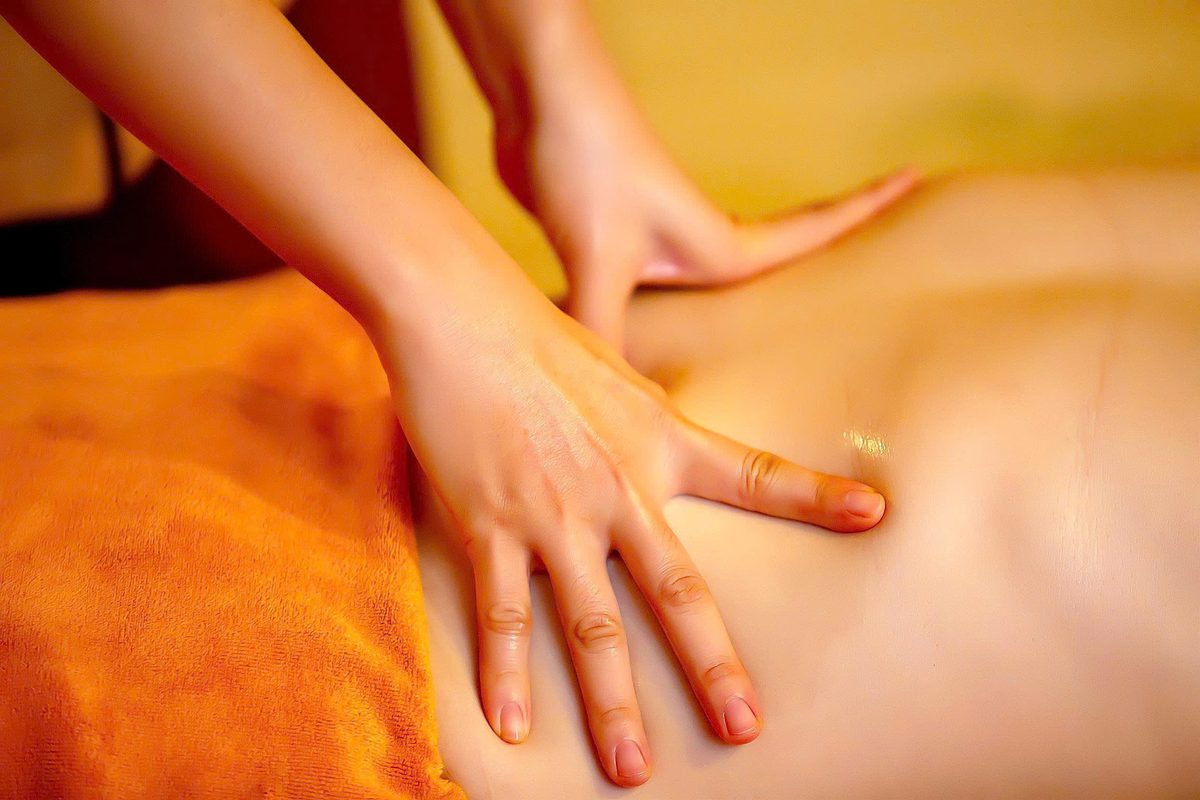
- Place the hands on the survey area. Read by touch with flat pressing, stroking, pressing and rolling, both hands symmetrical; move from the survey area to the key zone and then the key point.
- Keep or drop the idea. If it matches, that area becomes the key zone; if not, drop it and keep reading the whole back.
The hands read 4 objective signs in the chosen area
The curriculum calls this the set of four objective signs: 4 things the hands must read before working. No guessing, only objective feeling.
- Skin temperature: an area warmer than the normal physiological level is excited; cooler is inhibited.
- Cushioning muscle layer: muscle that is lumpy, stiff, slack, or has fibrous strands stuck on the tips of the spinous processes.
- Vertebra shape: protruding, protruding and shifted, shifted, sunken and shifted, sunken, compared with the vertebra above, the one below and both sides.
- Sensation: a localised point of pain, numbness or sharp ache when pressed gently to explore.
Example: a Tian face suggests D11–D12. The hands find thick, stiff muscle and skin warmer than the opposite side: the idea has grounds. A Yuan face suggests the lower back; the hands find cold skin and slack muscle: that is an inhibited area, so by the excitation principle you do not work on it directly, you only keep it warm and look for excited areas around it. How to read each sign is explained in 4 objective signs when reading the spine by hand.
What not to do
- Do not tell a client "you have a Shen face, so your stomach is weak".
- Do not draw conclusions about illness from the face or from vertebra shape.
- Do not use face reading to judge a client's character.
Lương Y Tống Văn Huynh teaches learners to link eyes and hands
Lương Y Tống Văn Huynh, founder of Tong Gia, has worked for more than 13 years in Y Tướng Học and spinal nerve-reflex balancing. He reminds learners: "The face tells you where to place your hands first, not what to do there; what to do is decided by the four signs under your hands." That is why the worksheet always has one more column: what the hands feel.
When to advise a client to see a doctor
Do not work, and advise the client to get checked at a medical facility, if there is: back pain with fever or unexplained weight loss; numbness spreading to the arms or legs, muscle weakness, or pain that keeps getting worse; pain in the flank and lower back with burning urination or urinary problems. If the face changes suddenly, such as a drooping mouth, one drooping eyelid or difficulty speaking, or there is chest tightness or shortness of breath: stop at once and call 115. Tong Gia Acupoint Wellness offers wellness care, not a medical service.
Which level teaches this?
This is taught in the Specialist Course (L3), where advanced Y Tướng Học is combined with wellness massage for spinal nerve-reflex balancing; staff confirm the fee when you register. Beginners start with L1 Introduction (1.500.000₫). Read more about the teacher: Lương Y Tống Văn Huynh.
How to sign up
The trial class on Sunday morning, 9:00–12:00, with no fee, and the Sunday Y Tướng Học class are open to beginners, at căn T16-21 khu Manhattan, Vinhomes Grand Park, TP. Thủ Đức (unit T16-21, Manhattan block, Thu Duc City). Tong Gia does not promise jobs or income after the course. Book a trial class or call the training hotline 0917 945 259.
Frequently asked questions
What is the process from face reading to the back areas to check? It means looking at the face shape to choose which back area the hands visit first, then reading 4 objective signs by touch to keep or drop that idea.
Which back area should you check for a Shen (申) face? In Tong Gia's curriculum, a Shen face suggests checking D7–D9 first. This is only a working idea; the hands must confirm it.
What if the hands find nothing in the area the face suggests? Drop the first idea and keep reading the whole back. Do not push the client to believe something the hands did not find.
Can face reading identify an illness? No. The face only guides which area to read by touch; if anything unusual appears, advise the client to get checked at a medical facility.
Related articles
- 30 basic massage techniques learners should know: learn them in groups, not as a list of names
- 8 principles of spinal wellness massage: the rules of the hands for Tong Gia learners
- How to use the right pressure in acupressure: measuring force by how the receiver feels
- Hands for wellness massage: soft hands, hard hands and 6 things you must train
- All articles about learning the trade
Reserve a free Sunday-morning trial class or ask about the learning path: message Zalo 0917 945 259.

Founder of Tong Gia Acupoint Wellness (Huyệt Đạo Tống Gia), with more than 13 years in Eastern wellness practice, Y Tướng Học (face reading for wellness) and spinal nerve-reflex balancing. Lương Y's story
417 customers have reviewed Tong Gia on Google Maps
Reviews are written by customers themselves on Google; tap to read them before you visit.
Huyệt Đạo Tống Gia Quận 12
225 Dương Thị Mười, Phường Tân Chánh Hiệp (District 12, Ho Chi Minh City). 8:00 – 19:00 daily.
See reviews on Google MapsHuyệt Đạo Tống Gia Quận 9
Căn T16-21 khu Manhattan, Vinhomes Grand Park, Phường Long Bình (Thủ Đức City, Ho Chi Minh City). 9:00 – 20:00 daily.
See reviews on Google MapsWant to be observed in person?
A 90-minute session starts with observation, and only then moves on to muscle release and acupressure on the right areas. Two branches: District 12 and Vinhomes Grand Park.