Massage course Vietnam: pushing and rotating tight muscles, how learners of therapeutic-style massage do it right
Lương Y (traditional healer) Tống Văn Huynh · Tong Gia Acupoint Wellness (Huyệt Đạo Tống Gia) · 10/11/2026
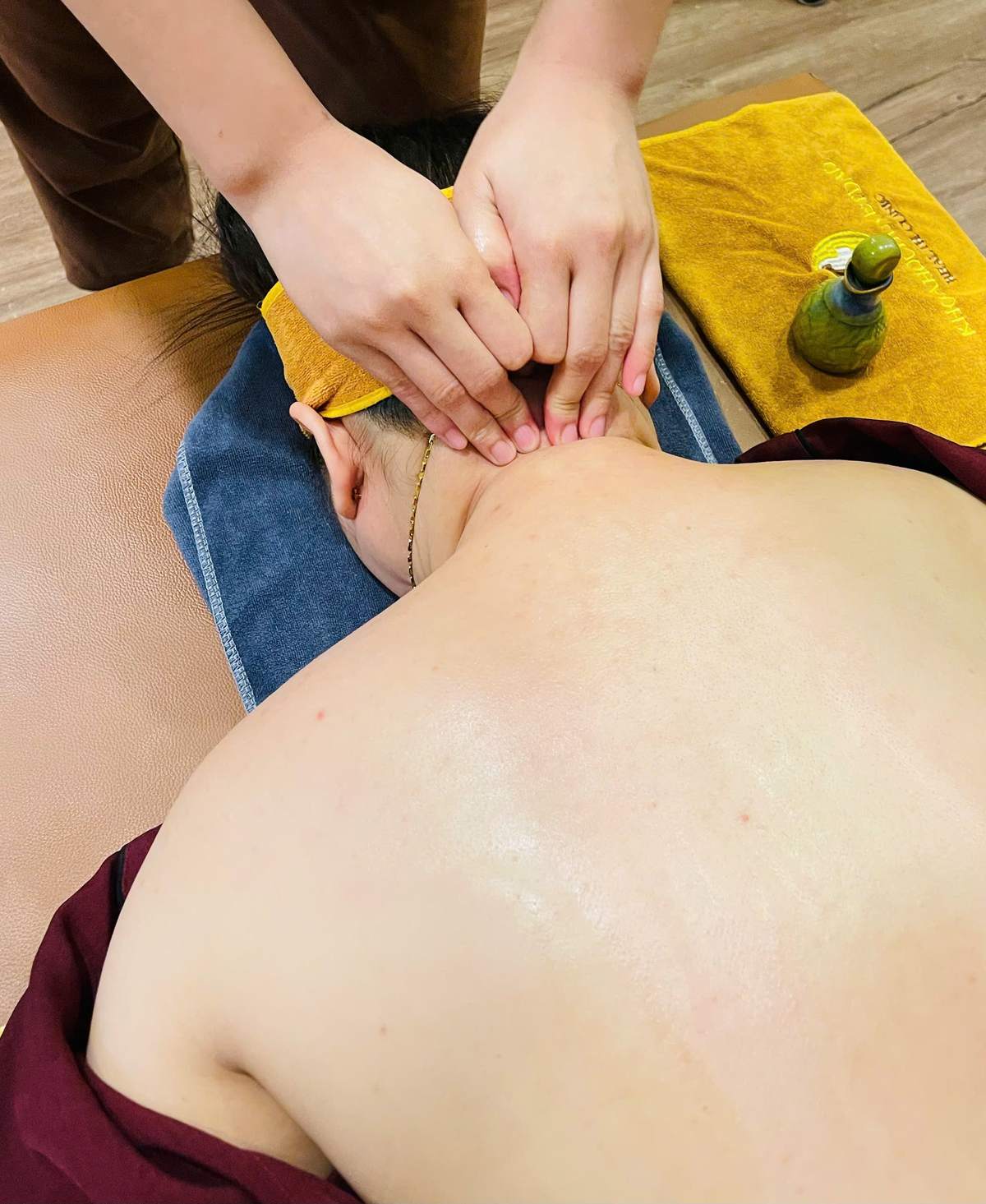
On a massage course in Vietnam, pushing and rotating for tight muscles work like this: pushing uses the heel of the hand or the thumb to move the muscle block a short way; rotating holds the muscle block and turns it slowly around the holding point. Tong Gia teaches learners to use them only once the muscle has been warmed and the area to work has been clearly read.
How do pushing and rotating differ from other strokes?
Most strokes beginners learn travel over the skin: rubbing, stroking, gliding with pressure. Pressing and point rotation work on a single point. Pushing and rotating differ in that they act on a whole muscle block. The practitioner does not slide the hand but holds the muscle block firmly under the hand and moves it.
- Pushing: place the heel of the hand or the thumb close to the edge of the muscle block, apply force so the block shifts a short way across the muscle fibres, hold for one beat, then release.
- Rotating: use the whole hand or both thumbs to hold the muscle block and turn it in slow circles of small amplitude, without sliding on the skin.
Why do tight muscles need pushing and rotating?
Muscles that have been tight for a long time, such as the neck and shoulders of people who sit at a computer or the lower back of people who stand a lot, often stick together into one patch. When touched, the practitioner feels the whole patch as stiff as a plank; press one point and the whole area tenses. Rubbing and stroking only warm the surface. Pushing and rotating help each muscle layer glide over the next again, so the feeling of heavy tension eases and the receiver relaxes more easily.
In Tong Gia's therapeutic-style massage method of spinal nerve-reflex balancing, the muscles on both sides of the spine are linked to the nerve-reflex system. When the muscles on both sides are released evenly, the receiver often feels lighter and sleeps more easily. This is wellness care and does not replace seeing a doctor when pain persists.
How to push and rotate correctly
- Warm up first. Rub, stroke and glide over the area for 3–5 minutes. Do not push or rotate a muscle that is still cold.
- Hold firmly, do not slide. The hand grips the muscle block; if you feel your hand sliding on the skin, you are rubbing, not pushing.
- Push across the fibres. For the long muscles on both sides of the spine, push from the inside outwards and avoid pushing down on the spinous processes.
- Rotate slowly, with small amplitude. Each circle takes 2–3 seconds, 5–8 circles in one position, then move the hand.
- Force comes from the body. Shoulders relaxed, body weight passing through the arm. Working with wrist strength tires you very quickly.
The receiver may feel a mild dull ache in the tight area. Sharp, stabbing pain or numbness spreading down the arms or legs is a sign to stop; do not push on.
Common mistakes when starting out
- Pushing straight onto the spine or the shoulder blade instead of moving the muscle block.
- Rotating too fast with large amplitude, so the client tenses up to resist.
- Using pushing and rotating on the front of the neck, the abdomen or the back of the knee, which need a light touch.
- Working on areas that are swollen and hot, bruised, freshly injured or wounded.
- Forgetting to ask the receiver how it feels during the session.
Learners can also read pressing and point rotation strokes to see how point strokes combine with block strokes, and advanced muscle release training for those already in the trade.
Who should learn pushing and rotating?
Massage technicians already in the trade who want to raise their skill, people learning to care for parents or a spouse with frequent shoulder and back fatigue, and people who want to open a wellness spa all need these strokes. They demand hands with even strength that can read how stiff a muscle is, so a mentor is essential. At Tong Gia, Lương Y Tống Văn Huynh personally corrects the hands of and guides each learner in class.
How to sign up
The Sunday-morning trial class, 9:00–12:00, and the free Sunday Y Tướng Học (face reading for wellness) session are the open schedule for newcomers, at căn T16-21 khu Manhattan, Vinhomes Grand Park, TP. Thủ Đức (Ho Chi Minh City). Sign up for a trial class or call the training hotline 0917 945 259.
Questions learners often ask
How are pushing and rotating techniques used for tight muscles?
Pushing moves a block of muscle a short way with the heel of the hand or thumb; rotating holds the muscle and turns it slowly around that point. Use both only after warming the muscle and reading the tight area by hand, so fibres can lengthen. Avoid swollen or acutely painful areas. Tong Gia teaches it; Zalo/WhatsApp +84 917 945 259.
Frequently asked questions
When are pushing and rotating used for tight muscles? On muscle areas that have stiffened into patches, after rubbing and stroking to warm them up and clearly reading the area to work.
How is pushing different from rubbing? Rubbing is the hand sliding over the skin. Pushing is the hand holding the muscle block firmly and shifting it a short way in one direction.
Should you push and rotate the neck? Work the back of the neck lightly with small amplitude. The front of the neck has blood vessels and nerves, so do not push or rotate there.
When must you stop? When the receiver feels sharp, stabbing pain or numbness spreading down the arms or legs, dizziness, or the area is swollen and hot.
Where can I learn massage techniques in Ho Chi Minh City? Tong Gia Acupoint Wellness holds a Sunday-morning trial class, 9:00–12:00, at Vinhomes Grand Park, Thủ Đức City. Call the training hotline 0917 945 259.
Related articles
- 8 principles of spinal wellness massage: the rules of the hands for Tong Gia learners
- How much pressure in acupressure: gauging force by how the receiver feels
- Hands for wellness massage: soft hands, hard hands and 6 things you must train
- Protecting a massage practitioner's hands: keeping your hands fit for a long career
- All articles about learning the trade
Reserve a free Sunday-morning trial class or ask about the learning path: message Zalo 0917 945 259.

Founder of Tong Gia Acupoint Wellness (Huyệt Đạo Tống Gia), with more than 13 years in Eastern wellness practice, Y Tướng Học (face reading for wellness) and spinal nerve-reflex balancing. Lương Y's story
417 customers have reviewed Tong Gia on Google Maps
Reviews are written by customers themselves on Google; tap to read them before you visit.
Huyệt Đạo Tống Gia Quận 12
225 Dương Thị Mười, Phường Tân Chánh Hiệp (District 12, Ho Chi Minh City). 8:00 – 19:00 daily.
See reviews on Google MapsHuyệt Đạo Tống Gia Quận 9
Căn T16-21 khu Manhattan, Vinhomes Grand Park, Phường Long Bình (Thủ Đức City, Ho Chi Minh City). 9:00 – 20:00 daily.
See reviews on Google MapsWant to be observed in person?
A 90-minute session starts with observation, and only then moves on to muscle release and acupressure on the right areas. Two branches: District 12 and Vinhomes Grand Park.