Should you learn acupressure or massage first: a sensible order for family carers, trade learners and shop owners
Lương Y (traditional healer) Tống Văn Huynh · Tong Gia Acupoint Wellness (Huyệt Đạo Tống Gia) · 29/11/2026
Should you learn acupressure or massage first: for most beginners, learn the basic massage techniques and the feel of muscle first, and learn points alongside, a few each session. Once the hands know how to place pressure and can tell tight muscle from soft, pressing a point lands in the right place at the right depth. Different goals call for a different mix; at Tong Gia Acupoint Wellness (Huyệt Đạo Tống Gia), learners follow the ladder from L1 to L2.
Questions learners often ask about learning acupressure or massage first
I am 34, live in Thu Duc, know nothing yet and want to work in the trade. Acupressure or massage first?
Learn the basic massage techniques and muscle feel first, with points alongside. Hands that know how to place pressure press a point at the right depth. At Tong Gia Acupoint Wellness, beginners enter L1 Introduction to Y Tuong Hoc at 1,500,000 VND, then L2 Basic Trade; classes are at unit T16-21, Manhattan block, Vinhomes Grand Park.
I only want to massage my parents at home in District 9. Must I finish massage before learning points?
No. Family care needs only a few light rubbing, squeezing and kneading techniques plus five to seven easy points, learned side by side. Knowing when not to work matters more: with lasting pain, growing numbness or weakness, or an underlying condition, take your parents to a medical facility. Wellness care is not a medical trade.
Can I study points from books and videos first, then take hands-on classes in Ho Chi Minh City?
Yes, but count it only as getting used to names and locations. Points sit in gaps between muscles and hollows beside bone, so they must be felt on a real person with someone correcting your hands. At Tong Gia about 70% of class time is practice in pairs, with Lương Y Tống Văn Huynh guiding each learner; training hotline 0917 945 259.
Should you learn acupressure or massage first: the short answer
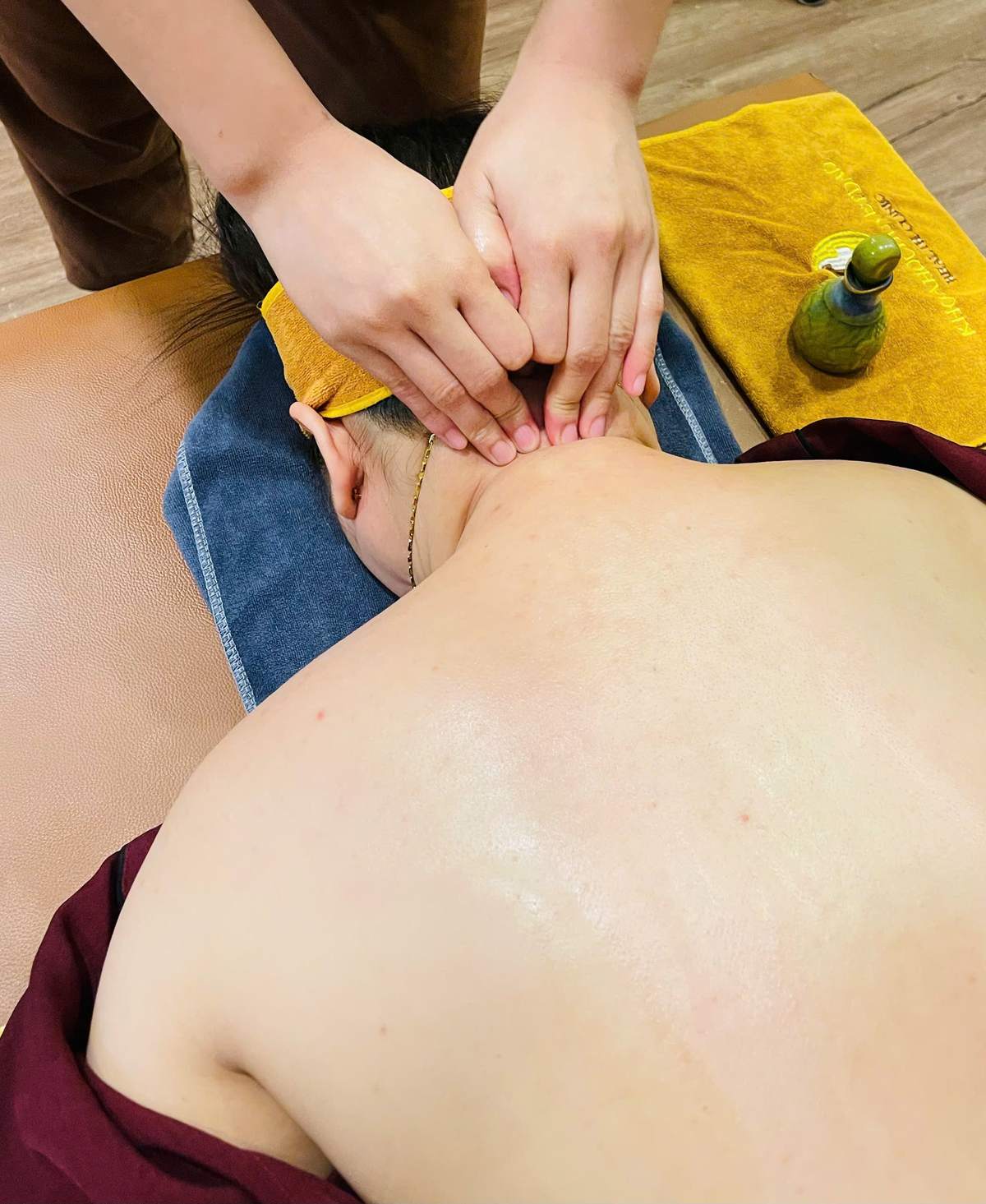
The question should you learn acupressure or massage first sounds like a choice between two things, but these are two parts of the same pair of hands. Massage is a group of techniques over a wide area: stroking, rubbing, gliding, squeezing, kneading, rolling. Acupressure works on one small spot. A small spot is only right once the hand knows how to pass through skin and muscle and stop at the right depth.
So a sensible order for a beginner is hands first, points second, but without waiting to finish massage before starting points. The two run side by side, with more massage in the early stage. You can read more in how acupressure and massage differ.
Why massage basics and muscle feel should come first
- Placing pressure: beginners tend to stiffen the fingers to press. Massage techniques teach you to use body weight and stand in the right posture, so your own fingers and wrists are not overloaded.
- Feel: the hand has to tell soft muscle, tight muscle, a hard band of muscle and a bony landmark apart. Points usually lie in gaps between muscles and hollows beside bone; without finding the landmark you are only guessing from a drawing.
- Warming up: when muscle has been softened by massage first, the receiver feels a pleasant ache on the point and tenses up less.
People who study points only from books, before they have hands, often know the names and locations by heart, yet their pressing is either too shallow or sharply painful. The foundation lies in the basic massage techniques.
A table for choosing the order by goal
| Goal | Start with | When to learn points | Note |
|---|---|---|---|
| Caring for family | A few light rubbing, squeezing and kneading techniques for neck and shoulders, back and legs | Alongside, five to seven easy and safe points | Knowing when not to work matters more than knowing many points |
| Working as a technician | A full base of techniques, standing posture, the flow of one session | Region by region, tied to the muscle area you are training | Practise on many different body types |
| Opening a shop | Go through the hand skills yourself to understand what correct work is | Enough to check the skill of your technicians | Add procedures and how to train staff; ask the local authority about business paperwork |
| Self-care | Daily self-massage and stretching | From the start, a few points on the hands and legs | Does not replace a medical check |
When learning points first is also fine
There are three cases where points first still makes sense. One is a person who only wants to knead a few points on themselves. Two is a person who has done relaxation massage for years, already has the hands, and now adds points and meridians. Three is a person studying Eastern medicine theory who wants to understand the system before practising. Outside those three cases, starting with the hands is the steadier way.
At Tong Gia: look first, hands next, points along the way
Lương Y Tống Văn Huynh, with over 13 years in the trade, arranges the programme as a four-level ladder. L1 Introduction to Y Tuong Hoc (1,500,000 VND) teaches reading facial colour, body shape, the 3 zones of the face, daily wellness habits and a few safe self-care points, with practice in pairs. L2 Basic Trade is where muscle release, acupressure for the neck and shoulders, back and legs, and the flow of a 90-minute session begin. L3 Specialist is massage that balances the spinal nerve reflex system together with advanced Y Tuong Hoc (Vietnamese medical face reading); L4 is for shop owners. Fees and length of L2–L4 are given by the advisor at registration.
The rule running through it all: every observation from the face has to be checked again by hand on the spine. About 70% of class time is practice on real people. For details see the four-level learning path and the massage training page. Tong Gia does not promise jobs or income after the course.
Three questions to ask yourself before choosing a class
- Who am I learning for: myself, my family or paying guests?
- Does the class let me place hands on real people, with someone beside me correcting my hands?
- Does the teacher say clearly when not to work and when to advise a medical check?
These three questions work at any school, not only at Tong Gia.
The boundary learners need to remember
Whichever part you learn first, the hands are used only for wellness care. A person with lasting pain, growing numbness or weakness, or an underlying condition needs a check at a medical facility first. Tong Gia Acupoint Wellness is a wellness care service, not a medical service.
How to register
The class schedule for beginners: the Sunday morning trial class 9:00–12:00 (10 places) and the Sunday Y Tuong Hoc session with no fee, at unit T16-21, Manhattan block, Vinhomes Grand Park, Thu Duc City, Ho Chi Minh City. At the trial class, Lương Y looks at your hand skills and suggests a suitable level. Book a trial class or call the training hotline 0917 945 259.
Frequently asked questions
Should you learn acupressure or massage first? Most beginners should learn basic massage techniques and muscle feel first, with points alongside, a few at a time. Hands that know how to place pressure press a point in the right place and at the right depth.
Are acupressure and massage two different trades? Not really. Massage is a group of techniques over a wide area, acupressure works on a small spot; in one care session the two usually go together.
Can I learn acupressure without knowing anatomy? Yes. Beginners learn the main bony landmarks and muscle groups directly on a partner during practice, with no need to memorise a book first.
How many points are enough to care for family? Five to seven easy, safe points plus a few light massage techniques are enough to begin. You also need to know when not to work.
Which level at Tong Gia teaches acupressure on other people? L1 includes a few safe self-care points. Acupressure and muscle release on other people are trained from L2 Basic Trade; fees for L2–L4 are given by the advisor at registration.
Related articles
- Who should learn acupressure massage: five groups it suits, who should think twice, and seven self-check questions before enrolling
- What is acupressure? Principles, limits and a structured path to an acupressure course in Vietnam
- Acupressure and acupuncture: what is the difference for learners
- Acupressure vs massage: how they differ, and where to start if you want to learn the trade
- All articles about learning the trade
Reserve a free Sunday-morning trial class or ask about the learning path: message Zalo 0917 945 259.

Founder of Tong Gia Acupoint Wellness (Huyệt Đạo Tống Gia), with more than 13 years in Eastern wellness practice, Y Tướng Học (face reading for wellness) and spinal nerve-reflex balancing. Lương Y's story
417 customers have reviewed Tong Gia on Google Maps
Reviews are written by customers themselves on Google; tap to read them before you visit.
Huyệt Đạo Tống Gia Quận 12
225 Dương Thị Mười, Phường Tân Chánh Hiệp (District 12, Ho Chi Minh City). 8:00 – 19:00 daily.
See reviews on Google MapsHuyệt Đạo Tống Gia Quận 9
Căn T16-21 khu Manhattan, Vinhomes Grand Park, Phường Long Bình (Thủ Đức City, Ho Chi Minh City). 9:00 – 20:00 daily.
See reviews on Google MapsWant to be observed in person?
A 90-minute session starts with observation, and only then moves on to muscle release and acupressure on the right areas. Two branches: District 12 and Vinhomes Grand Park.