The 20-day Applied Traditional Medicine (YHCT) course: Meridians – Acupoints – Anatomy and Muscle Release
Lương Y (traditional healer) Tống Văn Huynh · Tong Gia Acupoint Wellness (Huyệt Đạo Tống Gia) · 21/10/2026
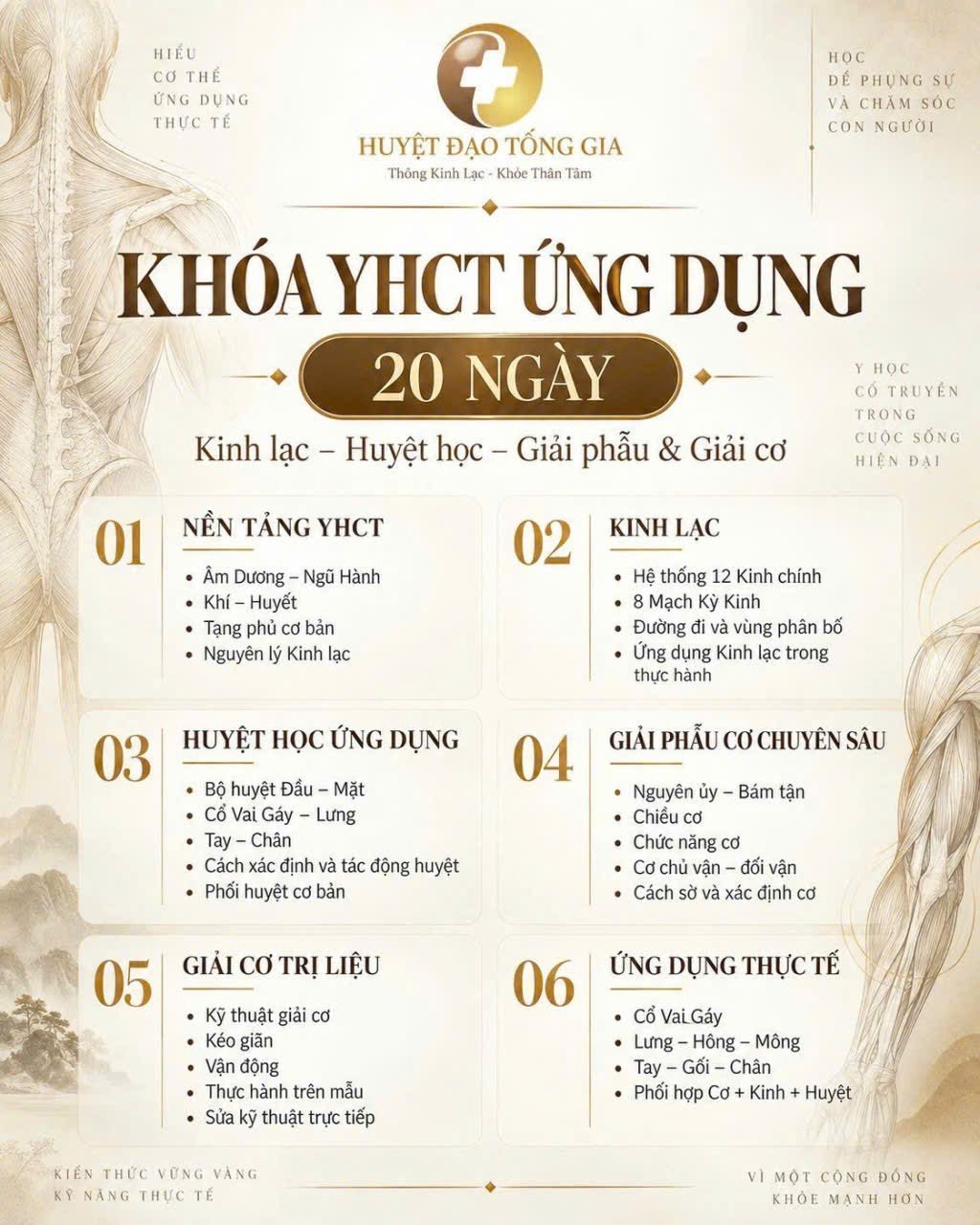
Quick summary: The 20-day Applied Traditional Medicine (YHCT) course is level L2 on the vocational ladder of Tong Gia, for people who want to change careers and start working as wellness practitioners. The course has 6 parts: traditional medicine foundations, meridians, applied acupoints, in-depth muscle anatomy, muscle-release bodywork, and practical application on the neck and shoulders; lower back, hips and buttocks; and arms, knees and legs.
Who the 20-day Applied Traditional Medicine course is for
YHCT is the Vietnamese abbreviation for traditional medicine. At Tong Gia, this course does not teach theory for exams; it teaches learners to understand the body from the Eastern perspective and then apply it with their hands within 20 days. The motto Tong Gia puts at the top of the course: understand the body, apply it in practice.
- People who want to change careers and start working as wellness practitioners.
- People who have learned massage but don't yet understand meridians and acupoints, and just work out of habit.
- People who want a solid foundation before moving up to L3 Expert.
The 6 parts of the Applied Traditional Medicine course
01. Traditional medicine foundations
Yin and Yang, the Five Elements; Qi and Blood; the basic organ systems; meridian principles. This is the common language for understanding every later part, and it links to how Tong Gia reads appearance to understand the organs in Y Tướng Học (face reading for wellness).
02. Meridians
The system of the 12 main meridians and the 8 extraordinary vessels, the pathway and coverage area of each meridian, and how to apply meridians when practising on real people.
03. Applied acupoints
Acupoint sets for the head and face, neck and shoulders, back, arms and legs; how to locate and work on acupoints; basic acupoint combinations. Learners find acupoints on their classmates, with someone coaching and correcting them.
04. In-depth muscle anatomy
Origin, insertion, fibre direction, muscle function, agonists and antagonists, how to palpate and identify muscles. Only when you know where a muscle lies and which way it runs can your hands land in the right place and apply pressure in the right direction.
05. Muscle-release bodywork
Muscle release, stretching and mobilisation techniques; practice on models; direct technique correction. Read more: what is muscle-release technique.
06. Practical application
Applying it on the most common areas: neck and shoulders; lower back, hips and buttocks; arms, knees and legs. Finally, combining muscles, meridians and acupoints in one complete care session following the standard Tong Gia 90-minute routine.
Why learn both meridians and muscle anatomy
Many classes teach only one side: either purely acupoints or purely anatomy-based muscle release. Tong Gia teaches both because practitioners need two pairs of eyes. Meridians and acupoints help you understand the body from the Eastern perspective. Muscle anatomy tells you exactly which muscle you are working on and in which direction. Put together, every movement in a session has a clear reason.
About 70% of class time is practice on real people: placing your hands, applying pressure, locating the muscle areas to work on. Classes are small, and Lương Y Tống Văn Huynh coaches and corrects each person's technique.
What you can do after the Applied Traditional Medicine course
- Understand the basic concepts of traditional medicine and explain them to clients in plain language.
- Locate and work correctly on the commonly used acupoint sets.
- Palpate and identify the main muscle groups in the neck and shoulders, back, arms and legs.
- Carry out a full 90-minute care session following the Tong Gia routine.
Tong Gia does not promise employment or income after the course. Ask the front desk directly about the paperwork you receive after the course and its legal standing before you pay the tuition.
Tong Gia is a hands-on wellness health care service, not a medical service. Learners are taught when not to work: if a client has prolonged pain, numbness or weakness that keeps getting worse, or an underlying condition, advise them to see a doctor at a medical facility.
Where the Applied Traditional Medicine course sits on the 4-level ladder
This is level L2 on Tong Gia's 4-level vocational ladder. Complete beginners can start from L1 Introduction to Y Tướng Học; after L2 you can move up to L3 Expert (therapeutic-style massage with spinal nerve-reflex balancing, advanced Y Tướng Học). See the L2 tuition on the 4-level ladder; the course advisor will tell you the start dates when you register.
How to register
Come to the free Saturday-morning trial class, 8:30–12:00, 10 places per session, at unit T16-21, Manhattan zone, Vinhomes Grand Park, TP. Thủ Đức (Thủ Đức City, Ho Chi Minh City). The Lương Y looks at your hand skills and suggests a suitable level.
Hold your place via Zalo 0888 264 559 by messaging "YHCT 20 NGÀY".
Frequently asked questions
How long is the Applied Traditional Medicine course? 20 days, in 6 parts: traditional medicine foundations, meridians, applied acupoints, in-depth muscle anatomy, muscle-release bodywork and practical application.
Can I learn if I know nothing about traditional medicine? Yes. The first part of the course teaches the foundations: Yin and Yang, the Five Elements, Qi and Blood, the organ systems. The Lương Y looks at your background at the trial class and suggests a suitable level.
Does the Applied Traditional Medicine course include practice? Yes, about 70% of the time is practice on real people, with someone coaching and correcting your technique directly.
After this course, can I practise medicine? No. This is a vocational course in hands-on wellness health care, not training to practise medicine. Ask the front desk about the paperwork you receive after the course before you pay the tuition.
Related articles
- Wellness spa model transfer: Tong Gia's L4 Master and Transfer course
- Spa CRM: managing and looking after clients so your centre doesn't lose them
- Spa practitioner training and operations support: building a team so your centre doesn't depend on one person
- Marketing training for wellness spa owners: bringing in the right clients and measuring every dong
- All articles about vocational training
Hold a place in the free Saturday-morning trial class or ask about the learning path: message Zalo 0888 264 559.

Founder of Tong Gia Acupoint Wellness (Huyệt Đạo Tống Gia), with more than 13 years in Eastern wellness care, Y Tướng Học (face reading for wellness) and spinal nerve-reflex balancing. The Lương Y's story
417 clients have reviewed Tong Gia on Google Maps
Reviews are written by clients themselves on Google; click through and read them before you visit.
Huyệt Đạo Tống Gia District 12
225 Dương Thị Mười, Phường Tân Chánh Hiệp (District 12, Ho Chi Minh City). 8:00 – 19:00 daily.
See reviews on Google MapsHuyệt Đạo Tống Gia District 9
Unit T16-21, Manhattan zone, Vinhomes Grand Park, Phường Long Bình (Thủ Đức City). 9:00 – 20:00 daily.
See reviews on Google MapsWant to be assessed in person?
The 90-minute session starts with observation, and only then moves on to muscle release and acupressure on the right areas. Two branches: District 12 and Vinhomes Grand Park.