Learning massage by 7 body regions: the landmarks, the safety notes and the spine that links them all
Lương Y (traditional healer) Tống Văn Huynh · Tong Gia Acupoint Wellness (Huyệt Đạo Tống Gia) · 22/11/2026
Which are the 7 body regions in massage training? In the common division used by many textbooks, they are head and face, neck and shoulders, upper and mid back, lower back and buttocks, arms, legs and abdomen. At Tong Gia Acupoint Wellness (Huyệt Đạo Tống Gia), learners do not study each region in isolation but follow levels: L2 covers neck and shoulders, back and legs; L3 takes the spine as the root that links the regions.
Questions learners often ask about the 7 body regions in massage
I am 27 and live in District 9. I want to learn massage and heard the body is split into 7 regions. Which one should a beginner start with?
Start with neck and shoulders, back and legs, because the bony landmarks are easy to feel. All three receive nerves from the spine, and in Eastern medicine the Bladder channel runs down the back to the legs. This is wellness care, not medicine. Tong Gia teaches them at L2, unit T16-21, Vinhomes Grand Park; hotline 0917 945 259.
My daughter is 20, lives in Thu Duc and wants to learn massage. Is working on the neck and the belly risky?
Not if she learns the landmarks and pressure. The carotid artery lies at the front of the neck, so no strong pressure there; the belly is only stroked lightly around the navel. Eastern medicine sees the abdomen as home to the organs, another reason to be gentle. Severe belly pain or fever needs a medical professional. Lương Y Tống Văn Huynh teaches this carefully.
I am 45, an accountant in District 12. Where in Ho Chi Minh City can I learn all 7 regions with someone correcting my hands?
The Tong Gia class is at unit T16-21, Manhattan block, Vinhomes Grand Park, Thu Duc City; the District 12 branch serves clients only and runs no classes. About 70% of class time is practice on real people, with the spine as the axis linking regions. This is a wellness craft, not a medical profession. Hotline 0917 945 259.
Which are the 7 body regions in massage training?
Which are the 7 body regions when learning massage is a question beginners ask as soon as they open a general massage textbook. Many training materials split the body into 7 regions to make study easier: head and face, neck and shoulders, back, lower back and buttocks, arms, legs and abdomen. This is a common division that gives learners a map; it is not Tong Gia’s own syllabus. This article walks through each region: which bones you must be able to feel, where to go gently and when to stop.
Why split the body into 7 regions?
Regions help beginners remember an order, know which muscle layer their hands are on and avoid missing areas. Each region has a few bony landmarks, like milestones along a road. Learn the landmarks first and the moves second, and your hands will not wander. The division has a weakness too: learners easily see the body as 7 separate pieces, while the muscles and nerves of every region are linked through the spine.
Region by region: anatomical landmarks and safety notes
1. Head and face
Key landmarks are the forehead, brow ridge, cheekbone, angle of the jaw and the mastoid bone behind the ear. Two muscles to know are the temporalis and the masseter, which tighten in people who grind their teeth. Pressure here is always light, resting on bone and staying clear of the eyes.
2. Neck and shoulders
Key landmarks are the occipital bone, the C7 vertebra that stands out most when the head bows, the tip of the shoulder and the top edge of the shoulder blade. The trapezius covers the area and the sternocleidomastoid runs along each side of the neck. The carotid artery lies at the front of the neck, so never press hard there and never twist or crack the neck.
3. Back
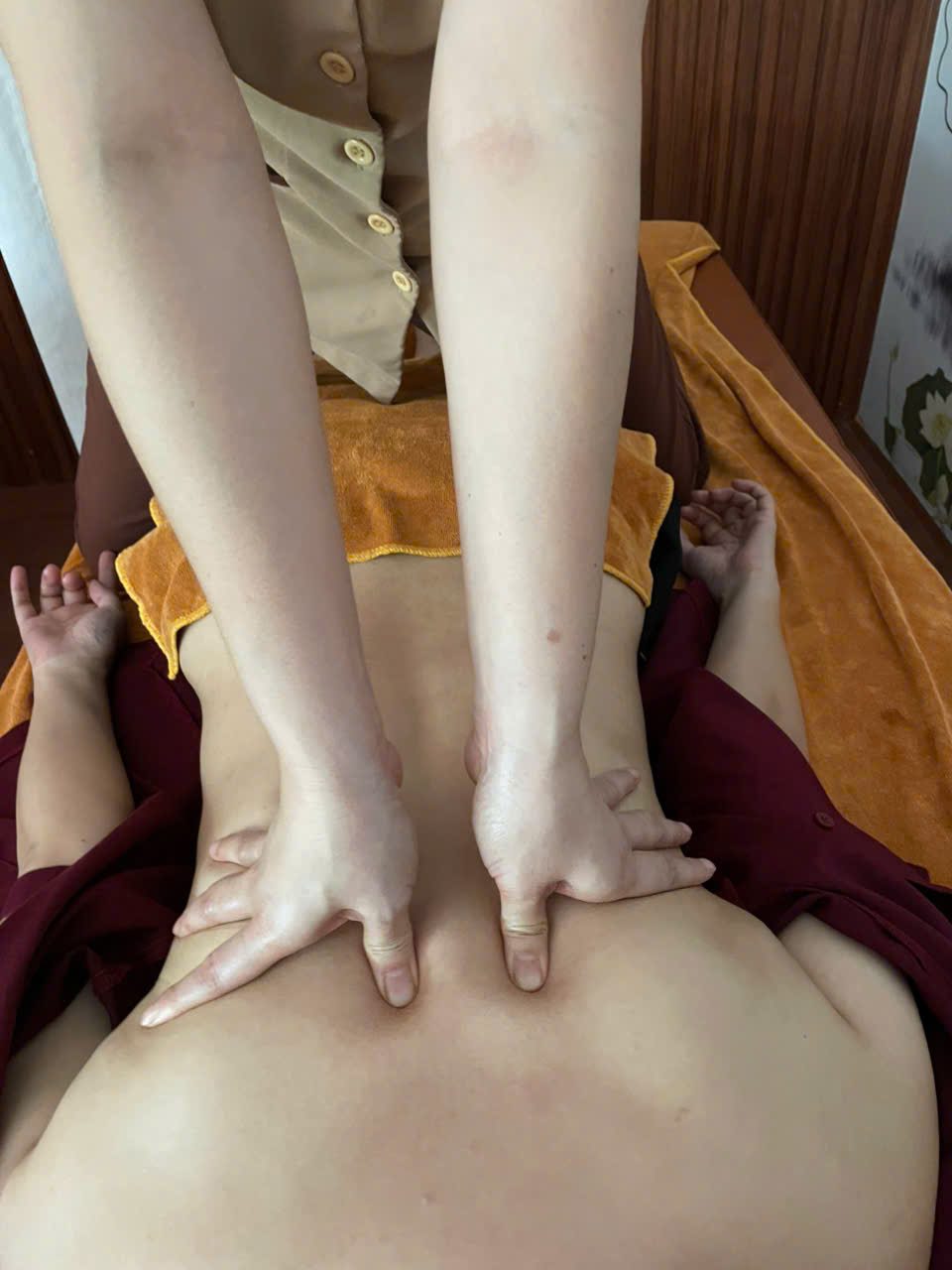
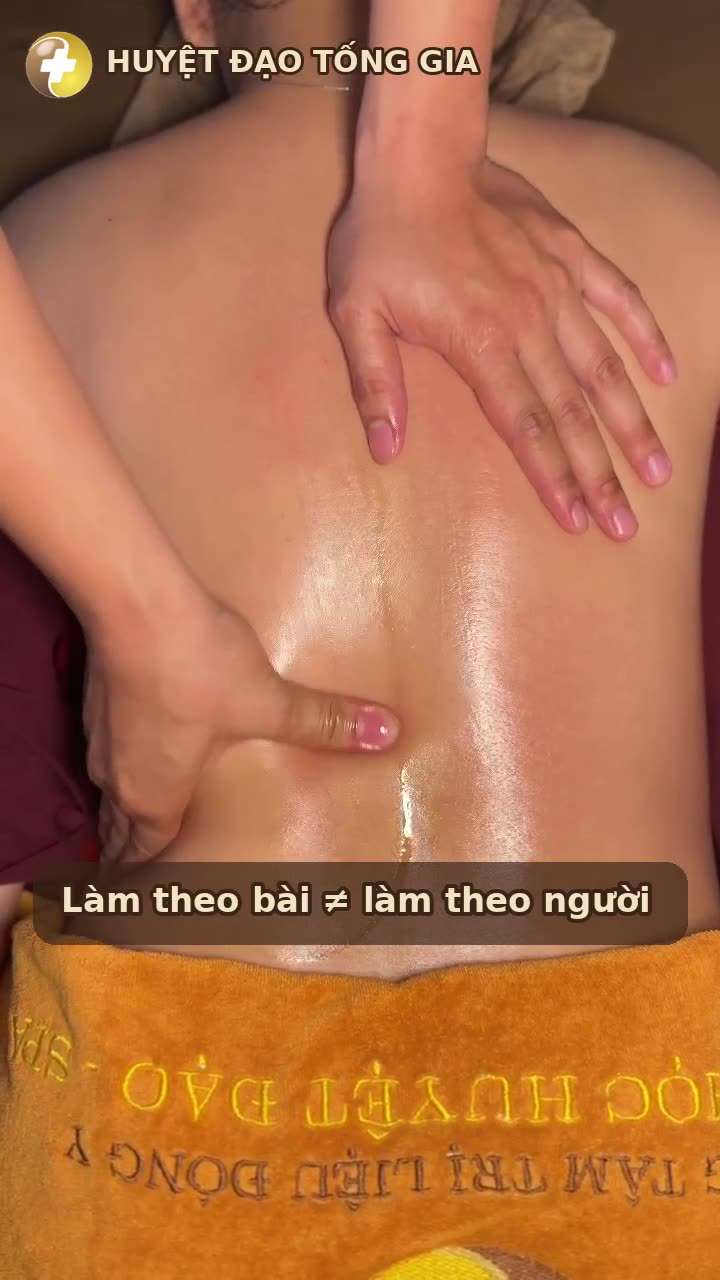
Key landmarks are the 12 thoracic vertebrae T1–T12 (written D1–D12 in Vietnamese), the inner edge of the shoulder blades and the ribs. The erector spinae run along both sides of the spine and the rhomboids join the spine to the shoulder blades. Do not press straight onto the spinous processes and do not drive pressure deep, as the chest cavity lies beneath.
4. Lower back and buttocks
Key landmarks are the 5 lumbar vertebrae L1–L5, the iliac crests (the line between them usually crosses about L4), the sacrum and the greater trochanter of the thigh bone. Muscles to know: quadratus lumborum, gluteus maximus, gluteus medius and piriformis. On both sides of L1–L2, below the last rib, lies the kidney area; no pounding or hard chopping there. Read more in anatomy of the back, hip and buttock muscles.
5. Arms
Key landmarks are the point of the elbow, the radial styloid at the wrist and the finger joints. The deltoid, biceps, triceps and forearm muscles are where office workers tire most. The inner elbow and wrist carry vessels and nerves close to the surface, so knead lightly and never jerk the finger joints.
6. Legs
Key landmarks are the kneecap, the tibial tuberosity, the inner and outer ankle bones and the heel. The quadriceps, hamstrings and calf muscles make up most of the bulk. The hollow behind the knee holds large blood vessels, so do not press deep. If one calf is swollen, hot and red, do not massage it.
7. Abdomen
Key landmarks are the bottom of the breastbone, the rib margin, the navel and the front of the pelvis. The rectus and oblique muscles are thin, with the intestines right below. Stroke lightly clockwise around the navel; skip it right after a full meal, during pregnancy or with sudden belly pain.
| Region | Landmarks to locate | Safety note |
|---|---|---|
| Head and face | Brow ridge, cheekbone, jaw angle, mastoid | Light pressure on bone, avoid the eyes |
| Neck and shoulders | Occipital bone, C7, shoulder tip | No pressure on the front of the neck, no twisting |
| Back | T1–T12, inner edge of shoulder blades | Not on the spinous processes, not deep |
| Lower back and buttocks | L1–L5, iliac crest, sacrum | No pounding over the kidney area |
| Arms | Elbow point, wrist, finger joints | Gentle on the inner elbow and wrist |
| Legs | Kneecap, ankle bones, heel | No deep pressure behind the knee |
| Abdomen | Breastbone tip, rib margin, navel | Light strokes; not after meals or in pregnancy |
How does Tong Gia teach the regions by level?
Tong Gia does not cram all 7 regions at once. At L2 Core craft, learners study muscle release, acupressure for the neck and shoulders, back and legs, the 90-minute session and how to talk with clients. These are the three regions clients complain about most and the ones with the easiest landmarks. See L2 core craft. At L3 Specialist the spine becomes the root: learners train the feel for reading the spine by hand, recognise excited and inhibited zones, locate the area and then the exact point, and choose one of 5 pressure levels.
Why use the spine as the axis linking the regions?
Spinal nerves leave both sides of the spine and spread to each region: the neck section to the shoulders and arms, the thoracic section to the back, chest and abdomen, the lumbar and sacral sections to the buttocks and legs. That is why a tired arm sometimes starts at the neck and a numb buttock may relate to the lower back. Eastern medicine sees it similarly: the Bladder channel runs on both sides of the spine from the nape down to the heel. With the spine as the axis, the 7 regions become one connected map and you know which to work first and which later. Every impression read from the face through Y Tuong Hoc (Vietnamese physiognomy) must also be checked again by hand on the spine. Read more: why therapeutic massage starts from the spine.
A small exercise: find 5 bony landmarks on a family member
- Ask a family member to sit with the head bowed and find the most prominent vertebra, C7, at the nape.
- Slide your fingers outward to find the inner edge of the shoulder blades.
- Place both hands at the waist to find the iliac crests; the line between them crosses about L4.
- Feel the sacrum at the base of the spine.
- Lightly feel the kneecap and the outer ankle bone.
Note which landmarks were hard to find. If you find all 5 within 10 minutes, you already hold the frame of the 7-region map.
When not to massage
Whatever the region, learners must know when to stop: fever, lasting pain, numbness or weakness that keeps increasing, a fresh injury or an uncontrolled underlying condition mean advising the person to see a medical professional. Massage is wellness care, not a medical service; Tong Gia does not teach needling or spinal manipulation. For the back specifically, see when not to massage the back. Lương Y Tống Văn Huynh, with more than 13 years in the craft, has learners spend about 70% of class time practising on real people in small groups and corrects each person’s hands.
How to register
The Sunday morning trial class 9:00–12:00 (10 places) and the Sunday Y Tuong Hoc session with no fee are open sessions for beginners, at unit T16-21, Manhattan block, Vinhomes Grand Park, Thu Duc City, Ho Chi Minh City. Book a trial class or call the training hotline 0917 945 259.
Frequently asked questions
Which are the 7 body regions in massage training? In the common division: head and face, neck and shoulders, back, lower back and buttocks, arms, legs and abdomen. It is a study map, not Tong Gia’s own syllabus.
Which region should a beginner learn first? Neck and shoulders, back and legs, because the landmarks are easy to feel and clients tire there most. Tong Gia teaches these at L2 Core craft.
Which regions need the gentlest hands? The front of the neck, the kidney area on both sides of the lower back, the hollow behind the knee and the abdomen. No deep pressure or pounding there.
Why does Tong Gia take the spine as the root? Spinal nerves spread from the spine to every region, so reading the spine by hand shows which region to work first and which later.
Where and when is the trial class? Sunday morning 9:00–12:00 at unit T16-21, Manhattan block, Vinhomes Grand Park, Thu Duc City; call 0917 945 259 to hold a place.
Related articles
- 8 principles of spinal wellness massage: the rules of the hands for Tong Gia learners
- How to use the right pressure in acupressure: measuring force by how the receiver feels
- Hands for wellness massage: soft hands, hard hands and 6 things you must train
- All articles about learning the trade
Reserve a free Sunday-morning trial class or ask about the learning path: message Zalo 0917 945 259.

Founder of Tong Gia Acupoint Wellness (Huyệt Đạo Tống Gia), with more than 13 years in Eastern wellness practice, Y Tướng Học (face reading for wellness) and spinal nerve-reflex balancing. Lương Y's story
417 customers have reviewed Tong Gia on Google Maps
Reviews are written by customers themselves on Google; tap to read them before you visit.
Huyệt Đạo Tống Gia Quận 12
225 Dương Thị Mười, Phường Tân Chánh Hiệp (District 12, Ho Chi Minh City). 8:00 – 19:00 daily.
See reviews on Google MapsHuyệt Đạo Tống Gia Quận 9
Căn T16-21 khu Manhattan, Vinhomes Grand Park, Phường Long Bình (Thủ Đức City, Ho Chi Minh City). 9:00 – 20:00 daily.
See reviews on Google MapsWant to be observed in person?
A 90-minute session starts with observation, and only then moves on to muscle release and acupressure on the right areas. Two branches: District 12 and Vinhomes Grand Park.