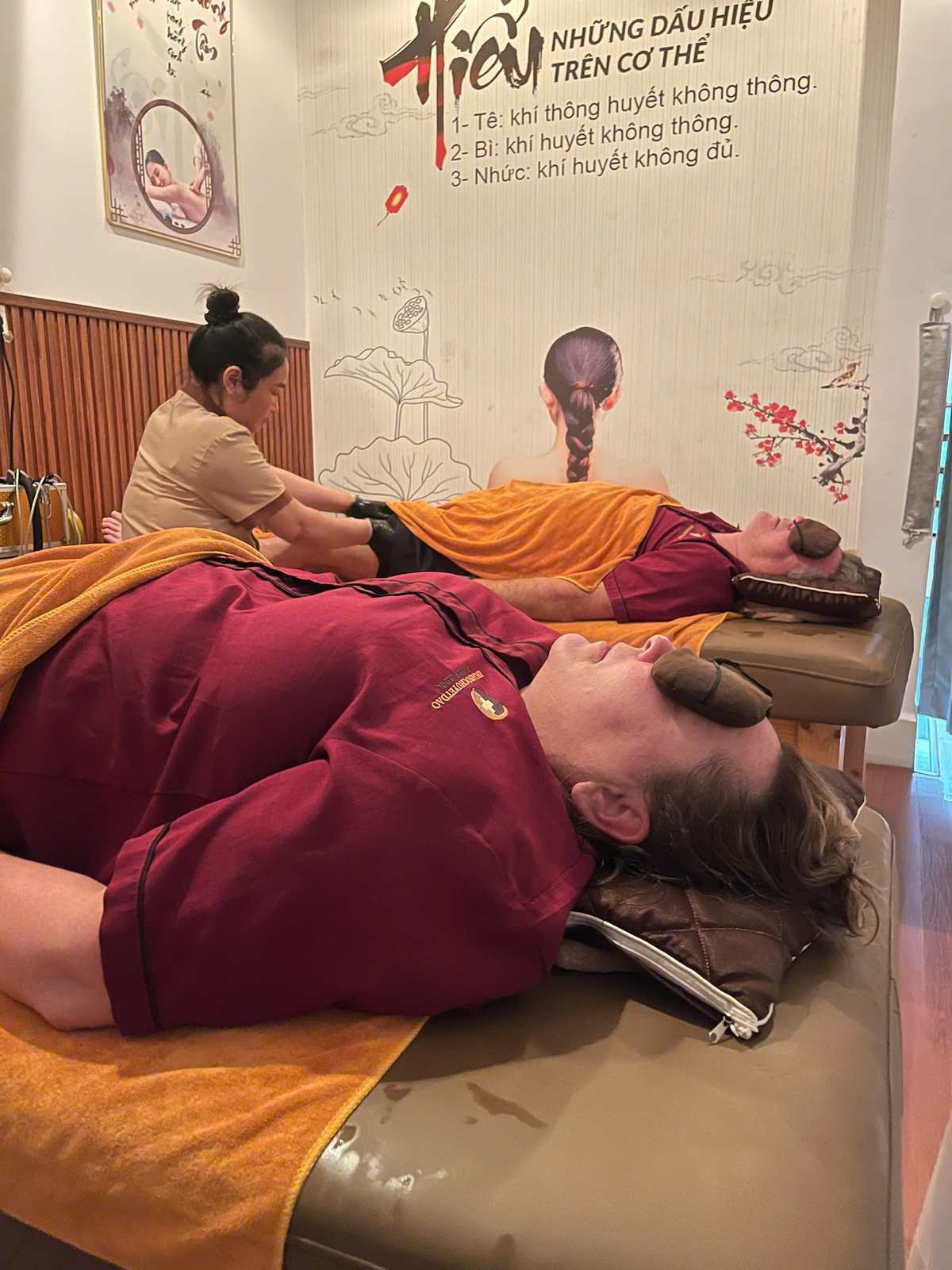
Acupressure course for the head, face and neck: commonly used points, how to apply pressure and the areas to avoid
Lương Y (traditional healer) Tống Văn Huynh · Tong Gia Acupoint Wellness (Huyệt Đạo Tống Gia) · 26/10/2026
Quick summary: An acupressure course for the head, face and neck teaches you to locate a familiar group of points such as Bách Hội (GV20, 百会), Ấn Đường (EX-HN3, 印堂), Toản Trúc (BL2, 攒竹), Thái Dương (EX-HN5, 太阳), Nghinh Hương (LI20, 迎香) and Phong Trì (GB20, 风池), while learning to use far lighter pressure than on the back or legs. The skin here is thin and many blood vessels and nerves lie close to the surface, so students must know where only a gentle circular rub is allowed, where not to press at all, and always ask how the receiver feels.
Short answer: Head, face and neck acupressure means finding points such as Baihui, Yintang, Zanzhu and Fengchi and pressing far more lightly than on the back, because vessels and nerves lie close. Eastern practice says yang meridians meet at the head. A sudden severe headache needs urgent medical care. Tong Gia, Zalo/WhatsApp +84 917 945 259.
Why the head, face and neck need their own training
The back and thighs have thick layers of muscle, so the practitioner can use body weight. The head, face and neck are the opposite: the skin is thin, bone sits right underneath, and blood vessels and nerves run near the surface. The same hand pressure that feels pleasant on the back can cause an ache on the temples.
That is why, when you take an acupressure course for the head, face and neck, you learn three things at once: finding the exact point within a small area, adjusting pressure very finely, and knowing which areas must not be worked strongly. This is also where clients feel a practitioner's skill most clearly, because being slightly off target or a little too heavy is noticed straight away.
Acupressure course for the head, face and neck: commonly used points
The list below is at beginner level and describes general locations. The exact position still has to be corrected on a real person with someone guiding you.
Head
- Bách Hội (GV20, 百会): on the top of the head, where the midline of the head meets the line joining the tops of the two ears.
- Tứ Thần Thông (EX-HN1, 四神聪): four points around Bách Hội, about one cun in front, behind, left and right.
Face
- Ấn Đường (EX-HN3, 印堂): the point midway between the inner ends of the eyebrows.
- Toản Trúc (BL2, 攒竹): the hollow at the inner end of the eyebrow.
- Thái Dương (EX-HN5, 太阳): the hollow at the temple, behind the outer corner of the eye and the end of the eyebrow.
- Nghinh Hương (LI20, 迎香): beside the wing of the nose, in the nasolabial groove.
- Giáp Xa (ST6, 颊车): at the angle of the jaw, where the chewing muscle bulges when you clench your teeth.
Neck and nape
- Phong Trì (GB20, 风池): the hollow below the occipital bone, between the two large muscles at the back of the neck.
- Phong Phủ (GV16, 风府): on the midline at the back of the neck, just below the occipital protuberance, above the hairline at the nape.
- Thiên Trụ (BL10, 天柱): on both sides of the midline of the nape, at the outer edge of the straight vertical neck muscle.
To locate these points accurately, you can see how to use bone landmarks and the body cun (proportional inch) in the article learning to locate acupoints.
Hand pressure in head, face and neck acupressure
Beginners often carry the habit of pressing hard from the back up to the face. Some general principles:
- Use the pad of the finger, never the fingernail tip or a knuckle on the face.
- Make small circles or hold light pressure for a few breaths, then release slowly, instead of pushing in.
- The face takes the lightest pressure, the hairy part of the head a little more, the back of the neck a little more again, but still far less than the back.
- Ask how it feels: a light, pleasant ache is enough. If the receiver frowns or holds their breath, reduce at once.
- Keep both sides even: when working Thái Dương (EX-HN5) or Phong Trì (GB20), work both sides with the same pressure.
To understand more about feeling pressure, the article how to use the right pressure in acupressure explains each level.
Places you must not press hard
This is the most important part of this area; anyone learning the trade must know it by heart before laying hands on another person:
- The eyeball and eyelids: never press on the eyes. Around the eye socket, touch only the bony rim.
- The front of the neck and both sides of the front of the neck: large blood vessels pass here. Do not squeeze, do not press deep, do not press both sides at the same time.
- The fontanelle in young children: do not press the top of the head of a child whose fontanelle is still open.
- Skin that is inflamed, with swollen spots or wounds: skip it, do not work there.
- Someone who has just had a blow to the head or neck: do not work; advise them to see a doctor at a medical facility.
With older people and people whose blood pressure is unstable, turn or tilt the neck back slowly and within a small range. No cracking, no jerking the neck.
A basic head, face and neck acupressure sequence
Every place has its own sequence. When you first start an acupressure course for the head, face and neck, here is an easy-to-remember suggestion for beginners, moving from back to front and from top to bottom:
- Warm up and gently rub the nape and shoulders so the receiver can relax.
- Circle-press Phong Trì (GB20), Thiên Trụ (BL10) and Phong Phủ (GV16) with medium pressure.
- Work the top of the head: Bách Hội (GV20) and Tứ Thần Thông (EX-HN1), then comb the scalp with your fingertips.
- Move down to the face: Ấn Đường (EX-HN3) and Toản Trúc (BL2), then stroke along the eyebrows out to Thái Dương (EX-HN5).
- Nghinh Hương (LI20) and Giáp Xa (ST6), then gently rub the whole face to finish.
People who do wellness head-spa hair washing use many of these skills. If that path interests you, see the article wellness head-spa course.
The face is not just a place to press
At Tong Gia, an acupressure course for the head, face and neck does not begin with the hands. Before placing hands on the face, students are taught to look at the face first. This is the first pillar: Y Tướng Học (face reading for wellness), reading complexion, Five Elements body types and the 3 zones of the face to understand a person's constitution, following the principle “the organs are the cause, the signs are the effect”. The second pillar is therapeutic-style massage for spinal nerve-reflex balancing: everything seen on the face must be cross-checked by hand on the spine, starting from the nape.
Lương Y Tống Văn Huynh teaches the classes himself; about 70% of the time is hands-on practice on real people, in small classes, with Lương Y guiding and correcting each person's fingers. Level L1, Introduction to Y Tướng Học (1.500.000đ), covers reading complexion, the three zones of the face, daily wellness care and a few safe points for self-care. Level L2 goes into muscle release and acupressure for the neck and shoulders, back and legs. Detailed head and face content at each level, fees from L2 upwards and the number of sessions are given by a consultant when you register. Tong Gia does not promise a job or income after the course.
Acupressure is wellness care and relaxation by hand, not a medical service. People with long-lasting headaches, dizziness, facial numbness, or numbness and weakness in the hands that keeps getting worse, or with underlying health conditions, should see a doctor at a medical facility; anyone learning the trade must know when not to work and advise the client to see a doctor.
How to register
If you want to know whether your hand pressure already suits the face, the quickest way is to have an experienced practitioner check it in person. The free trial class runs 9:00 to 12:00 every Sunday morning, 10 places, at căn T16-21 khu Manhattan, Vinhomes Grand Park, Phường Long Bình, TP. Thủ Đức (unit T16-21, Manhattan area, Vinhomes Grand Park, Thủ Đức City, Ho Chi Minh City).
The L1 Introduction to Y Tướng Học class runs on a set schedule. Register via hotline 0917 945 259.
Questions learners often ask
What is the Fengchi acupoint, and is it safe to press it myself?
Fengchi (GB20) is a Gallbladder-meridian point in the hollow below the base of the skull, between two neck muscles. Gentle self-pressure for 1–2 minutes is generally safe for a tight neck; avoid hard pressure. Dizziness with arm numbness needs a medical check first. Tong Gia teaches it in class; Zalo/WhatsApp +84 917 945 259.
Where is the Fengchi point located at the back of the neck?
Slide your fingers from behind the ear along the base of the skull until they drop into the hollow between the sternocleidomastoid and trapezius muscles. Eastern practice calls it a "wind gate" of the head. Use moderate pressure for 1–2 minutes. Lasting arm numbness needs a medical check. Tong Gia, Zalo/WhatsApp +84 917 945 259.
What is the Dazhui point at the base of the neck used for?
Dazhui (GV14) lies just below the bump of the seventh neck vertebra. On the Governing Vessel, where yang meridians meet, it is used in wellness care to relax a stiff neck and upper back with gentle rubbing. High fever with neck stiffness needs urgent medical care. Tong Gia, Zalo/WhatsApp +84 917 945 259.
Frequently asked questions
Does facial acupressure need strong pressure? No. The skin on the face is thin and bone lies close underneath, so a gentle circular rub with the finger pad is enough, up to a light, pleasant ache.
Where is the Phong Trì point (GB20, 风池)? Phong Trì is in the hollow below the occipital bone at the back of the neck, between the two large muscles, one point on each side. Work both sides evenly with medium pressure.
Can you do acupressure on the front of the neck? Do not press deep on the front of the neck or on either side of it, because large blood vessels pass there. Beginners should work only the back of the neck.
Does head, face and neck acupressure help you sleep better? Many people feel relaxed and comfortable after a round of head, face and neck work, but everyone feels it differently. Long-lasting sleeplessness should be checked by a doctor at a medical facility to find the cause.
What is the acupressure course for the head, face and neck like at Tong Gia? Students are taught to read the face with Y Tướng Học before laying hands on, then practise on real people with Lương Y guiding them. For the content of each level, ask a consultant on Zalo 0917 945 259.
Related articles
- The 3 “no’s” of the Tong Gia spinal balancing method: no needles, no medicine, no rough force
- How the 33 vertebrae are grouped into regions: the spine map every therapeutic-style massage student must know
- 4 objective factors when reading the spine by hand: let the hands record, not guess
- 5 vertebral patterns (raised, sunken, shifted): reading the spine by hand in the Specialist course
- All articles on learning the trade
Reserve a free Sunday-morning trial class or ask about the learning path: message Zalo 0917 945 259.

Founder of Tong Gia Acupoint Wellness (Huyệt Đạo Tống Gia), with more than 13 years in Eastern wellness practice, Y Tướng Học (face reading for wellness) and spinal nerve-reflex balancing. Lương Y's story
417 customers have reviewed Tong Gia on Google Maps
Reviews are written by customers themselves on Google; tap to read them before you visit.
Huyệt Đạo Tống Gia Quận 12
225 Dương Thị Mười, Phường Tân Chánh Hiệp (District 12, Ho Chi Minh City). 8:00 – 19:00 daily.
See reviews on Google MapsHuyệt Đạo Tống Gia Quận 9
Căn T16-21 khu Manhattan, Vinhomes Grand Park, Phường Long Bình (Thủ Đức City, Ho Chi Minh City). 9:00 – 20:00 daily.
See reviews on Google MapsWant to be observed in person?
A 90-minute session starts with observation, and only then moves on to muscle release and acupressure on the right areas. Two branches: District 12 and Vinhomes Grand Park.