Do you need to be good at biology to work in therapeutic-style massage? You need to understand the body, not top grades
Lương Y (traditional healer) Tống Văn Huynh · Tong Gia Acupoint Wellness (Huyệt Đạo Tống Gia) · 11/11/2026
Do you need to be good at biology to work in therapeutic-style massage? You do not need top school biology grades, only an understanding of the body you can use with your hands: muscle groups, the spine, meridians and acupoints. At Tong Gia this is learned on real people, by touch, so even people who were weak at biology can learn it.
Questions learners often ask about whether a wellness massage course needs biology
Is wellness massage a stable job in Vietnam, and can I learn it at Vinhomes Grand Park?
Whether wellness massage is a stable job depends on your skill; Tống Gia does not promise jobs or income. You don't need top biology grades, just a working grasp of muscles, bones and the spine, and the Eastern idea that outer signs reflect inner organs. Tống Gia teaches wellness care, not medical services; lasting pain or numbness needs a medical check first. Classes: căn T16-21 khu Manhattan, Vinhomes Grand Park, TP. Thủ Đức; Zalo/WhatsApp +84 917 945 259.
Do I need to be good at biology to become a massage practitioner?
No. You need to understand the body well enough to use your hands: muscle groups, the spine, meridians and points. At Tong Gia, anatomy is learned by touch on real people, alongside the Eastern idea that outer signs reflect the organs. It is wellness care, not medical work. Zalo/WhatsApp +84 917 945 259.
Why do so many people worry about biology?
Students choosing a career, people changing careers, and parents guiding their children often ask: do you need to be good at biology to work in therapeutic-style massage? The worry is understandable. Hearing the word "therapeutic", many people assume it means studying like a future doctor and memorising the Latin name of every muscle and bone.
The reality is different. Therapeutic-style massage is hands-on wellness care, not a medical profession. Practitioners do not examine illnesses or prescribe medicine. What they need is to understand the body well enough to place their hands in the right spot, use the right amount of pressure, and know when to stop.
What do massage learners need to know about the body?
- The large muscle groups. Neck, shoulders, back, lower back, buttocks, thighs, calves. Know where each muscle lies and which way it runs, so you stroke and press along the fibres. Example: muscle anatomy of the neck and shoulder area.
- The spine. Thirty-three vertebrae divided into cervical, thoracic, lumbar and sacro-coccygeal regions. With spinal nerve-reflex balancing, learners practise feeling each vertebra by hand.
- Meridians and acupoints. In Eastern wellness, the body has meridians with acupoints along them. Learners gradually remember the commonly used points through practice.
- Areas to avoid. Areas with large blood vessels, damaged skin, and the cases where you should not work and should advise the person to see a doctor at a medical facility.
This is usable knowledge, not exam knowledge. There is no written test of muscle names in a foreign language.
How is learning by hand different from learning from books?
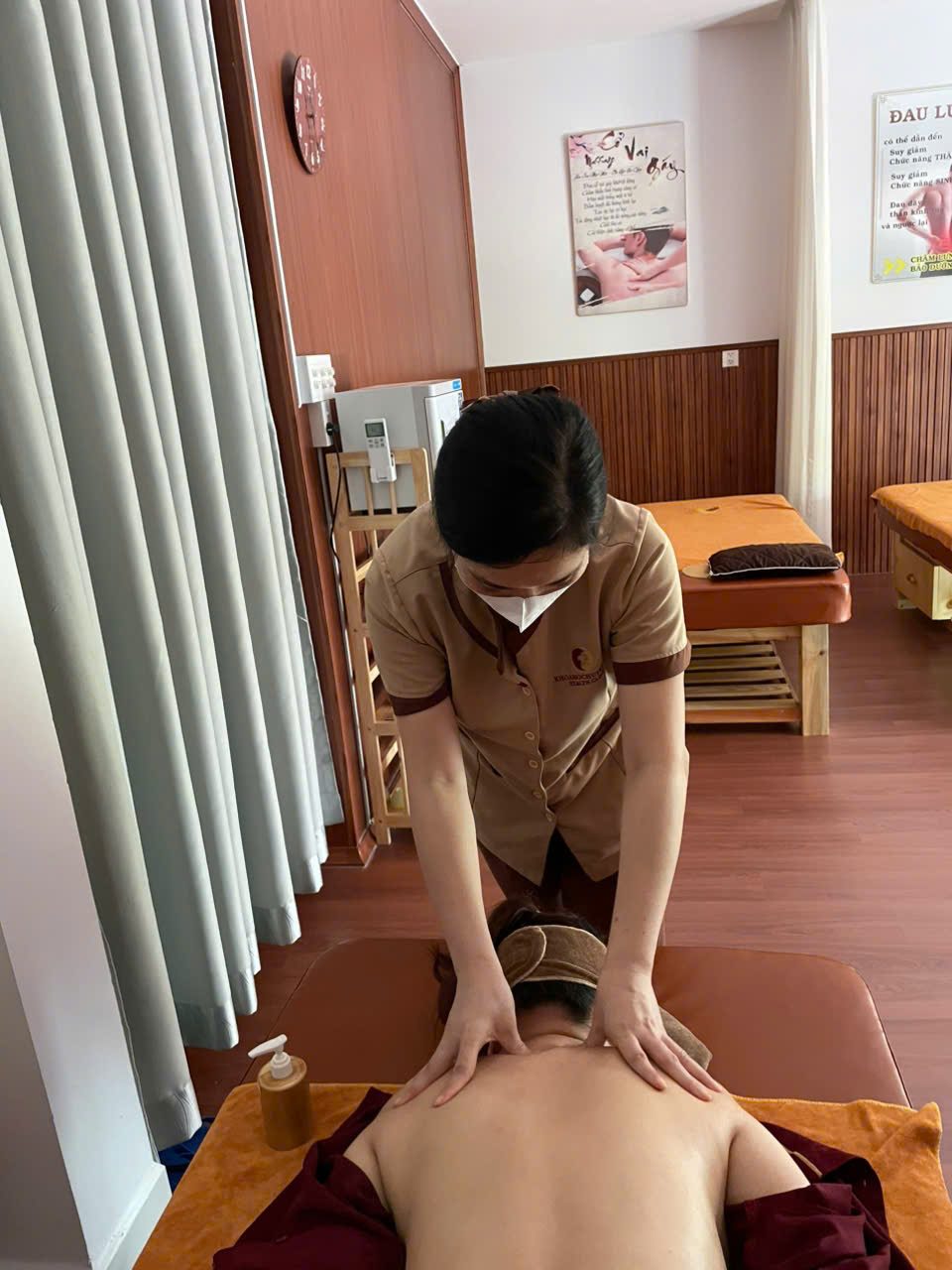
At school, biology means reading, memorising and doing exercises. In a hands-on trade, learners put their hands on a real person's back, feel the spinous processes of the vertebrae, feel where muscle is thick or thin, and notice where it is rigid. Many trainees say they dreaded biology at school, but once they could feel it on a real person they remembered it for a long time, because what you touch is hard to forget.
Beyond knowing the body, this trade needs things a biology grade cannot measure: perseverance, attentiveness and a genuine wish to care for people. Read more: which personalities suit therapeutic-style massage.
So do people who are good at biology have an advantage?
Yes, but less than many think. People already familiar with the terms read the materials faster in the first week. After that, whoever practises more with their hands gets better. Some people with high biology grades have stiff hands and uneven pressure; some who did poorly in biology have soft hands and a good sense of touch.
Tips if you worry you won't keep up
- Start with your own body. Feel your own shoulders and nape, and trace your neck vertebrae as you bend your head.
- Learn one area at a time. Finish the neck and shoulders before moving to the back and lower back.
- Learn acupoints by meridian. Remembering a route is easier than remembering scattered points.
- Learn with someone guiding your hands. The teacher places their hand on yours and shows the right spot and the right pressure.
Learning at Tong Gia
At Tong Gia, Lương Y Tống Văn Huynh personally teaches therapeutic-style massage with spinal nerve-reflex balancing and Y Tướng Học (face reading for wellness). Body knowledge is taught in plain language and goes hand in hand with practice on real people, suitable even for people who have never studied medicine. You can learn to work in the trade, to care for your family, or to help others.
How to register
The Sunday morning trial class, 9:00–12:00, and the free Sunday Y Tướng Học session are open to newcomers, at unit T16-21, Manhattan zone, Vinhomes Grand Park, Thủ Đức City (Ho Chi Minh City). Register for a trial class or call the training hotline 0917 945 259 (Zalo/WhatsApp +84 917 945 259).
Frequently asked questions
Do you need to be good at biology to work in therapeutic-style massage? You do not need good school biology grades, but you do need to understand muscles, the spine, meridians and acupoints well enough to use them with your hands.
I was weak at biology. Can I still learn wellness massage? Yes. Body knowledge is learned by touching real people with someone guiding your hands, so many people who were weak at biology still remember it well.
Does a wellness massage course include anatomy? Yes, but at a hands-on level: the large muscle groups (neck, shoulders, back, lower back, buttocks, thighs, calves), the 33 vertebrae divided into the cervical, thoracic, lumbar and sacrococcygeal regions, the meridians and commonly used acupoints, plus the areas to avoid.
Can someone who never studied medicine learn acupressure? Yes. Acupoints are learned by meridian and found on real people under guidance.
When is the trial class at Tong Gia? Sunday morning, 9:00–12:00 at Vinhomes Grand Park, Thủ Đức City; free Y Tướng Học session on Sunday. Training hotline 0917 945 259.
Related articles
- The 12 main meridians: names, pathway rules and peak qi hours, an easy chart for learners
- Tong Gia spinal balancing's 3 no's: no needles, no medicines, no rough force
- Face reading for health: the 3 facial zones in Y Tướng Học, how to divide them and how to read them to care for the body properly
- 30 basic massage techniques learners should know: learn them in groups, not as a list of names
- All articles about learning the trade
Reserve a free Sunday morning trial or ask about the learning path: message Zalo 0917 945 259.

Founder of Tong Gia Acupoint Wellness (Huyệt Đạo Tống Gia), with more than 13 years in Eastern wellness practice, Y Tướng Học (face reading for wellness) and spinal nerve-reflex balancing. Lương Y's story
417 customers have reviewed Tong Gia on Google Maps
Reviews are written by customers themselves on Google; tap to read them before you visit.
Huyệt Đạo Tống Gia Quận 12
225 Dương Thị Mười, Phường Tân Chánh Hiệp (District 12, Ho Chi Minh City). 8:00 – 19:00 daily.
See reviews on Google MapsHuyệt Đạo Tống Gia Quận 9
Căn T16-21 khu Manhattan, Vinhomes Grand Park, Phường Long Bình (Thủ Đức City, Ho Chi Minh City). 9:00 – 20:00 daily.
See reviews on Google MapsWant to be observed in person?
A 90-minute session starts with observation, and only then moves on to muscle release and acupressure on the right areas. Two branches: District 12 and Vinhomes Grand Park.