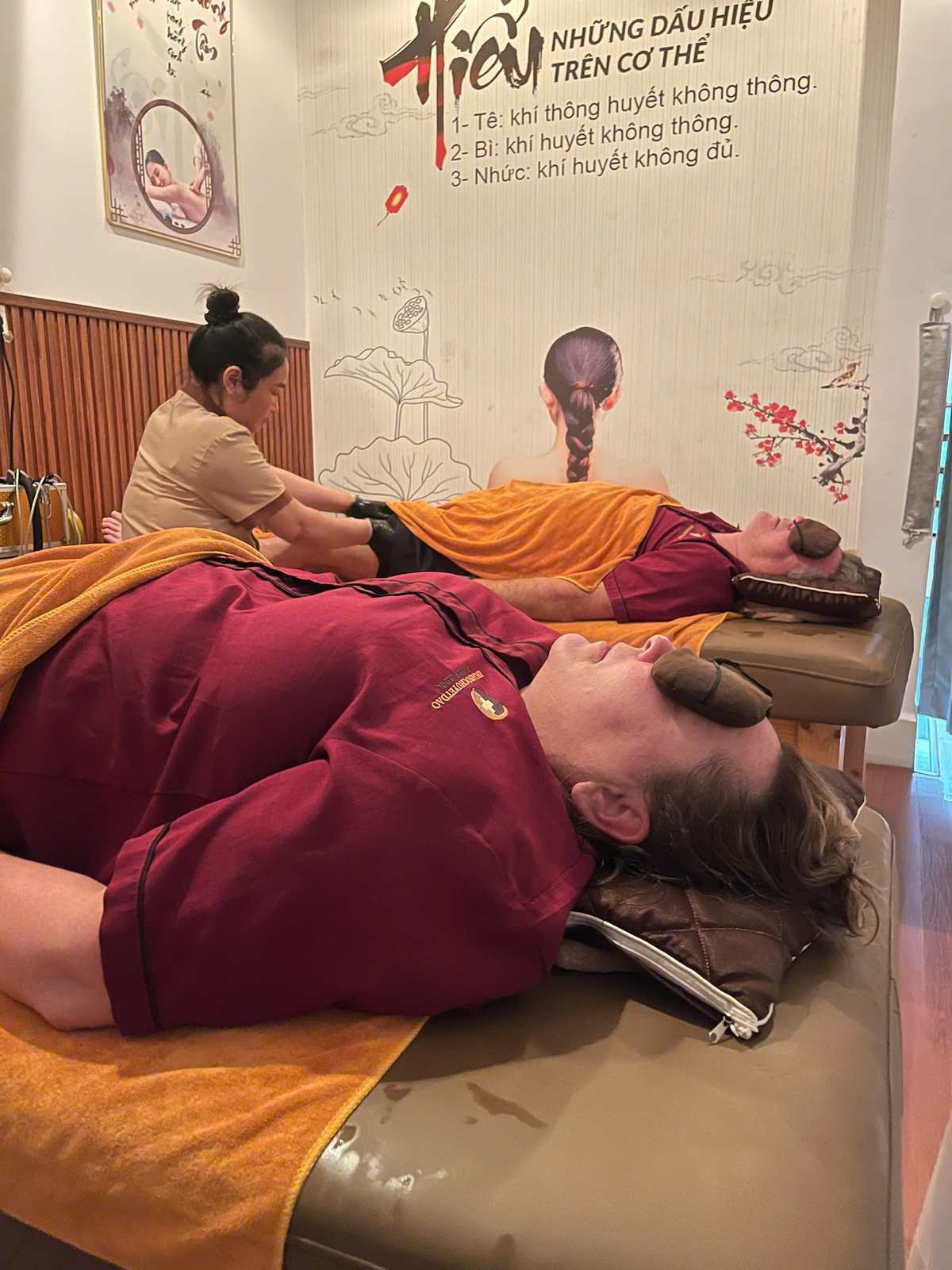
Head, neck, shoulder and lower back massage course in Ho Chi Minh City: why learn it as one sequence along the spine
Lương Y (traditional healer) Tống Văn Huynh · Tong Gia Acupoint Wellness (Huyệt Đạo Tống Gia) · 22/10/2026
Quick answer: A head, neck, shoulder and lower back massage course in Ho Chi Minh City teaches one flowing sequence from the head down to the neck, shoulders, along the back and into the lower back in a single session, instead of learning each area separately. Learning it as a chain makes sense because these areas are linked by the spine: when one section tightens, another usually has to compensate. At Tong Gia, the neck, shoulder and back areas belong to level L2, while reading and balancing the spinal axis is studied in depth in L3.
Questions students often ask about the head, neck, shoulder and lower back massage course
Where in HCMC can I take a neck and shoulder massage course to work with office clients?
Tong Gia's class in Vinhomes Grand Park, Thu Duc City, teaches head, neck, shoulder and lower-back massage as one sequence along the spine, which suits office workers. Students learn the trapezius and spinal erectors and read outer signs of the inner organs to choose pressure. Anyone with ongoing pain should get checked at a medical facility first; this is wellness care, not a medical service. Free Sunday-morning trial at Vinhomes Grand Park, TP. Thủ Đức; Zalo/WhatsApp +84 917 945 259.
What does a head, neck, shoulder and lower back massage course teach?
This type of course teaches you to work in one continuous flow from the head down to the neck, shoulders, mid-back and lower back in the same session, rather than learning each area on its own. The key lies in the word “continuous”: these areas are joined by one shared axis, the spine.
Clients rarely feel tired in just one spot. Office workers often have a heavy head, a stiff nape, tight shoulders and a tired lower back all at once. A practitioner who only knows how to work area by area ends up finishing the shoulders while the back is still stiff, or finishing the back only to find the nape tense again.
Why learn it as a sequence instead of area by area?
The spine is the common thread
The neck is the top section of the spine and the lower back is the bottom section. The muscles on both sides of the spine run from the nape all the way down to the hips. When one section tightens, the others usually have to brace to compensate. Uneven shoulders may go together with an uneven lower back; a head pushed forward drags the upper back into a hunch.
A seamless rhythm helps the body let go
A sequence done without breaks, with an even rhythm from top to bottom, helps the person receiving it relax far more easily than being stopped midway, switching areas and changing position all the time. Once they relax, the practitioner’s hands can also go deeper without needing extra force.
Students understand the root, not just the tired spot
Learning in a sequence makes you ask yourself: the fatigue is here, but where does the tension start? That is how long-time practitioners think, unlike someone who has only memorised the moves. As Tong Gia often says: “The body is the house, the acupoints are the doors, qi and blood are the wind” – the wind has to flow through the whole house, not just one room.
How a head – neck – shoulder – lower back sequence usually goes
Every school has its own order. Below is a general framework to help you picture it and compare when you look at a course:
- Observe and ask: standing and sitting posture, complexion; ask which area feels tired, for how long, and whether it spreads anywhere.
- Head: gentle work on the scalp and hairline, so the person receiving it starts to relax.
- Neck and nape: warm up, gentle muscle release on both sides of the neck and below the occiput; no cracking, no twisting.
- Shoulders and shoulder blades: release the trapezius and the muscles around the shoulder blades, knead and press tight points.
- Along the spine: the hands travel down both sides of the spine from top to bottom, finding tight or shifted sections.
- Lower back and hips: muscle release on the lower back and glutes; moderate pressure suited to the person’s build.
- Finish: long strokes down the back, let the client rest, remind them to get up slowly and drink warm water.
At Tong Gia, the neck, shoulder and back areas belong to level L2 and are built into the standard Tong Gia 90-minute session routine.
The spinal axis: where you start and where you check again
The way Tong Gia teaches the continuous sequence rests on two pillars. The first is Y Tướng Học (face reading for wellness) – reading the face to understand the organs. Before laying hands on anyone, students practise reading complexion and body shape by the Five Elements to know whether this person needs light or deep work, fast or slow. “The organs are the cause, the signs are the effect.”
The second pillar is spinal nerve-reflex balancing. Every impression taken from the face must be checked again by hand on the spine. Running the hands along the spinal axis is both a checking step and the thread that ties the head, neck, shoulders and lower back into one seamless session. This part is studied in depth at level L3. Read more: learning spinal massage and what spinal nerve-reflex balancing is.
Common mistakes when learning separate areas
- Putting all the force into one tired spot and working it too long, so the area is sore the next day.
- Skipping the mid-back, the section that connects the shoulders and the lower back.
- Changing the client’s position constantly, which breaks the rhythm of relaxation.
- Not observing first, so there is no sense of the person’s build to adjust pressure; a slim person gets pressed as hard as someone with thick muscles.
- Only learning the areas clients complain about without understanding why those areas are tense.
When you must stop
The lower back, like the neck, has warning signs a practitioner must not ignore: long-lasting pain, numbness or weakness that keeps increasing, numbness spreading down the leg, a leg getting weaker, a recent fall or knock, or an underlying illness. In these cases, stop and advise the client to see a doctor at a medical facility. Tong Gia is a wellness care service using the hands for relaxation, not a medical service.
The head, neck, shoulder and lower back massage course in the Tong Gia learning path
Beginners start with L1 – Introduction to Y Tướng Học (1.500.000đ): reading complexion and body shape by the Five Elements, the 3 zones of the face, daily wellness habits, a few safe acupoints for self-care, and practice in pairs. Moving up to L2 – Core Trade Skills, you learn muscle release and acupressure for the neck, shoulders, back and legs, plus the 90-minute session routine. The Specialist Course (L3) goes deep into spinal nerve-reflex balancing. Fees for L2–L3, the number of sessions and duration are given by an advisor when you register.
About 70% of class time is hands-on practice on real people; classes are small and Lương Y Tống Văn Huynh coaches each person. If you only need to go deep on the neck area, see the article neck and shoulder massage course. For the type of document issued after the course and its legal value, ask reception directly before paying the fee. Tong Gia does not promise a job or income after the course.
How to register
Lương Y Tống Văn Huynh assesses your hands-on skill at the trial class and then suggests the right level. Free trial class every Sunday 9:00–12:00, 10 places, at căn T16-21 khu Manhattan, Vinhomes Grand Park, Phường Long Bình, TP. Thủ Đức (Thủ Đức City, Ho Chi Minh City).
The L1 Introduction to Y Tướng Học class opens on a schedule; register via the hotline 0917 945 259 (Zalo/WhatsApp +84 917 945 259).
Frequently asked questions
Why is my back still tired after a neck and shoulder massage? The neck, shoulders, back and lower back are linked through the spine; when one section is tense, another usually compensates. That is why practitioners should learn to work in one sequence along the spinal axis.
In what order is a head, neck, shoulder and lower back massage done? It usually goes from observation to the head, neck and nape, shoulders, along the spine, then the lower back and hips, ending gently. Each school may adjust its own order.
Should I get a massage for lower back pain with numbness down the leg? Do not do it on your own. Long-lasting pain, numbness spreading down the leg or a weakening leg needs a check at a medical facility first.
Which Tong Gia level covers full-body sequence massage? The neck, shoulder and back areas are part of L2 Core Trade Skills; spinal nerve-reflex balancing is studied in depth in L3. Fees are given by an advisor when you register via Zalo 0917 945 259.
Related articles
- The 3 “no’s” of the Tong Gia spinal balancing method: no needles, no medicine, no rough force
- How the 33 vertebrae are grouped into regions: the spine map every therapeutic-style massage student must know
- 4 objective factors when reading the spine by hand: let the hands record, not guess
- 5 vertebral patterns (raised, sunken, shifted): reading the spine by hand in the Specialist course
- All articles on learning the trade
Reserve a free Sunday-morning trial class or ask about the learning path: message Zalo 0917 945 259.

Founder of Tong Gia Acupoint Wellness (Huyệt Đạo Tống Gia), with more than 13 years in Eastern wellness practice, Y Tướng Học (face reading for wellness) and spinal nerve-reflex balancing. Lương Y's story
417 customers have reviewed Tong Gia on Google Maps
Reviews are written by customers themselves on Google; tap to read them before you visit.
Huyệt Đạo Tống Gia Quận 12
225 Dương Thị Mười, Phường Tân Chánh Hiệp (District 12, Ho Chi Minh City). 8:00 – 19:00 daily.
See reviews on Google MapsHuyệt Đạo Tống Gia Quận 9
Căn T16-21 khu Manhattan, Vinhomes Grand Park, Phường Long Bình (Thủ Đức City, Ho Chi Minh City). 9:00 – 20:00 daily.
See reviews on Google MapsWant to be observed in person?
A 90-minute session starts with observation, and only then moves on to muscle release and acupressure on the right areas. Two branches: District 12 and Vinhomes Grand Park.