Kidney acupressure points: how learners find Thận du, Mệnh môn and Thái khê by hand
Lương Y (traditional healer) Tống Văn Huynh · Tong Gia Acupoint Wellness (Huyệt Đạo Tống Gia) · 13/11/2026
Kidney acupressure points tonify Kidney qi in Eastern medicine: mainly Thận du (BL23), Mệnh môn (GV4) and Chí thất (BL52) on the lower back, plus Thái khê (KI3) and Dũng tuyền (KI1) on the foot. At Tong Gia Acupoint Wellness (Huyệt Đạo Tống Gia) in Ho Chi Minh City, learners count to L2, then knead each point 1–2 minutes.
Questions learners often ask about kidney acupressure points
I'm learning massage in Thu Duc: where is Thận du (BL23), how do I find it, how long to press, who should avoid it?
Thận du (BL23) sits below the L2 spinous process, 1.5 cun out on each side. Find the iliac crests at L4, count up to L2, measure two fingers, knead with medium pressure 1–2 minutes. For fever with flank pain, blood in the urine or swelling, advise a check at a medical facility. Tong Gia teaches this at Vinhomes Grand Park.
I'm over 40 in District 12 and want to learn acupressure for my parents' tired back and knees. Where can I practise on real people?
Tong Gia's classes are at căn T16-21 khu Manhattan, Vinhomes Grand Park, TP. Thủ Đức (unit T16-21, Manhattan block, Thu Duc City); District 12 is a care branch, no classes. Safe self-care points start at L1 (1.500.000₫); about 70% is hands-on practice. For lasting pain or an existing condition, see a doctor. Zalo 0917 945 259.
I'm in Ho Chi Minh City and curious: does pressing Thận du or Thái khê act directly on the kidneys themselves?
No, it does not act directly on the kidneys. In Western medicine, the kidneys lie behind the peritoneum, from about T12 to L3; the hand only reaches skin, muscle and meridians. In Eastern medicine, kneading these points helps balance qi and blood, tonify Kidney qi and support relaxation. Lương Y Tống Văn Huynh teaches exactly this.
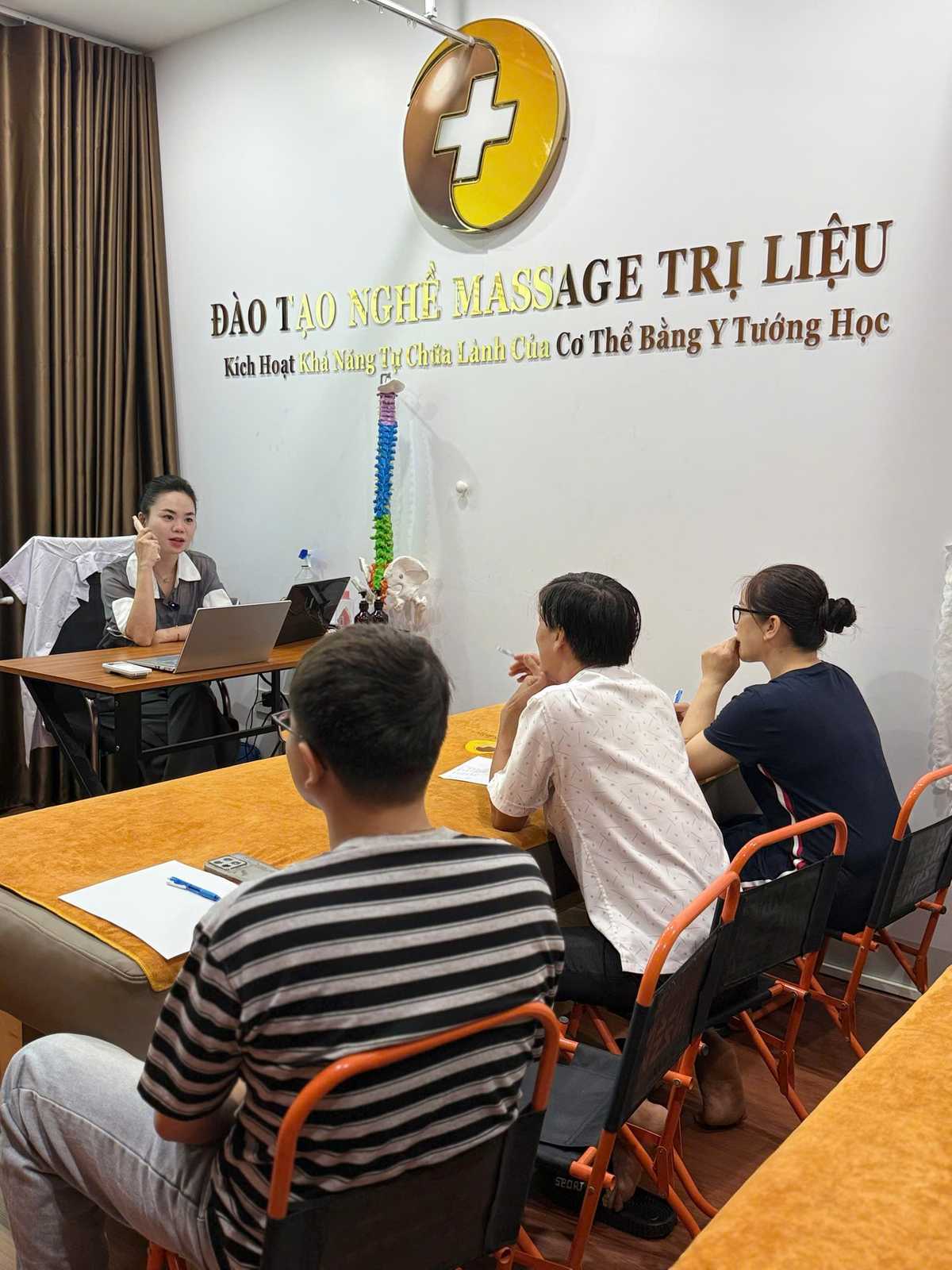
A kidney acupressure class: fingers searching for the L2 spinous process
In class at Vinhomes Grand Park, the acupoint part of the Kidney chapter always begins on the lower back. Learners place both thumbs on either side of a partner's spine and press straight down where they guess Thận du is. Lương Y Tống Văn Huynh lifts their hands away, tells them to feel the two iliac crests again, count the spinous processes from the bottom up, and only then place their fingers. Learning kidney acupressure points at Tong Gia means learning to count landmarks before learning to press.
Which points are kidney acupressure points?
The Kidney chapter of the curriculum (section 5.10) sets the goals: tonify Kidney qi, balance Kidney yin and Kidney yang, and open the meridians of the back and knees according to traditional Eastern medicine. The points lie on the Kidney meridian (KI), the Bladder meridian (BL, running along both sides of the spine), the Governing Vessel and the Conception Vessel.
- Thận du (BL23, 腎俞): below the L2 spinous process, 1.5 cun out to the side; the Back-Shu point of the Kidney, strengthens the lower back and knees.
- Mệnh môn (GV4, 命門): the hollow below the L2 spinous process; warms and tonifies Kidney yang. See the Mệnh môn point.
- Chí thất (BL52, 志室): below the L2 spinous process, 3 cun out to the side; tonifies the Kidney, strengthens the lower back.
- Thái khê (KI3, 太溪): the hollow between the inner ankle bone and the Achilles tendon; the Source point of the Kidney meridian. See the Thái khê point.
- Dũng tuyền (KI1, 湧泉): the hollow in the front third of the sole when the toes curl; draws fire downward and eases sleep.
- Quan nguyên (CV4, 關元), 3 cun below the navel, and Khí hải (CV6, 氣海), 1.5 cun below the navel: nourish the original qi.
- Tam âm giao (SP6, 三陰交): 3 cun above the tip of the inner ankle bone, close to the back edge of the shinbone.
The curriculum is clear: acupoints do not act directly on kidney cells. In Western medicine, the kidneys lie behind the peritoneum, from about T12 to L3; the hand only reaches skin, muscle and meridians. So learners say “nourishing the Kidney in Eastern medicine”, never “pressing to make the kidneys healthy”.
Finding Thận du and Chí thất by hand
- The receiver lies face down, arms by the sides, with the back kept warm.
- Feel the two iliac crests; the line joining their tops is usually level with the L4 spinous process.
- From L4, count up two spinous processes to L2. The hollow just below the L2 spinous process is Mệnh môn.
- From Mệnh môn, measure 1.5 cun out on each side (index and middle fingers held together, using the receiver's hand as the measure): that is Thận du.
- Measure 3 cun out (four fingers together): that is Chí thất.
- Check again with the finger pad: the point is usually a slight hollow that feels more tender than the area around it; compare both sides.
The iliac-crest landmark has some margin of error, so cross-check with the lower angle of the shoulder blade (usually level with D7). For how to measure cun, read what the cun finger measure is.
Pressure and timing when kneading kidney acupressure points
Pressure moves from light to strong through 5 pressure levels, never skipping a step:
- To open: rub both palms until warm, place them on both sides of the lower back and rub up and down until the skin is warm.
- Stroke down along the Bladder meridian on both sides of the spine, from top to bottom.
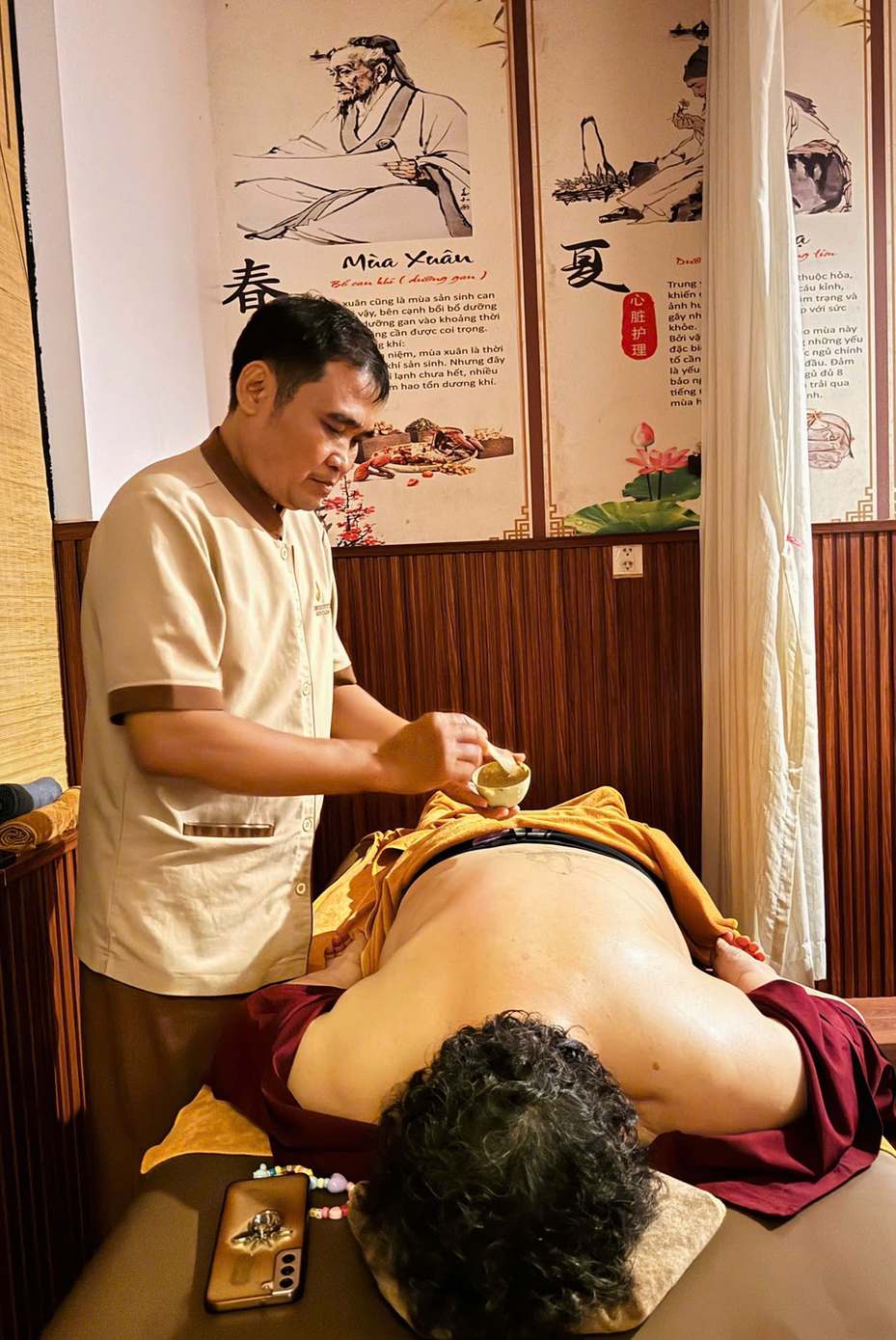
- Knead Thận du, Chí thất and Mệnh môn with the thumb pad in slow circles, 1–2 minutes per point; a mild ache is enough, no pain needed.
- On the legs: knead Thái khê for 1–2 minutes on each side; tell the client to rub Dũng tuyền for 3–5 minutes on each side in the evening.
- Stop by the dosage principle: when the skin at the point turns from dry to moist, the threshold is reached.
Areas that are cold, slack or low in sensation are inhibited areas: do not knead them directly, just keep them warm.
Who should not receive kidney acupressure
- Pregnant women: do not use Tam âm giao, be cautious with Quan nguyên, do not work on the abdomen.
- Clients with cramping flank pain spreading to the lower abdomen, fever with flank pain, or burning urination: do not knead the flank and lower-back area.
- Clients with kidney disease, high blood pressure, diabetes or bleeding disorders: ask carefully, work lightly and follow their doctor's advice.
- Older people and those with osteoporosis: use much lighter pressure; if the skin on the back has a wound, do not work on that area.
Lương Y Tống Văn Huynh teaches learners to count landmarks before pressing
With more than 13 years in the profession and hundreds of learners trained, Lương Y Tống Văn Huynh reminds the class: “Kidney points are not where you guess they are, they are where you count them out; count the right spinous process before placing your finger, and press until it is warm, not until it hurts.” Anyone who places a finger on the wrong landmark starts again from feeling the iliac crests.
Learners also practise the right way to explain it: “Thận du is commonly used to tonify Kidney qi in Eastern medicine”, never promising that any point will rid the kidneys of disease.
When to advise a client to see a doctor
The curriculum (section 5.8) lists: blood in the urine; foamy urine that persists; swelling of the face or legs; very little urine; cramping flank pain; fever with burning urination; frequent night-time urination that persists; high blood pressure that is hard to control. With any of these signs, learners stop kneading the points and advise a check at a medical facility. For what Eastern medicine calls Kidney deficiency, read signs of weak Kidneys in Eastern medicine. Tong Gia offers wellness care, not a medical service.
Which level teaches this?
Thái khê and Dũng tuyền, as safe self-care points, start at L1 Foundation (1.500.000₫). The Kidney care routine that links acupoints with reading the lumbar spine is in chapter 5, the five-organ wellness part, of the Specialist Course (L3). Fees for L2–L4 are given by a consultant when you register. Read more about the teacher: Lương Y Tống Văn Huynh.
How to sign up
The Sunday-morning trial class, 9:00–12:00, with no fee, and the Sunday Y Tướng Học (face reading for wellness) class for beginners are held at căn T16-21 khu Manhattan, Vinhomes Grand Park, TP. Thủ Đức (unit T16-21, Manhattan block, Thu Duc City). Tong Gia does not promise jobs or income after the course. Book a trial class or call the training hotline 0917 945 259.
Frequently asked questions
Which points are kidney acupressure points? In Tong Gia's curriculum: Thận du, Mệnh môn and Chí thất on the lower back; Quan nguyên and Khí hải on the lower abdomen; Thái khê, Phục lưu, Tam âm giao and Dũng tuyền on the leg and foot; Ủy trung behind the knee.
How far is Thận du from Mệnh môn? Both lie level with the space below the L2 spinous process. Mệnh môn is in the middle, Thận du is 1.5 cun out on each side, and Chí thất is 3 cun out.
How long should you knead Thận du? About 1–2 minutes per point; a mild ache is enough. Stop when the skin at the point turns from dry to moist.
Where can I learn acupressure for the lower back? At Tong Gia Acupoint Wellness, căn T16-21 khu Manhattan, Vinhomes Grand Park, TP. Thủ Đức (unit T16-21, Manhattan block, Thu Duc City). Trial class Sunday morning 9:00–12:00 with no fee, hotline 0917 945 259.
Related articles
- The 12 main meridians: names, pathway rules and peak hours, an easy table for vocational learners
- Face reading for health: the 3 facial zones in Y Tướng Học, how to divide them and how to read them to care for the body properly
- What are the 8 extraordinary vessels: roles, main pathways and how wellness learners use them
- Yin-Yang and the Five Elements for wellness learners: enough to make the hands work right
- All articles about learning the trade
Reserve a free Sunday-morning trial class or ask about the learning path: message Zalo 0917 945 259.

Founder of Tong Gia Acupoint Wellness (Huyệt Đạo Tống Gia), with more than 13 years in Eastern wellness practice, Y Tướng Học (face reading for wellness) and spinal nerve-reflex balancing. Lương Y's story
417 customers have reviewed Tong Gia on Google Maps
Reviews are written by customers themselves on Google; tap to read them before you visit.
Huyệt Đạo Tống Gia Quận 12
225 Dương Thị Mười, Phường Tân Chánh Hiệp (District 12, Ho Chi Minh City). 8:00 – 19:00 daily.
See reviews on Google MapsHuyệt Đạo Tống Gia Quận 9
Căn T16-21 khu Manhattan, Vinhomes Grand Park, Phường Long Bình (Thủ Đức City, Ho Chi Minh City). 9:00 – 20:00 daily.
See reviews on Google MapsWant to be observed in person?
A 90-minute session starts with observation, and only then moves on to muscle release and acupressure on the right areas. Two branches: District 12 and Vinhomes Grand Park.