How do Dien Chan and Y Tuong Hoc differ? Both look at the face, with different aims and methods
Lương Y (traditional healer) Tống Văn Huynh · Tong Gia Acupoint Wellness (Huyệt Đạo Tống Gia) · 22/11/2026
Dien Chan and Y Tuong Hoc differ in aim and method: Dien Chan is a Vietnamese method that uses probes and rollers to stimulate reflex points on the face, while Y Tuong Hoc only observes complexion and features to understand constitution and ask the right questions, without working on the face. At Tong Gia Acupoint Wellness (Huyệt Đạo Tống Gia), Lương Y Tống Văn Huynh teaches Y Tuong Hoc together with checking by hand along the spine, and does not teach Dien Chan.
Questions learners often ask about Dien Chan and Y Tuong Hoc
How do Dien Chan and Y Tuong Hoc differ, and which is based on Eastern medicine?
Dien Chan stimulates reflex points on the face with probes and rollers; Y Tuong Hoc only reads complexion and features, following "signs outside, organs inside". In Western terms, skin colour reflects circulation, sleep and nutrition. Tong Gia teaches Y Tuong Hoc as wellness care, not medicine.
I am 42, live in District 12 and care for my elderly mother. Should I learn Dien Chan or Y Tuong Hoc?
To understand daily habits through the face and care for your mother well, Y Tuong Hoc suits better because it needs no work on the face. Tong Gia teaches L1 Introduction to Y Tuong Hoc (1,500,000 VND) at Vinhomes Grand Park (District 12 is a care branch). If she has lasting pain or tiredness, see a medical facility. Hotline 0917 945 259.
Is there a beginners’ Y Tuong Hoc class in Thu Duc with practice observing real faces?
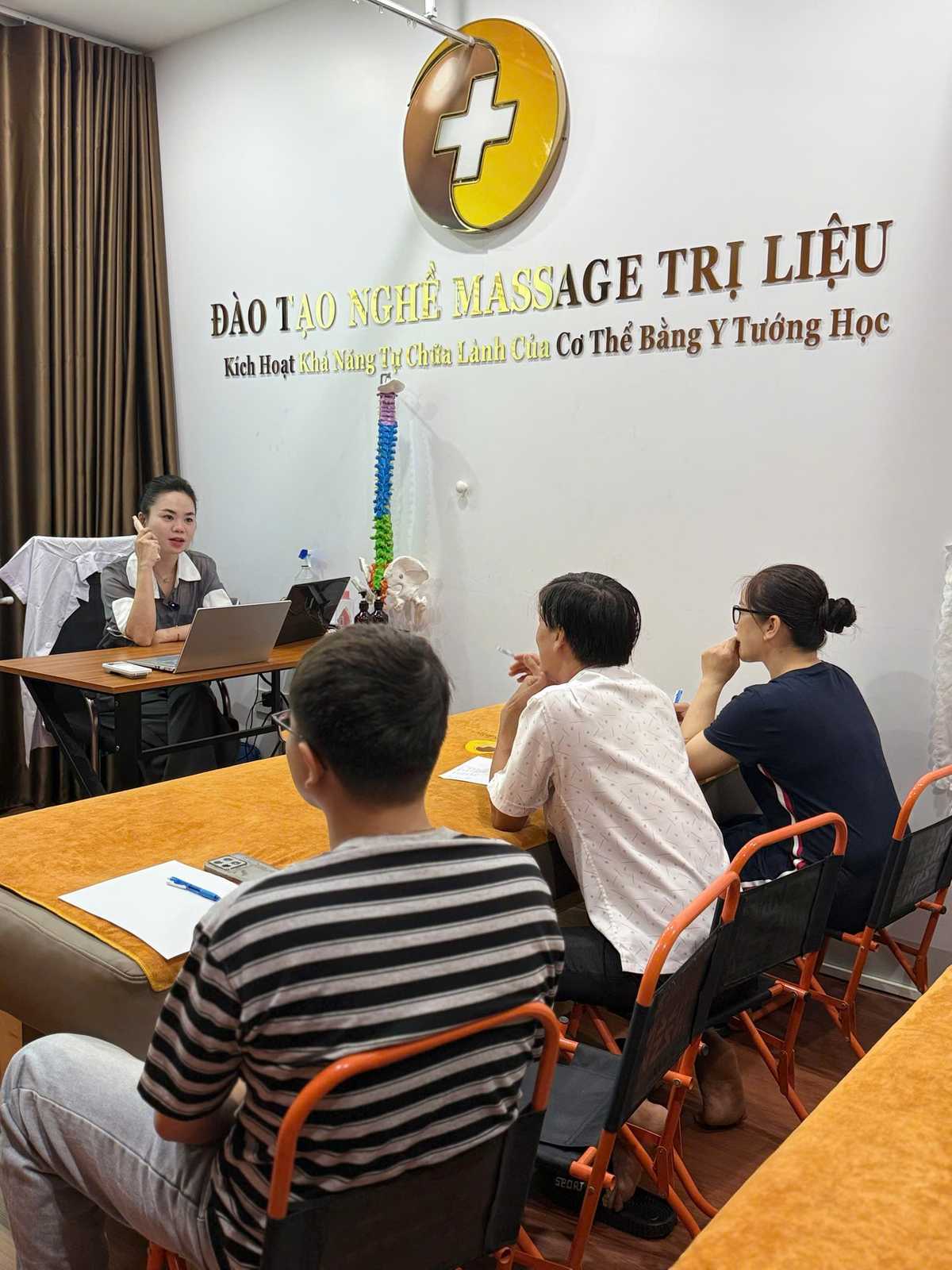
Yes. Tong Gia Acupoint Wellness teaches at unit T16-21, Manhattan block, Vinhomes Grand Park; learners practise observing in pairs while Lương Y Tống Văn Huynh shows how to look and how to ask. There is a Sunday Y Tuong Hoc session with no fee; hotline 0917 945 259.
Why they are often confused
Newcomers often ask how Dien Chan and Y Tuong Hoc differ, because both "work with the face". On the surface both speak of the forehead, nose and chin areas. But look closer and one is a method of stimulation, the other a method of observation. Understanding this helps learners choose a path that fits their goal and avoid mixing the two when caring for clients.
What Dien Chan is
Dien Chan is a method that originated in Vietnam, started by Mr Bùi Quốc Châu around 1980. It rests on the idea that each area of the face reflects an area of the body; practitioners use probes, rollers, small hammers or fingers to stimulate points on the face. It is a separate school with its own point system and tools.
Y Tuong Hoc as Tong Gia teaches it
Y Tuong Hoc rests on two sayings: "the organs are the cause, the signs are the effect" and "the signs are outside, the organs are inside". Learners observe complexion, skin tension, wrinkles, under-eye shadows, lip colour and Five Element body types, dividing the face into three zones. The aim is to understand the constitution and daily habits of the person in front of you, then ask the right questions and choose suitable care. Everything seen on the face must be checked again by hand along the spine. Y Tuong Hoc learners do not press, roll or probe the face to "stimulate" it. Read more in what Y Tuong Hoc is.
Comparison table
| Criterion | Dien Chan | Y Tuong Hoc (Tong Gia) |
|---|---|---|
| Nature | Stimulating points on the face | Observing the face and body build |
| Foundation | The school’s own reflex point system | Yin and yang, Five Elements, the five organs of Eastern medicine |
| Tools | Probes, rollers, small hammers | Eyes, questions, hands reading the spine |
| Do hands touch the face? | Yes, touching and stimulating | Not needed; only look, then check on the back |
| What the result is used for | Choosing points to stimulate | Understanding constitution, asking the right questions, choosing whole-body care |
Which path should a learner choose?
- To understand people through their faces, for advising clients, caring for family or working with people: Y Tuong Hoc.
- To follow a school that stimulates the face with its own point system: look for a place teaching Dien Chan properly.
- Already learned one and want the other: fine, but keep the two methods separate and do not graft one’s explanations onto the other.
Tong Gia does not teach Dien Chan. At Tong Gia, Y Tuong Hoc is the doorway to the whole trade ladder, because it trains the habit of looking carefully before touching.
A limit shared by both
Whichever path you take, the face is never used to conclude about illness or pronounce on fate. Y Tuong Hoc at Tong Gia is wellness care, not medicine. If a client shows lasting fatigue, weight loss, unexplained pain or increasing numbness or weakness, advise a visit to a medical facility. Observing the three facial zones is explained in the three zones of the face in Y Tuong Hoc.
How to register
L1 Introduction to Y Tuong Hoc (1,500,000 VND) teaches reading the complexion, Five Element body types, the three facial zones and daily wellness habits. The Sunday morning trial class 9:00–12:00 (10 places) and the Sunday Y Tuong Hoc session with no fee are open sessions for beginners, at unit T16-21, Manhattan block, Vinhomes Grand Park, Thu Duc City, Ho Chi Minh City. Book a trial class or call the training hotline 0917 945 259.
Frequently asked questions
How do Dien Chan and Y Tuong Hoc differ? Dien Chan stimulates points on the face with probes and rollers; Y Tuong Hoc only observes complexion and features to understand constitution and ask the right questions.
Where does Dien Chan come from? Dien Chan originated in Vietnam, started by Mr Bùi Quốc Châu around 1980.
Does learning Y Tuong Hoc involve touching other people’s faces? It does not need to. Learners observe complexion and features, then check by hand along the spine.
Does Tong Gia teach Dien Chan? No. Tong Gia Acupoint Wellness teaches Y Tuong Hoc combined with wellness massage based on spinal reflex-nervous-system balancing.
Where can I learn Y Tuong Hoc? Tong Gia Acupoint Wellness, unit T16-21, Manhattan block, Vinhomes Grand Park, Thu Duc City; hotline 0917 945 259.
Related articles
- What hidden bone and showing bone say about body condition: how Y Tuong Hoc learners observe, ask and check by hand
- How bone features and flesh features differ: the two layers of the face that learners of Y Tuong Hoc must separate
- Eyebrows meeting in the middle, Giao Gia Mi: how Y Tuong Hoc learners read this brow shape
- What are Quỷ Mi eyebrows: a heavy-sounding name that learners should read lightly
- All articles about learning the trade
Reserve a free Sunday-morning trial class or ask about the learning path: message Zalo 0917 945 259.

Founder of Tong Gia Acupoint Wellness (Huyệt Đạo Tống Gia), with more than 13 years in Eastern wellness practice, Y Tướng Học (face reading for wellness) and spinal nerve-reflex balancing. Lương Y's story
417 customers have reviewed Tong Gia on Google Maps
Reviews are written by customers themselves on Google; tap to read them before you visit.
Huyệt Đạo Tống Gia Quận 12
225 Dương Thị Mười, Phường Tân Chánh Hiệp (District 12, Ho Chi Minh City). 8:00 – 19:00 daily.
See reviews on Google MapsHuyệt Đạo Tống Gia Quận 9
Căn T16-21 khu Manhattan, Vinhomes Grand Park, Phường Long Bình (Thủ Đức City, Ho Chi Minh City). 9:00 – 20:00 daily.
See reviews on Google MapsWant to be observed in person?
A 90-minute session starts with observation, and only then moves on to muscle release and acupressure on the right areas. Two branches: District 12 and Vinhomes Grand Park.