Habits that tire the Spleen and Stomach: how wellness learners read the lips, place hands on the back and advise clients
Lương Y (traditional healer) Tống Văn Huynh · Tong Gia Acupoint Wellness (Huyệt Đạo Tống Gia) · 13/11/2026
Habits that tire the Spleen and Stomach include late-night eating, skipping meals, eating fast with little chewing, raw or cold food, alcohol, worry and lying down after meals. At Tong Gia in Ho Chi Minh City, learners read lips and complexion, feel the Tỳ Du (BL20, 脾俞) area and advise habit changes; unusual signs mean a medical check.
Questions learners often ask about habits that tire the Spleen and Stomach
I'm over 30 and work as a spa practitioner in Thu Duc (old District 9). Where can I learn Spleen-Stomach habits hands-on to advise clients?
Learn it in Tong Gia's Five-Organ Wellness module, at T16-21 khu Manhattan, Vinhomes Grand Park, TP. Thủ Đức (Thu Duc City). Lương Y Tống Văn Huynh links Western digestion with the Eastern Spleen and Stomach, teaching lip reading and checking the Tỳ Du area by hand. It is wellness care, not medicine. Zalo 0917 945 259.
A Vietnamese coworker says pale lips and a yellowish face mean a weak Spleen. Is that real Eastern medicine, or superstitious face reading?
Only as a hint. Eastern medicine says the Spleen opens into the mouth and shows on the lips, so pale lips and a dull yellowish face are a reason to ask about meals, sleep and worry. Tong Gia always checks by hand at D11–D12 and never names a disease. Yellow skin or black stools: get a medical check.
New to Eastern medicine and living in Ho Chi Minh City: what does a Spleen-Stomach wellness course cost, and how do I choose a school?
No prior Eastern medicine is needed. Tong Gia runs L1 Foundation at 1.500.000đ; the Spleen-Stomach part sits in the Specialist Course (L3), with the fee given by a consultant when you register. Choose a place with practice on real people that clearly teaches when to stop. Trial class Sunday morning at Vinhomes Grand Park, Zalo 0917 945 259.
The hands stop level with the 11th thoracic vertebra
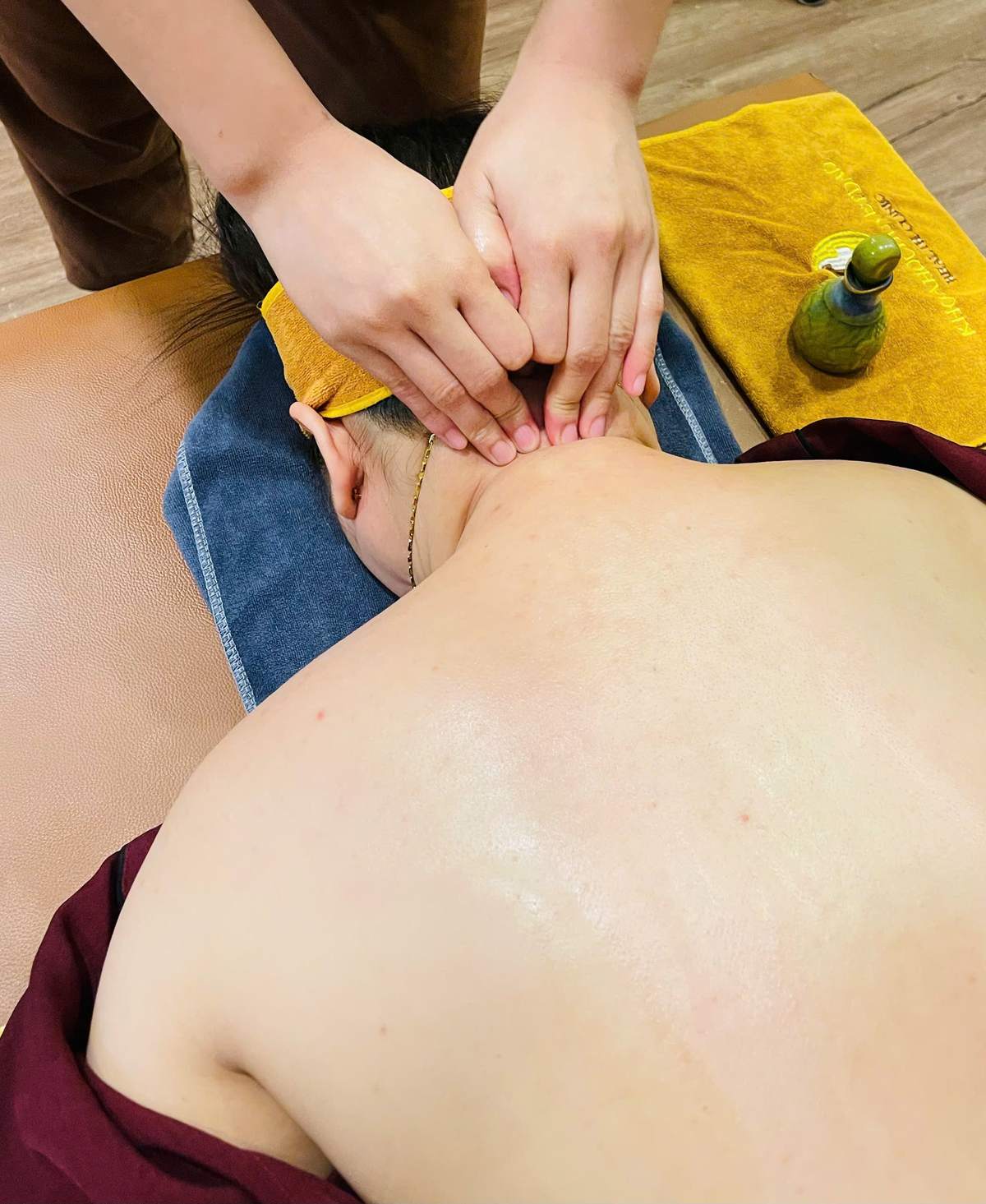
In class at Vinhomes Grand Park, a learner counts the vertebrae up from the iliac crest and stops level with the 11th–12th thoracic vertebrae of a partner. Both hands report a thick, tight band of muscle. Lương Y Tống Văn Huynh moves the two thumbs onto the correct line, 1.5 cun from the spine, then asks the person lying down: what time did you eat this morning, how many minutes did lunch take, did you lie down straight after dinner last night? The hands found the tight spot; those three questions open the lesson on habits that tire the Spleen and Stomach.
Spleen and Stomach in Eastern medicine, digestion in Western medicine
In Western medicine, the stomach holds about 1–1.5 litres when full, keeps food for 2–4 hours and contracts to grind it and mix it with gastric juice; the pancreas secretes digestive enzymes, and the small intestine absorbs most of the nutrients.
Eastern medicine calls the Spleen and Stomach the root of postnatal life. The Stomach receives food and "ripens" it. The Spleen transforms food into qi and blood, nourishes the muscles and limbs, opens into the mouth and shows on the lips; the Spleen likes dryness and dislikes damp. The Spleen (Tỳ) is not the anatomical spleen: do not say "your spleen is weak", say "in Eastern medicine, your Spleen function, meaning your ability to digest and absorb, is running low".
Eight habits that tire the Spleen and Stomach every learner should know
- Late-night eating: the stomach works when the body needs rest, making reflux and poor sleep more likely.
- Skipping meals, eating irregularly: gastric juice is secreted into an empty stomach, so pain and a gnawing feeling come easily.
- Eating fast, chewing little: leads easily to bloating and to eating too much.
- Raw, cold food and iced water: Eastern medicine holds that cold damages Spleen yang.
- Alcohol and nicotine smoke: irritate the stomach lining, making inflammation, ulcers and reflux more likely.
- Worry and stress: "overthinking injures the Spleen"; pent-up frustration lets the Liver overact on the Spleen.
- Taking painkillers and anti-inflammatories on your own for long periods: NSAIDs can cause stomach inflammation and ulcers.
- Eating too much, then sitting still or lying down right away: creates damp, heaviness and slow digestion. People who sit for long hours and bend forward a lot also often have tight back muscles level with T11–T12.
The signs show outside: lips, mouth and a yellowish complexion
- Lips: pale, dry and lacking freshness when the Spleen is weak.
- Mouth: clients often complain of a bland or sticky mouth and no taste for food.
- Complexion: a pale-yellow, dull face is common in the Spleen qi deficiency pattern of Eastern medicine.
- Eyelids, tongue, build: puffy eyelids, a swollen tongue with teeth marks, more flesh than bone suggest Spleen deficiency producing damp.
Tell them apart: a dull pale-yellow complexion is a wellness hint; clearly yellow skin or yellow whites of the eyes is a sign to get checked at a medical facility. Everything you observe is only for asking the client, never for naming a disease.
Checking the back by hand
Tỳ Du (BL20, 脾俞) lies below the spinous process of the 11th thoracic vertebra and Vị Du (BL21, 胃俞) below the 12th, both 1.5 cun out to the side (see the Tỳ Du point). According to the Y Tướng Học (face reading for wellness) curriculum, people with a square, 田-shaped face should have D11–D12 surveyed first, as this area easily stiffens into a large band. Learners read skin temperature, the cushioning muscle layer, the shape of the spine and sensation, and compare both sides, following spinal nerve-reflex balancing wellness massage.
Stomach trouble and bloating: the learner's view
Clients often say "I have stomach problems". Learners need to remember: pain in the upper abdomen can come from the stomach, gallbladder, pancreas or even the heart, so a practitioner never names the illness for the client.
Do: work about 1–2 hours after a meal; knead Tỳ Du and Vị Du; rub gently around the navel clockwise for 30–50 circles; knead Trung Quản (CV12, 中脘) and Túc Tam Lý (ST36, 足三里); if the client feels nauseous, knead Nội Quan (PC6, 内关).
Don't: do not work right after a full meal; do not rub or press the abdomen, and do not use Tam Âm Giao (SP6, 三阴交), for pregnant women; take care with recent surgical scars or acute abdominal pain. Never say "belly massage makes stomach pain go away".
What the practitioner reminds the client after a session
From the curriculum: eat on time and do not skip breakfast; chew well and give each meal 20–30 minutes; eat until moderately full; keep dinner light and 2–3 hours before bed; favour warm, cooked food; walk slowly for 10–15 minutes after eating; worry less. Clients can knead the Túc Tam Lý point themselves at home.
Lương Y Tống Văn Huynh teaches learners to wait before caring for the Spleen and Stomach
With more than 13 years in the trade and hundreds of learners trained, Lương Y Tống Văn Huynh teaches learners to choose the right moment before placing their hands on the Tỳ Du area: "Hands that care for the Spleen and Stomach must know how to wait: while the client's belly is still full, do not place your hands; while the client's mind is still unsettled, do not rush to press."
When to advise a client to get checked
Do not work, and advise the client to get checked at a medical facility, if there is: vomiting blood or coffee-ground material; black or bloody stools; unexplained weight loss; difficulty swallowing; severe, sudden abdominal pain; yellow skin or yellow eyes; persistent vomiting; new digestive symptoms after age 50. Upper abdominal pain with cold sweats or shortness of breath: call 115 (Vietnam's emergency number). Tong Gia offers wellness and health care, not a medical service.
Which level covers this?
The Spleen-Stomach chapter is part of Five-Organ Wellness in the Specialist Course (L3). Beginners start with L1 Foundation (1.500.000đ). Read more about the teacher: Lương Y Tống Văn Huynh.
How to sign up
The trial class on Sunday morning, 9:00–12:00, with no fee, and the Sunday Y Tướng Học class are the open sessions for beginners, at căn T16-21 khu Manhattan, Vinhomes Grand Park, TP. Thủ Đức (unit T16-21, Manhattan block, Thu Duc City). Tong Gia does not promise jobs or income after the course. Book a trial class or call the training hotline 0917 945 259.
Frequently asked questions
Which habits tire the Spleen and Stomach? Late-night eating, skipping meals, eating fast and chewing little, raw or cold food, alcohol, worry and stress, taking painkillers and anti-inflammatories on your own for long periods, and lying down right after eating too much.
Is the Spleen in Eastern medicine the same as the spleen organ? No. The Spleen (Tỳ) is a functional system for digestion, absorption and producing qi and blood; the spleen organ filters blood and supports immunity. Do not tell clients their spleen is weak.
When should you rub a client's belly? About 1–2 hours after a meal, gently around the navel, clockwise. Do not rub or press the abdomen of pregnant women.
Which digestive signs mean advising the client to get checked? Vomiting blood, black or bloody stools, unexplained weight loss, difficulty swallowing, severe abdominal pain, yellow skin and eyes, persistent vomiting.
Related articles
- The 12 main meridians: names, pathway rules and peak hours, an easy table for vocational learners
- Face reading for health: the 3 facial zones in Y Tướng Học, how to divide them and how to read them to care for the body properly
- What are the 8 extraordinary vessels: roles, main pathways and how wellness learners use them
- Yin-Yang and the Five Elements for wellness learners: enough to make the hands work right
- All articles about learning the trade
Reserve a free Sunday-morning trial class or ask about the learning path: message Zalo 0917 945 259.

Founder of Tong Gia Acupoint Wellness (Huyệt Đạo Tống Gia), with more than 13 years in Eastern wellness practice, Y Tướng Học (face reading for wellness) and spinal nerve-reflex balancing. Lương Y's story
417 customers have reviewed Tong Gia on Google Maps
Reviews are written by customers themselves on Google; tap to read them before you visit.
Huyệt Đạo Tống Gia Quận 12
225 Dương Thị Mười, Phường Tân Chánh Hiệp (District 12, Ho Chi Minh City). 8:00 – 19:00 daily.
See reviews on Google MapsHuyệt Đạo Tống Gia Quận 9
Căn T16-21 khu Manhattan, Vinhomes Grand Park, Phường Long Bình (Thủ Đức City, Ho Chi Minh City). 9:00 – 20:00 daily.
See reviews on Google MapsWant to be observed in person?
A 90-minute session starts with observation, and only then moves on to muscle release and acupressure on the right areas. Two branches: District 12 and Vinhomes Grand Park.