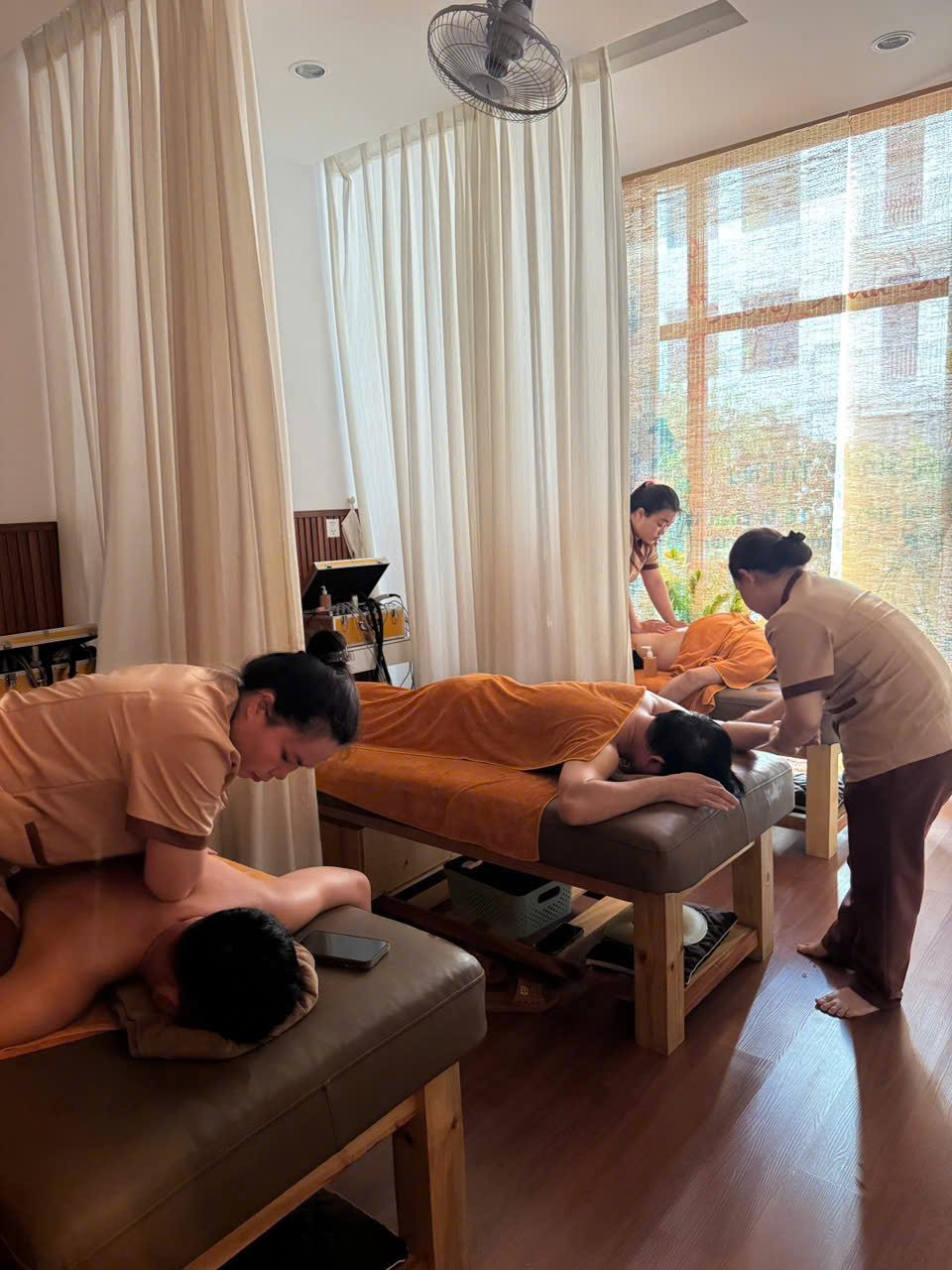
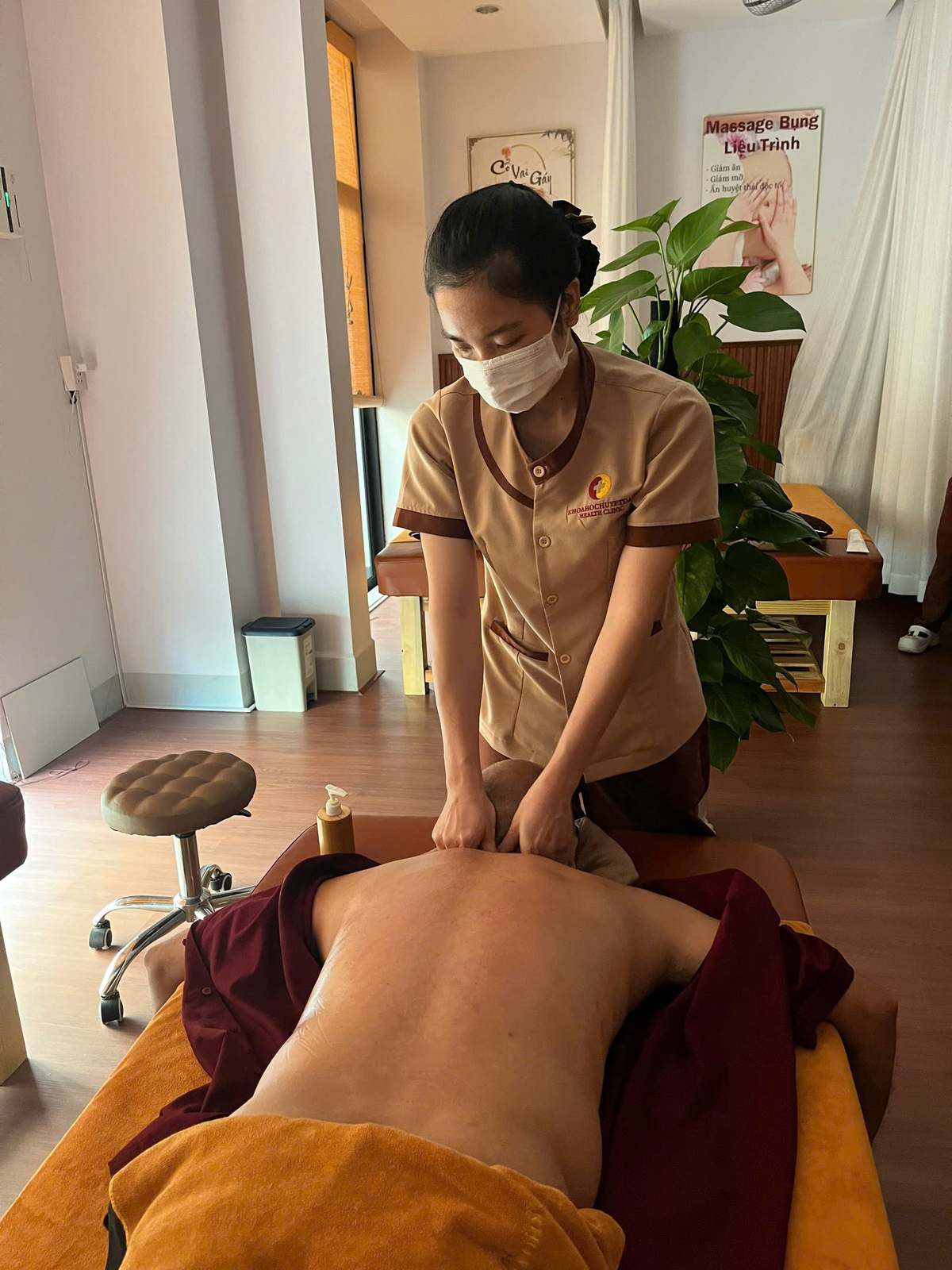
What is a sensation wave in massage? How to keep the rhythm so muscles release on their own
Lương Y (traditional healer) Tống Văn Huynh · Tong Gia Acupoint Wellness (Huyệt Đạo Tống Gia) · 08/11/2026
What is a sensation wave in massage? It is a technique of the practitioner’s hands, not the wave mode of a massage chair: soft pressure moves up and down in an even rhythm so the client feels a mild, pleasant ache and the muscles gradually let go on their own. Tong Gia teaches this technique in the Specialist Course.
Why does the same pressure relax one client and make another tense up?
Two massage practitioners press the same spot with the same strength. The first one's client starts breathing more slowly and their shoulders drop. The second one's client holds their breath and grips the towel. The difference usually isn't the pressure but the rhythm: one delivers pressure like a wave, the other presses down once and holds it rigidly.
Among the 8 principles of the spinal nerve-reflex balancing method, this is principle number 4: creating a sensation wave.
What is a sensation wave in massage?
It means using yielding pressure (soft and elastic), delivered in an even up-and-down rhythm, to create a “pleasant ache” for the client. With each beat, the muscle is stimulated to contract a little and then slacken. Repeated evenly, the muscle gets used to it and releases on its own, following the body’s own rhythm. The phrase to remember: a pleasant ache, and the body adjusts itself.
Think of waves lapping the shore: no single wave hits much harder than the others, yet the steady rhythm gradually reshapes the sand. A practitioner’s hands work the same way.
Three elements of a good wave
- Even rhythm: the pressing-in and easing-off phases are about the same length. A hurried rhythm startles the client; a rhythm that keeps speeding up and slowing down makes it hard for them to relax.
- Moderate amplitude: the peak pressure of each beat only reaches the point where the client feels a mild ache. Beyond that threshold, the muscle reacts by tensing against you.
- Watching the response: the client’s breathing, face and hands. Slower breathing and lowered shoulders mean the wave is right; held breath and curled fingers mean you need to ease off.
Where does the sensation wave fit in a care session?
Waves are not applied everywhere. Learners are taught to work in order: read the spine by hand, find the excited areas, then do zone and point localisation. Once the key point is found, the sensation wave is delivered right there, combined with setting the pressure (choosing a suitable level) and setting the direction (using the spinal axis as the reference).
Besides a wave at a single point, the curriculum also includes the wave method: creating waves zone by zone from the neck down to the sacrum and coccyx, keeping an even, controlled rhythm, so the whole back is covered in one smooth pass.
Try it now: practise the wave rhythm on the upper arm
- Place your thumb on your own upper arm or your practice partner’s.
- Count silently “one – two” as you press in and “three – four” as you ease off. Don’t lift your hand fully off the skin.
- Do 10 beats. Ask the person receiving: which beat felt most pleasant, and which felt harsh?
- Repeat at double speed, then compare how it feels.
Most learners notice that a slow, even rhythm softens the muscle faster even though the pressure stays the same. That is the first lesson about waves.
Note: when not to create strong waves
- Inhibited areas (soft, cool, barely responsive): work only lightly or not at all.
- The client has spreading numbness, sharp stabbing pain, dizziness or difficulty breathing: stop immediately.
- When the skin at the key point turns from dry to moist: the dosage threshold has been reached, so stop.
Therapeutic-style massage at Tong Gia is wellness care and does not replace a medical check-up. If a client has long-lasting pain, increasing numbness or weakness, or an underlying health condition, the practitioner must advise them to see a doctor at a medical facility.
Where can you learn this?
Sensation waves, the 5 pressure levels and the wave method are taught in part 2 of the Specialist course: therapeutic-style massage with spinal nerve-reflex balancing. Lương Y Tống Văn Huynh teaches the class himself, placing his hands over the learner’s hands to correct the rhythm. Newcomers can first read the article hand sensitivity in therapeutic-style massage.
How to sign up
The Sunday-morning trial class, 9:00–12:00 every week, and the free Sunday Y Tướng Học (face reading for wellness) session are the open schedule for newcomers, at căn T16-21 khu Manhattan, Vinhomes Grand Park, TP. Thủ Đức (Thu Duc, Ho Chi Minh City). Register for a trial class or call the training hotline 0917 945 259.
Frequently asked questions
What is a sensation wave in massage? It is a hands-on technique of the practitioner, different from the wave mode of a massage chair: soft pressure in an even up-and-down rhythm creates a pleasant aching sensation, so the muscle alternately tightens and slackens and then relaxes by itself.
Is a stronger massage always better? No. Pressure beyond the comfortable threshold makes the muscle tense against it. An even rhythm with moderate pressure usually softens the muscle faster.
How do I know the sensation wave is right? The client breathes more slowly and their shoulders and hands relax. If the client holds their breath, curls their fingers or flinches, reduce the pressure or slow the rhythm.
How is the wave method different from a wave at a single point? A single-point wave is done at the key point. The wave method moves zone by zone from the neck down to the sacrum and coccyx with an even rhythm.
Where can I learn the sensation wave technique? Tong Gia at Vinhomes Grand Park, Thu Duc, Ho Chi Minh City teaches it in the Specialist course. Trial class on Sunday mornings 9:00–12:00; call 0917 945 259.
Related articles
- The 3 “no’s” of the Tong Gia spinal balancing method: no needles, no medicine, no rough force
- How the 33 vertebrae are grouped into regions: the spine map every massage learner must know
- 4 objective factors when reading the spine by hand: let your hands record, not guess
- 5 vertebral patterns (raised, sunken, shifted): reading the spine by hand in the Specialist course
- All articles about learning the trade
Reserve a free Sunday-morning trial class or ask about the learning path: message Zalo 0917 945 259.

Founder of Tong Gia Acupoint Wellness (Huyệt Đạo Tống Gia), with more than 13 years in Eastern wellness practice, Y Tướng Học (face reading for wellness) and spinal nerve-reflex balancing. Lương Y's story
417 customers have reviewed Tong Gia on Google Maps
Reviews are written by customers themselves on Google; tap to read them before you visit.
Huyệt Đạo Tống Gia Quận 12
225 Dương Thị Mười, Phường Tân Chánh Hiệp (District 12, Ho Chi Minh City). 8:00 – 19:00 daily.
See reviews on Google MapsHuyệt Đạo Tống Gia Quận 9
Căn T16-21 khu Manhattan, Vinhomes Grand Park, Phường Long Bình (Thủ Đức City, Ho Chi Minh City). 9:00 – 20:00 daily.
See reviews on Google MapsWant to be observed in person?
A 90-minute session starts with observation, and only then moves on to muscle release and acupressure on the right areas. Two branches: District 12 and Vinhomes Grand Park.