Where is the Qu Yuan point and how to press it: the point at the inner end of the fossa above the scapular spine in neck and shoulder care
Lương Y (traditional healer) Tống Văn Huynh · Tong Gia Acupoint Wellness (Huyệt Đạo Tống Gia) · 29/11/2026
Where the Qu Yuan point is and how to press it: the point (Khúc Viên, SI13, Hand Tai Yang Small Intestine meridian) lies at the inner end of the fossa above the scapular spine, about midway between the Nao Shu point and the spinous process of the 2nd thoracic vertebra. Learners at Tong Gia Acupoint Wellness (Huyệt Đạo Tống Gia) feel for the scapular spine first, then press and knead with the thumb 30–60 seconds each side, stopping if the client has arm numbness or pain after an injury.
Questions learners often ask about the Qu Yuan point
Where is the Qu Yuan point, how is it pressed, how do I find it by hand and for how long do I press?
Qu Yuan (SI13) lies at the inner end of the fossa above the scapular spine, about midway between the Nao Shu point and the spinous process of T2. Trace the ridge of the scapular spine inward to the inner edge of the shoulder blade, then move up into the hollow. Knead with the thumb 30–60 seconds each side, raising pressure step by step. Tong Gia teaches this as wellness care.
I am 41, work in a warehouse in Thu Duc City and my shoulder blades ache after loading. Can Qu Yuan be pressed at home?
For ordinary muscle fatigue a family member can press lightly after warming the shoulder with strokes. Under the point lie the trapezius and supraspinatus, which tighten in people who lift and carry. With shoulder pain after a fall or blow, or growing arm numbness or weakness, do not press; get a medical check. Lương Y Tống Văn Huynh teaches this at Vinhomes Grand Park; Zalo 0917 945 259.
Which level at Tong Gia teaches shoulder-blade points such as Qu Yuan and Tian Zong, and is there practice on real people?
At Tong Gia Acupoint Wellness, neck, shoulder and shoulder-blade points are taught in L2 Basic Trade, with about 70% of time practising in pairs on real people. Beginners start with L1 Introduction to Y Tuong Hoc at 1,500,000 VND. Classes at unit T16-21, Manhattan block, Vinhomes Grand Park, Thu Duc City; trial class Sunday morning 9:00–12:00.
Where the Qu Yuan point is
The Qu Yuan point is point 13 of the Hand Tai Yang Small Intestine meridian (international code SI13). "Qu" means curved and "yuan" means a wall: the name describes the curved hollow beside the scapular spine, where the ridge of the shoulder blade rises like a low wall. The point lies at the inner end of the fossa above the scapular spine, about midway along the line joining the Nao Shu point (SI10) and the spinous process of the 2nd thoracic vertebra (T2).
In the same shoulder-blade area are the Tian Zong point in the fossa below the spine of the scapula and the Jian Wai Shu point, closer to the spinal column. All three belong to the Small Intestine meridian and are often worked together in the neck and shoulder routine.
Anatomical landmarks learners must be able to feel
| Landmark | How to recognise it | Role in finding the point |
|---|---|---|
| Scapular spine | The bony ridge running across the back of the shoulder blade, from its inner edge out to the acromion | The lower border of the supraspinous fossa; the point sits just above the inner end of this ridge |
| Supraspinous fossa | The hollow above the scapular spine | Where the supraspinatus muscle lies |
| Trapezius | The surface muscle layer covering from the nape out to the shoulder | The first layer under the finger |
| Supraspinatus | Deep in the supraspinous fossa, under the trapezius | A muscle that tightens in people who raise their arms a lot or carry loads |
| T2 spinous process | Count two vertebrae down from the 7th cervical | The spinal-side landmark for estimating the midpoint |
How to locate the Qu Yuan point
- Have the client sit upright with both hands relaxed on the thighs, or lie face down.
- Feel the scapular spine and trace the ridge inward until it becomes lower, close to the inner edge of the shoulder blade.
- Move the finger slightly up over the ridge: it drops into a small hollow, the inner end of the supraspinous fossa.
- Check with two landmarks: Nao Shu in the hollow below the scapular spine, directly above the end of the rear armpit crease, and the T2 spinous process; the point is about midway between them.
- Press lightly; the client feels a local ache, sometimes spreading slightly to the shoulder: that is the point.
How to press and knead it in a neck and shoulder session
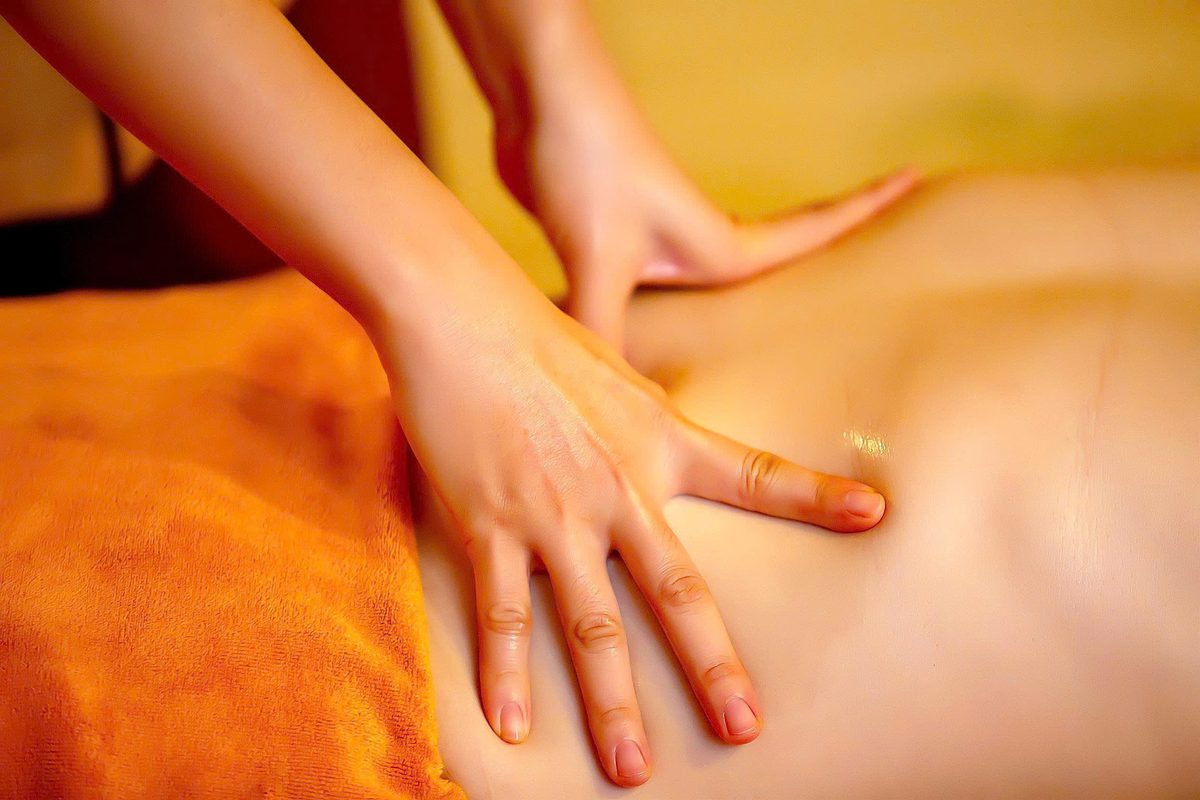
Qu Yuan is not worked alone. After warming the trapezius with gliding strokes, learners use the thumb pad to press and hold 5–7 seconds, release, repeat, alternating with slow circles, about 30–60 seconds each side. The pressure is angled down and into the bony hollow, without sliding onto the ridge of the scapular spine and without leaning on the spinal column. Pressure rises step by step and the client is always asked how it feels; for older or thin people use light pressure. The full sequence is in learning neck and shoulder acupressure.
Cross-checking with the upper thoracic vertebrae
In the massage method of balancing the spinal nerve reflex system taught by Lương Y Tống Văn Huynh, the shoulder-blade area is cross-checked against the upper thoracic segment. Before working the Qu Yuan area, learners feel both sides of the spinal column level with T1 to T3 to see whether the muscle is uneven, stiff or more sensitive on one side. Tightness in the supraspinous fossa is often related to raised shoulders, a head carried forward and the habit of carrying loads on one side; this is a relationship for learners to observe, not a conclusion about illness.
Y Tuong Hoc (Vietnamese medical face reading) reminds learners to look before touching: uneven shoulders, a sunken neck and a tired facial colour are things to note. Under the principle "the organs are the cause, the signs are the result", what the eye sees must be checked again by hand on the spinal column.
When not to work and to advise a medical check
- Shoulder pain after a fall, blow or accident.
- Growing numbness or weakness in the arm, weaker grip.
- A swollen, hot or red shoulder, or one with fever.
- Shoulder pain together with chest pain or difficulty breathing.
- Being unable to raise the arm after a forceful movement.
In these cases learners do not press or knead but advise the client to go to a medical facility. Tong Gia Acupoint Wellness (Huyệt Đạo Tống Gia) is a wellness care service, not a medical service.
Which level teaches the Qu Yuan point
Neck, shoulder and shoulder-blade points are taught in L2 Basic Trade; beginners start with L1 Introduction to Y Tuong Hoc (1,500,000 VND). About 70% of the time is practice in pairs: learners find the scapular spine and Qu Yuan on a partner until confident, then add them to the neck and shoulder routine. Fees and length for L2, L3 Expert and L4 are given by the advisor at registration. People who study to care for family or to help others follow the same order.
How to register
The Sunday morning trial class 9:00–12:00 (10 places) and the Sunday Y Tuong Hoc session with no fee are open sessions for beginners, at unit T16-21, Manhattan block, Vinhomes Grand Park, Thu Duc City, Ho Chi Minh City. Book a trial class or call the training hotline 0917 945 259.
Frequently asked questions
Where is the Qu Yuan point? At the inner end of the fossa above the scapular spine, about midway between the Nao Shu point (SI10) and the spinous process of the 2nd thoracic vertebra.
Which meridian does Qu Yuan belong to? The Hand Tai Yang Small Intestine meridian; it is point 13 (SI13).
How is the Qu Yuan point pressed? After warming the trapezius, press and hold with the thumb pad 5–7 seconds, release, repeat, alternating with slow circles, 30–60 seconds each side.
Which muscles lie under Qu Yuan? The surface layer is the trapezius; the deep layer in the supraspinous fossa is the supraspinatus.
When should Qu Yuan not be kneaded? With shoulder pain after a fall or blow, growing arm numbness or weakness, a hot red swollen shoulder, or shoulder pain with chest pain or difficulty breathing; then get a medical check.
Related articles
- Where is the Gao Huang point and how to press it: the point between the shoulder blades in upper-back relaxation
- Where is the Qiuhou point (Cầu Hậu) and how to press it: finding it on the lower eye-socket rim and pressing gently
- Where is the Juliao point (Cự Liêu) and how to press it: below the cheekbone, level with the nostril, with the right pressure
- Where is the Da Ying point and how to press it: the jaw point where learners must avoid pressing the pulse
- All articles about learning the trade
Reserve a free Sunday-morning trial class or ask about the learning path: message Zalo 0917 945 259.

Founder of Tong Gia Acupoint Wellness (Huyệt Đạo Tống Gia), with more than 13 years in Eastern wellness practice, Y Tướng Học (face reading for wellness) and spinal nerve-reflex balancing. Lương Y's story
417 customers have reviewed Tong Gia on Google Maps
Reviews are written by customers themselves on Google; tap to read them before you visit.
Huyệt Đạo Tống Gia Quận 12
225 Dương Thị Mười, Phường Tân Chánh Hiệp (District 12, Ho Chi Minh City). 8:00 – 19:00 daily.
See reviews on Google MapsHuyệt Đạo Tống Gia Quận 9
Căn T16-21 khu Manhattan, Vinhomes Grand Park, Phường Long Bình (Thủ Đức City, Ho Chi Minh City). 9:00 – 20:00 daily.
See reviews on Google MapsWant to be observed in person?
A 90-minute session starts with observation, and only then moves on to muscle release and acupressure on the right areas. Two branches: District 12 and Vinhomes Grand Park.