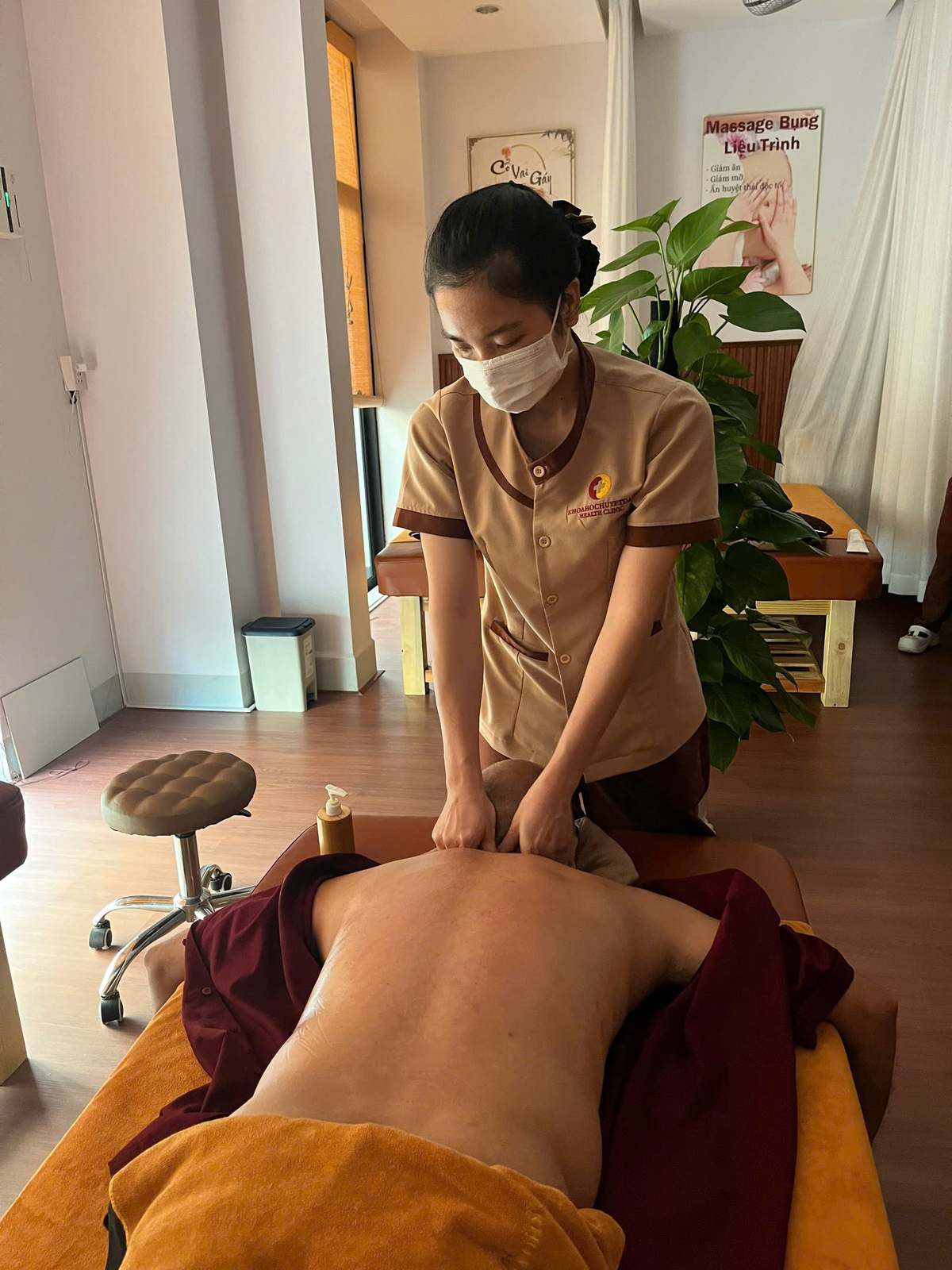
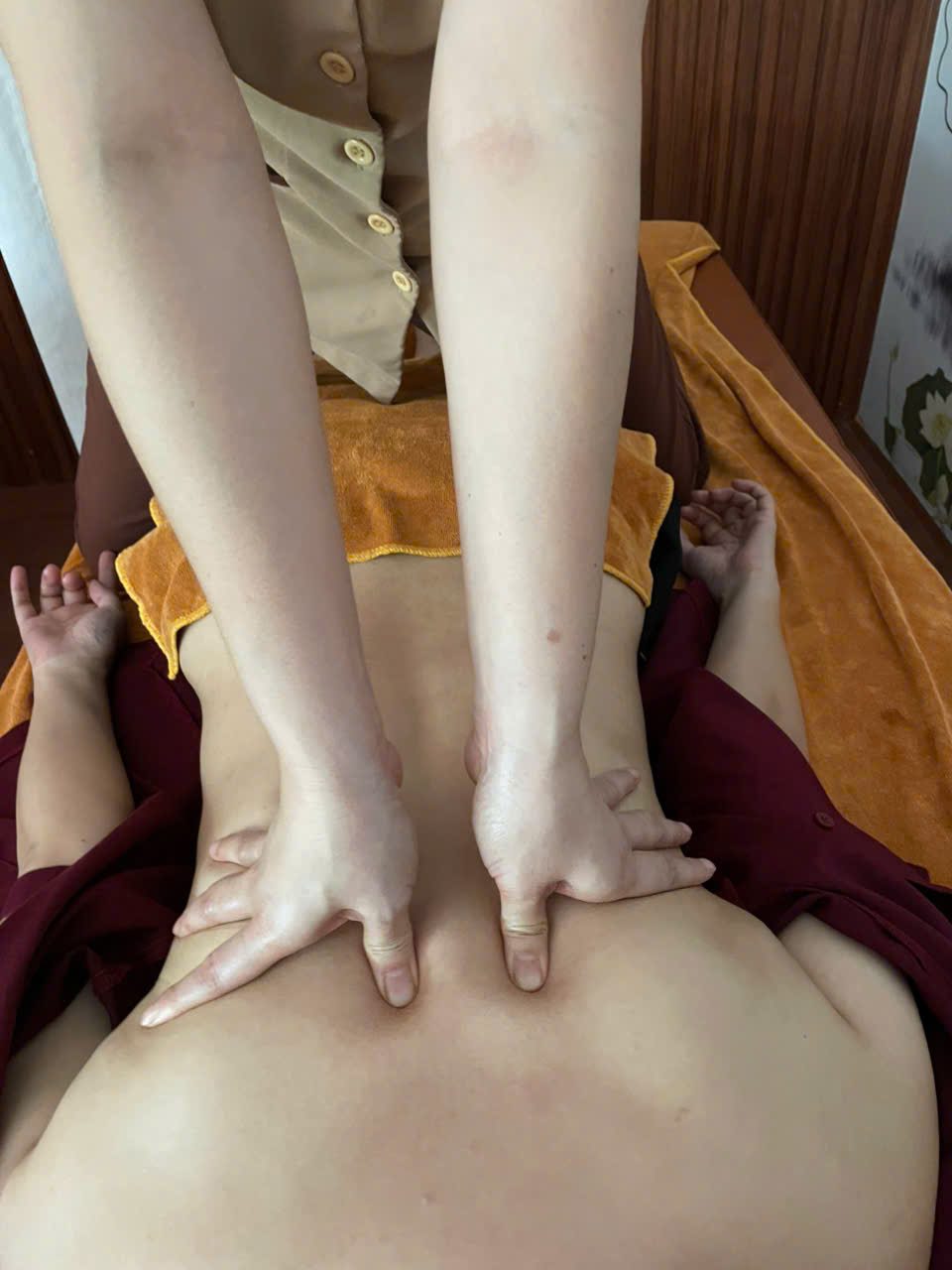
Where is the Bingfeng point and how to press it: a point in the middle of the supraspinous fossa, pressed with moderate force in relaxing shoulder care
Lương Y (traditional healer) Tống Văn Huynh · Tong Gia Acupoint Wellness (Huyệt Đạo Tống Gia) · 29/11/2026
Where the Bingfeng point is and how to press it: the point (Bỉnh Phong, SI12, Small Intestine meridian) lies in the middle of the fossa above the spine of the shoulder blade, directly above the Tianzong point, and the spot sinks when the arm is raised sideways. Press with the pad of the thumb straight down onto the supraspinatus muscle with moderate force, hold a few seconds and release, for about one minute each side. Learners at Tong Gia Acupoint Wellness (Huyệt Đạo Tống Gia) practise finding the point on a partner before pressing.
Questions learners often ask about the Bingfeng point
Where exactly is the Bingfeng point (SI12), how do I find it by hand, and how does it differ from Tianzong?
Bingfeng lies in the middle of the fossa above the spine of the shoulder blade, while Tianzong lies in the middle of the fossa below it; the two line up one above the other. Feel the bony ridge running across the back of the shoulder, place the thumb just above it and raise the arm sideways; the spot that sinks is Bingfeng. Tong Gia teaches this as wellness care.
My husband is 45, drives for a living and often has tired shoulders. Can I press the Bingfeng point for him at home?
Yes, if it is only muscle tiredness after long sitting. Press the pad of the thumb straight down with moderate force, hold a few seconds and release, about one minute each side. With lasting shoulder pain, growing numbness or weakness down the arm, or an underlying condition, he should be checked at a medical facility first. Pressing the point is only relaxing care.
Which level in Thu Duc teaches acupressure for the shoulders and neck, and is there practice on real people?
Beginners start at L1 Introduction to Y Tuong Hoc, 1,500,000 VND. The neck and shoulder routine is trained from L2 Basic Trade, with about 70% of time practising in pairs; content and fees for each level are given by the advisor at registration. Classes at unit T16-21, Manhattan block, Vinhomes Grand Park; training hotline 0917 945 259.
Where the Bingfeng point is
The short answer to where the Bingfeng point is and how to press it: it lies on the back of the shoulder, in the middle of the fossa above the spine of the shoulder blade, and is pressed with moderate force onto the muscle underneath. Bingfeng (Bỉnh Phong) is point 12 of the Hand Tai Yang Small Intestine meridian (international code SI12). "Bing" means to grasp or receive and "feng" means wind: the name suggests the shoulder as the place that receives the wind.
The spine of the shoulder blade is the bony ridge running across the back of the shoulder, easy to feel. Above that ridge is a trough called the supraspinous fossa, which holds the supraspinatus muscle. Bingfeng lies in the middle of this trough, directly above the Tianzong point. When the arm is raised to shoulder height, this area sinks under the finger.
Telling Bingfeng apart from other points around the shoulder blade
Several points lie close together around the shoulder blade, and beginners often confuse them. The landmark that separates them is the spine of the shoulder blade.
| Point | Meridian | Position relative to the shoulder blade |
|---|---|---|
| Bingfeng (SI12) | Small Intestine | Middle of the supraspinous fossa, directly above Tianzong |
| Tianzong (SI11) | Small Intestine | Middle of the infraspinous fossa |
| Quyuan (SI13) | Small Intestine | Inner end of the supraspinous fossa |
| Jianjing (GB21) | Gallbladder | On top of the shoulder, above the shoulder blade |
Bingfeng lies directly above the Tianzong point, separated from it by the spine of the shoulder blade. Further in along the same trough is the Quyuan point; down behind the armpit is the Jianzhen point. These points are often worked together in shoulder care.
How learners find the point
- Have your partner sit upright, both hands resting loosely on the thighs.
- Feel the spine of the shoulder blade: the bony ridge running across the back of the shoulder, from the tip of the shoulder in towards the backbone.
- Place the thumb just above that ridge, about halfway along its length.
- Ask your partner to raise the arm to shoulder height: a hollow sinks under the finger, and that is Bingfeng.
- Lower the arm and press lightly as a test; on the point your partner feels a pleasant heavy ache right there.
Anatomical landmarks and how much force
Unlike points on the face, Bingfeng has a thick layer of muscle underneath, so it takes moderate force. Learners need to remember three landmarks:
- The surface layer is the trapezius; the deep layer is the supraspinatus, a muscle that helps lift the arm out to the side.
- The floor of the fossa is the surface of the shoulder blade, so pressure straight down is supported by bone.
- The suprascapular nerve and vessels pass through the notch at the outer side of the fossa; no hard kneading there, and no elbow driving force in that direction.
So the force at Bingfeng is moderate, built up slowly and directed straight down. Do not let the thumb slide onto the bony ridge, and do not lean on the collarbone in front.
How to press it in relaxing shoulder care
| Step | How |
|---|---|
| Position | The person sits upright or lies face down, shoulders loose |
| Finger | Pad of the thumb; the two thumbs can be stacked |
| Direction | Straight down to the floor of the fossa |
| Movement | Press slowly, hold 3–5 seconds, release slowly; or knead in small circles |
| Pressure | Moderate, a pleasant heavy ache; sharp pain or numbness running down the arm means too much |
| Time | About 1 minute each side |
Bingfeng is not worked alone. In relaxing shoulder care, the giver usually warms and gently squeezes the trapezius first, presses along the supraspinous fossa from the inside outwards, then moves down to Tianzong and the area around the shoulder blade.
When not to do it and to advise a check
- A recent shoulder injury, fall or blow.
- The arm cannot be raised, or is clearly weak.
- A swollen, hot, red shoulder.
- Lasting shoulder pain, or pain that gets worse at night.
- Growing numbness or weakness spreading down the arm and hand.
- Left shoulder pain with chest tightness or shortness of breath: call emergency services.
- A wound or inflammation on the skin of the shoulder.
These cases, like people with an underlying condition, need a check at a medical facility, not pressing a point to wait and see. Tong Gia Acupoint Wellness is a wellness care service, not a medical service.
Look before you place your hands
Lương Y Tống Văn Huynh, with over 13 years in the trade, teaches massage in the approach of balancing the spinal nerve reflex system combined with Y Tuong Hoc (Vietnamese medical face reading) at Tong Gia Acupoint Wellness, so learners are reminded to look before touching. For the shoulder area: are the two shoulders level, do the shoulders roll forward, which shoulder blade sticks out more. Then check by hand along the neck and upper back section of the spine, because the shoulder muscles are closely linked with this section. If something looks unusual, do not press, and ask the person again.
Which level teaches shoulder points
Beginners start with L1 Introduction to Y Tuong Hoc (1,500,000 VND). Hand techniques on other people, including the neck and shoulder routine, are trained from L2 Basic Trade, then L3 Specialist and L4; content, fees and length of each level are given by the advisor at registration. About 70% of class time is practice in pairs, so you find Bingfeng on a partner and your partner finds it on you. Tong Gia does not promise jobs or income after the course.
How to register
The class schedule for beginners: the Sunday morning trial class 9:00–12:00 (10 places) and the Sunday Y Tuong Hoc session with no fee, at unit T16-21, Manhattan block, Vinhomes Grand Park, Thu Duc City, Ho Chi Minh City. Book a trial class or call the training hotline 0917 945 259.
Frequently asked questions
Where is the Bingfeng point and how is it pressed? In the middle of the fossa above the spine of the shoulder blade, directly above Tianzong, where a hollow appears when the arm is raised sideways. Press the pad of the thumb straight down with moderate force, hold 3–5 seconds and release, about 1 minute each side.
Which meridian does the Bingfeng point belong to? The Hand Tai Yang Small Intestine meridian; it is point 12 (SI12).
Why raise the arm sideways to find Bingfeng? When the arm is raised to shoulder height, the middle of the supraspinous fossa sinks under the finger, so the point is easy to locate.
Which muscle lies under the Bingfeng point? The surface layer is the trapezius and the deep layer is the supraspinatus; the floor of the fossa is the surface of the shoulder blade.
When should Bingfeng not be pressed? After a recent shoulder injury, with a swollen hot red shoulder, an arm that cannot be raised, pain that lasts or gets worse at night, or numbness and weakness spreading down the arm. Those cases need a check at a medical facility.
Related articles
- Where is the Gao Huang point and how to press it: the point between the shoulder blades in upper-back relaxation
- Where is the Qiuhou point (Cầu Hậu) and how to press it: finding it on the lower eye-socket rim and pressing gently
- Where is the Juliao point (Cự Liêu) and how to press it: below the cheekbone, level with the nostril, with the right pressure
- Where is the Da Ying point and how to press it: the jaw point where learners must avoid pressing the pulse
- All articles about learning the trade
Reserve a free Sunday-morning trial class or ask about the learning path: message Zalo 0917 945 259.

Founder of Tong Gia Acupoint Wellness (Huyệt Đạo Tống Gia), with more than 13 years in Eastern wellness practice, Y Tướng Học (face reading for wellness) and spinal nerve-reflex balancing. Lương Y's story
417 customers have reviewed Tong Gia on Google Maps
Reviews are written by customers themselves on Google; tap to read them before you visit.
Huyệt Đạo Tống Gia Quận 12
225 Dương Thị Mười, Phường Tân Chánh Hiệp (District 12, Ho Chi Minh City). 8:00 – 19:00 daily.
See reviews on Google MapsHuyệt Đạo Tống Gia Quận 9
Căn T16-21 khu Manhattan, Vinhomes Grand Park, Phường Long Bình (Thủ Đức City, Ho Chi Minh City). 9:00 – 20:00 daily.
See reviews on Google MapsWant to be observed in person?
A 90-minute session starts with observation, and only then moves on to muscle release and acupressure on the right areas. Two branches: District 12 and Vinhomes Grand Park.