Massage course for women in Vietnam: can small hands do it, and what should you watch for?
Lương Y (traditional healer) Tống Văn Huynh · Tong Gia Acupoint Wellness (Huyệt Đạo Tống Gia) · 25/10/2026
Quick answer: A massage course for women in Vietnam is a very good fit, because pressure in this work comes from posture and body weight, not from big muscles. What women should prepare for is how to keep themselves safe on the job, how to protect the wrists and thumbs, and a few points to know during pregnancy. Tong Gia runs a free Sunday-morning trial class in Ho Chi Minh City so you can try it with your own hands before deciding.
Questions learners often ask about massage courses for women
As a woman living in Ho Chi Minh City, where can I take a beginner-friendly therapeutic massage course?
Women with small hands can learn therapeutic massage well, because pressure comes from body weight and posture, not just arm strength. Tống Gia's class in Thu Duc teaches safe wrist alignment and Eastern observation, where outer signs reflect inner organs. Tống Gia teaches wellness care, not medical services; lasting pain or numbness needs a medical check first. Free trial class on Sunday mornings at căn T16-21 khu Manhattan, Vinhomes Grand Park, TP. Thủ Đức; Zalo/WhatsApp +84 917 945 259.
Massage course for women: is the “weak hands” worry true?
The question women ask most when looking for a massage and acupressure class is: “My hands are small and I’m not strong. Can I really work on a big male client?” It is a real worry, but it mostly comes from the mistaken idea that massage is about arm and hand muscle.
In reality, experienced practitioners do not press with finger strength. The pressure comes from the whole body: feet planted firmly, knees slightly bent, shoulders relaxed, then body weight leaning through a straight arm down onto the spot being worked. Trained the right way, a petite woman can still create deep, even pressure, and she tires less than a big, strong person using the wrong posture.
On the other hand, women often already have real strengths: soft hands, fine sensitivity, calm persistence, and the ability to listen. In hands-on wellness work, feeling where a muscle is tight and hearing what the client says matter just as much as force.
Protecting your own hands
When your hands are your tools, your hands are your capital. New learners usually run into three problems:
- Sore thumbs. Caused by loading all the force into the thumb so the joint bends backwards. Use the whole hand or the heel of the hand, or stack one thumb on the other when deep pressure is needed.
- Tired wrists. Caused by bending the wrist while pressing. Keep the wrist straight so the force travels straight down from the shoulder.
- The practitioner’s own back pain. Caused by a table that is too low, forcing you to stoop. Adjust the table height or change your standing position.
When you look into a massage course for women, ask whether the class teaches these things from the very start. A good class teaches them early instead of waiting until students are already in pain to correct them.
Staying safe on the job
Few places talk about this, but women should think about it in advance, especially if you plan to work freelance or do home visits:
- Prefer working where other people are also working and there is a clear client-reception procedure.
- If you take home visits, tell a family member the address and the time. It is wise to start with clients referred by people you know.
- State clearly at the start of the session which areas you will and will not work on. If a client’s words or gestures are inappropriate, end the session without hesitation.
- Wear neat, modest clothing that lets you move easily.
These principles should be part of any massage course for women. They do not make the work any lesser; they help you work for the long term and with confidence.
Notes if you are pregnant
If you are pregnant, you can still study the theory, observe, and learn face reading. But for partner practice you need to tell the instructor in advance so suitable arrangements can be made. Some very common acupoints, such as Tam Âm Giao (SP6, 三阴交) (on the inner side of the lower leg, above the inner ankle bone) and Hợp Cốc (LI4, 合谷) (on the back of the hand, between the thumb and index finger), are advised to be avoided for pregnant women. This applies both when you are the one being practised on and later, when you work on a pregnant client.
With pregnant clients, the general rule is to ask carefully first, work gently, and advise the client to check with the doctor following her pregnancy if you are not sure.
Massage course for women: what to learn it for
Women come to this work for many reasons. Some want to care for their parents, husband and children. Some own a nail salon or hair-wash salon and want to add neck, shoulder and back care for clients. Some want a hands-on trade with flexible hours so they can still look after the family.
Nail salon and spa owners abroad can see the page for nail salon and spa owners. If you want to start by caring for your parents, read learn massage for elderly parents at home.
The learning path at Tong Gia
Tong Gia was founded by Lương Y Tống Văn Huynh. He has more than 13 years in Eastern wellness practice, Y Tướng Học (face reading for wellness) and spinal nerve-reflex balancing, and he personally built the programme and teaches the classes.
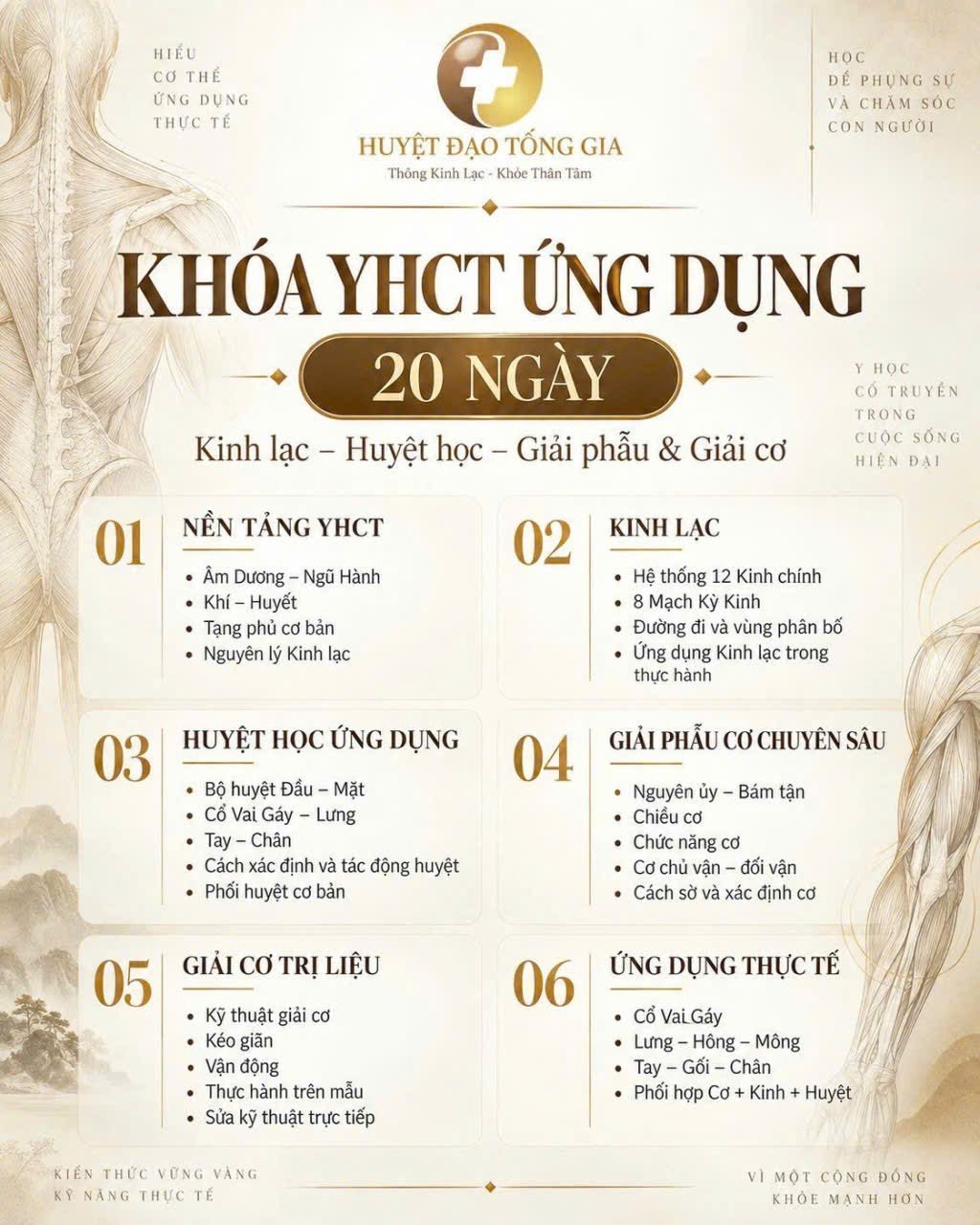
- L1 Introduction to Y Tướng Học (1.500.000đ): reading complexion, Five Element body types, the 3 face zones, daily self-care, a few safe self-care acupoints, partner practice.
- L2 Core Trade Skills: muscle release, acupressure for the neck and shoulders, back and legs; the standard Tong Gia 90-minute session routine; communicating with clients.
- L3 Specialist: spinal nerve-reflex balancing, advanced Y Tướng Học.
- L4 Master and Transfer: transferring the routine, SOPs, and how to train staff for business owners.
The teaching rests on two pillars. The first is Y Tướng Học: read the signs to understand the organs before placing your hands, because “the organs are the cause, the signs are the effect”. The second is therapeutic-style massage through spinal nerve-reflex balancing: every reading from the face must be cross-checked by hand on the spine. About 70% of class time is hands-on practice on real people, classes are small and Lương Y coaches each person, so posture and wrist corrections for each woman happen right there in class. Fees for L2 to L4, number of sessions and duration are given by an advisor when you register.
What to know before you register
Tong Gia does not promise a job or income after the course. For the type of paper issued after the course and its legal value, ask reception directly before paying the fee.
Tong Gia is a wellness and relaxation service using the hands, not a medical service. Anyone with long-lasting pain, increasing numbness or weakness, or an underlying illness should see a doctor at a medical facility. Students are taught to know when not to work and to advise the client to see a doctor.
How to register
The free trial class runs 9:00 to 12:00 every Sunday morning, 10 places per session, at căn T16-21 khu Manhattan, Vinhomes Grand Park, Phường Long Bình, TP. Thủ Đức (Thu Duc City, Ho Chi Minh City). Lương Y looks at your hand skills and then suggests a suitable level. General information is on the page massage course in Ho Chi Minh City.
The L1 Introduction to Y Tướng Học class runs on a set schedule. Register via hotline 0917 945 259.
Frequently asked questions
I’m a woman with small, not-so-strong hands. Can I still take a massage course in Ho Chi Minh City? Yes. Pressure in this work comes from posture and body weight, not just finger strength. Trained the right way, a petite person can still create deep, even pressure.
Can I join a massage course while I’m pregnant? You can study the theory and observe, but tell the instructor in advance so partner practice can be arranged. Tam Âm Giao (SP6, 三阴交) and Hợp Cốc (LI4, 合谷) are acupoints advised to be avoided for pregnant women.
Is massage work safe for women? Prefer working where there is a clear client-reception procedure, state in advance which areas you will and will not work on, and end the session if a client’s words or gestures are inappropriate.
I own a nail salon. Should I learn therapeutic-style massage? If you want to add neck, shoulder and back care for clients, learn it from the foundations. Massage is a regulated business line in Vietnam, so salon owners need to check the local procedures.
Related articles
- The 3 “no’s” of the Tong Gia spinal balancing method: no needles, no medicine, no rough force
- How the 33 vertebrae are grouped into regions: the spine map every therapeutic-style massage student must know
- 4 objective factors when reading the spine by hand: let the hands record, not guess
- 5 vertebral patterns (raised, sunken, shifted): reading the spine by hand in the Specialist course
- All articles on learning the trade
Reserve a free Sunday-morning trial class or ask about the learning path: message Zalo 0917 945 259.

Founder of Tong Gia Acupoint Wellness (Huyệt Đạo Tống Gia), with more than 13 years in Eastern wellness practice, Y Tướng Học (face reading for wellness) and spinal nerve-reflex balancing. Lương Y's story
417 customers have reviewed Tong Gia on Google Maps
Reviews are written by customers themselves on Google; tap to read them before you visit.
Huyệt Đạo Tống Gia Quận 12
225 Dương Thị Mười, Phường Tân Chánh Hiệp (District 12, Ho Chi Minh City). 8:00 – 19:00 daily.
See reviews on Google MapsHuyệt Đạo Tống Gia Quận 9
Căn T16-21 khu Manhattan, Vinhomes Grand Park, Phường Long Bình (Thủ Đức City, Ho Chi Minh City). 9:00 – 20:00 daily.
See reviews on Google MapsWant to be observed in person?
A 90-minute session starts with observation, and only then moves on to muscle release and acupressure on the right areas. Two branches: District 12 and Vinhomes Grand Park.