Zone and point locating in massage: the narrowing-down principle of spinal wellness massage, taught in our massage course in Vietnam
Lương Y (traditional healer) Tống Văn Huynh · Tong Gia Acupoint Wellness (Huyệt Đạo Tống Gia) · 08/11/2026
What is zone and point locating? In therapeutic-style spinal massage, as taught on the Tong Gia massage course in Vietnam, it is the principle of going from wide to narrow: scan the whole area, mark out the key zone with the most tension and the clearest imbalance, then find the smallest key point to work on first. Tong Gia teaches this principle so that force lands in the right place, in the right amount.
A full 90 minutes, so why does the client still say “you didn’t quite hit the spot”?
Many massage practitioners work very diligently: stroking the whole back, kneading the neck and shoulders thoroughly, pressing every acupoint. Yet clients leave saying “it felt nice, but it didn’t hit the spot.” The cause usually isn’t hand strength, but the fact that the pressure was shared out evenly over the whole back. The spot that needed work most only got a small part of it.
In the spinal nerve-reflex balancing method of therapeutic-style massage taught by Lương Y Tống Văn Huynh, this is principle number 3 of the 8 principles: zone and point locating.
What is zone and point locating?
Put simply, it means gradually narrowing the working area through 3 levels:
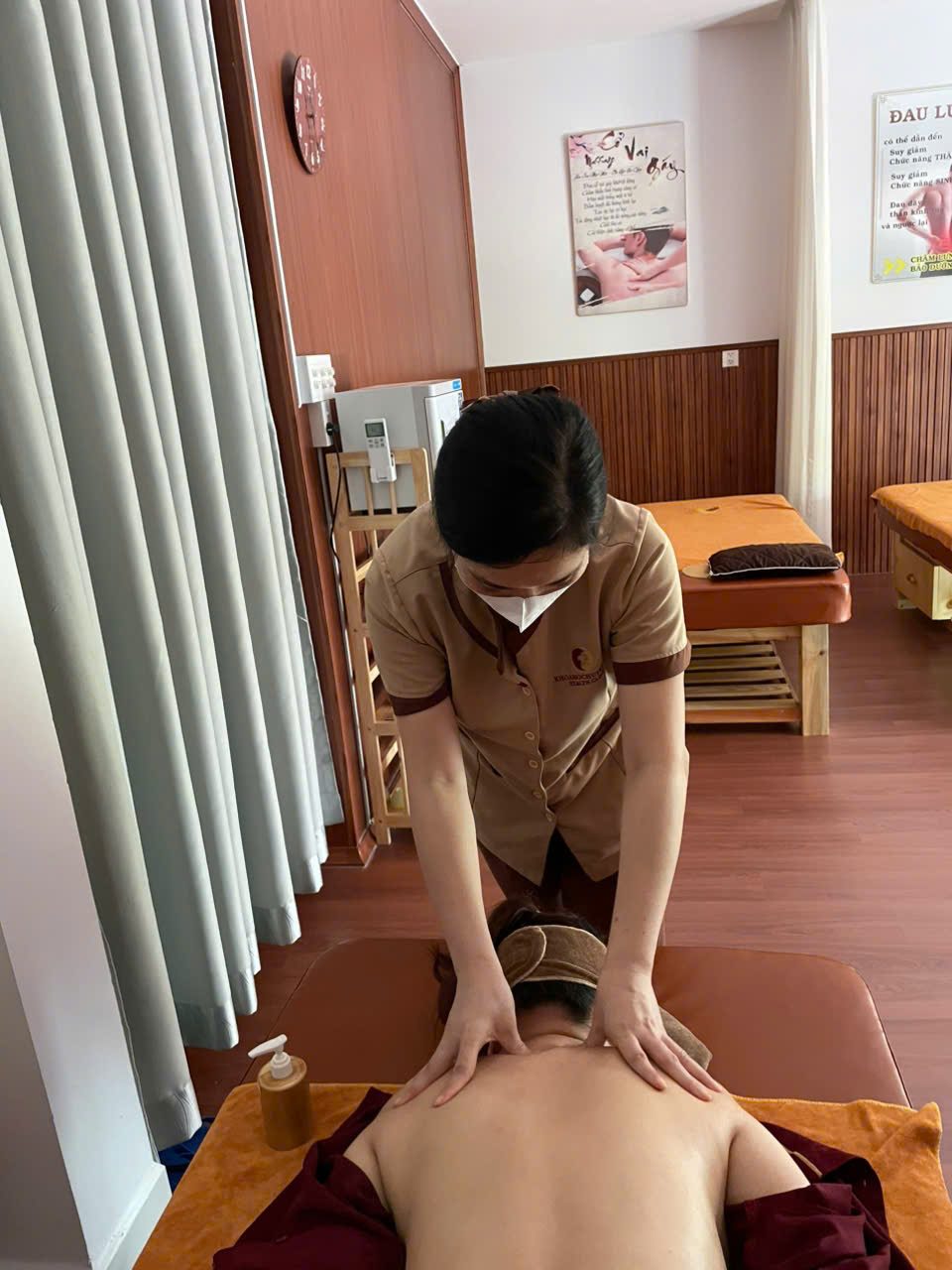
- Survey area: the whole section of the spine and the muscles on both sides that the practitioner sweeps over with the hands, for example from the nape down to the lower back.
- Key zone: within the survey area, mark off a smaller zone with the clearest signs: thick, hard muscle, skin warmer or cooler than the other side, an uneven groove along the spine.
- Key point: within the key zone, find the single smallest spot where the hands sense the “root” of the holding tension. This is where you work first and most carefully.
The memory line for this principle is very short: find the smallest root.
Why not just work the whole back evenly to be safe?
- Pressure is limited: a care session has only so much time and hand strength. Spread it evenly and the important spot goes short.
- The body responds from the root: often a whole stretch of back is tight just because one small area is bracing. Release exactly that spot and the surrounding area eases with it.
- Safer: knowing where the key point is also tells you where strong pressure is not needed, especially in inhibited zones (soft, cool, barely responsive).
The article excited zones and inhibited zones on the back explains why principle 2 must come before principle 3: you only mark key zones within excited zones.
What is zone and point locating based on?
Not on the gut feeling of “press wherever it hurts.” Learners are taught to read 4 objective factors by hand: skin temperature, the muscle cushion layer, the shape of the vertebrae and the client’s sensations. Then compare right with left, upper with lower (the symmetry principle). Only the spot that differs most clearly, and keeps showing up over several sweeps, counts as a key zone.
The tool is palpation (cảm thủ): laying the palm flat to feel warmth, stroking along the spinal groove, probing with pressure and rolling gently to sense the details. Before the hands go on, Y Tướng Học (face reading for wellness) helps suggest which areas to survey closely; but every hint from the face must be checked again by hand on the spine.
Try it now: a 3-round exercise on one back
- Round 1 (wide): lay the palms from the nape down to the lower back, both sides at once. Note the 2–3 sections that feel most different.
- Round 2 (zone): pick one section and stroke with three fingers along both sides of the spinal groove. Mark off a small zone about two vertebrae long.
- Round 3 (point): probe very slowly with one fingertip inside that zone. Ask the person receiving: “How does this spot feel compared with the one next to it?” Mark the most different point.
Repeat after 5 minutes. If the second time lands on the same point, you are reading correctly. If it is a different spot each time, your hands are still guessing and you need someone to guide you.
Take note: common mistakes of beginners
- Jumping straight to pressing the painful point and skipping the survey area.
- Choosing a key point in an inhibited zone and then pressing hard.
- Finding the key point but working it too long. The dosage principle is clear: once the threshold is reached, stop.
Therapeutic-style massage at Tong Gia is hands-on wellness care, not a medical service. If a client has long-lasting pain, numbness or weakness that keeps increasing, or an underlying spinal condition, the practitioner must stop and advise the client to see a doctor at a medical facility.
Where to learn this?
Zone and point locating is part 2 of the Expert Course (level L3): spinal nerve-reflex balancing massage, together with the 8 principles, palpation and the hands-on techniques. Most class time is hands-on practice on real people, with Lương Y Tống Văn Huynh correcting each learner’s hands.
How to sign up
The Sunday-morning trial class, 9:00–12:00 every week, and the free Sunday Y Tướng Học session are the open schedule for newcomers, at unit T16-21, Manhattan block, Vinhomes Grand Park, Thủ Đức City (Ho Chi Minh City). Sign up for a trial class or call the training hotline 0917 945 259.
Frequently asked questions
What is zone and point locating? In therapeutic-style spinal massage, it is the principle of narrowing the working area: scan the survey zone, mark out the clearest key zone, then find the smallest key point to work on first.
How do the key zone and the key point differ? The key zone is a small area with clear signs, usually spanning a few vertebrae. The key point is the smallest spot inside that zone, where the hands determine work should start.
Is the spot where the client says it hurts most the key point? Not necessarily. The key point is determined by several factors: skin temperature, the muscle layer, the shape of the vertebrae and sensation, comparing both sides.
How long does it take a beginner to learn point locating? It depends on each person’s hands. A simple check: if you sweep again after a few minutes and still land on the same point, your hands are reading consistently.
Where can I learn zone and point locating in Ho Chi Minh City? Tong Gia, at Vinhomes Grand Park, Thủ Đức City, teaches it in the Expert Course. Trial class on Sunday mornings 9:00–12:00; call 0917 945 259.
Related articles
- The 3 “no’s” of the Tong Gia spinal balancing method: no needles, no medicine, no rough force
- How the 33 vertebrae are divided into regions: the spine map every massage learner must know
- 4 objective factors when reading the spine by hand: let the hands record, not guess
- 5 vertebral shapes (raised, sunken, shifted): reading the spine by hand in the Expert Course
- All articles on learning the craft
Reserve a free Sunday-morning trial class or ask about the learning path: message Zalo 0917 945 259.

Founder of Tong Gia Acupoint Wellness (Huyệt Đạo Tống Gia), with more than 13 years in Eastern wellness practice, Y Tướng Học (face reading for wellness) and spinal nerve-reflex balancing. Lương Y's story
417 customers have reviewed Tong Gia on Google Maps
Reviews are written by customers themselves on Google; tap to read them before you visit.
Huyệt Đạo Tống Gia Quận 12
225 Dương Thị Mười, Phường Tân Chánh Hiệp (District 12, Ho Chi Minh City). 8:00 – 19:00 daily.
See reviews on Google MapsHuyệt Đạo Tống Gia Quận 9
Căn T16-21 khu Manhattan, Vinhomes Grand Park, Phường Long Bình (Thủ Đức City, Ho Chi Minh City). 9:00 – 20:00 daily.
See reviews on Google MapsWant to be observed in person?
A 90-minute session starts with observation, and only then moves on to muscle release and acupressure on the right areas. Two branches: District 12 and Vinhomes Grand Park.