Massage course Vietnam: directing force along the spine axis, and why the same pressure in the wrong direction brings the client no relief
Lương Y (traditional healer) Tống Văn Huynh · Tong Gia Acupoint Wellness (Huyệt Đạo Tống Gia) · 09/11/2026
Directing force along the spine axis is a hand-work principle of Tong Gia’s therapeutic-style massage, taught on its massage course in Vietnam, and it is not stretching: take the spinal canal as the axis, then choose to push, circle or shear (bỉ) on the muscle groups on both sides. In the wrong direction the muscle stays tense; first read the back following the idea “the signs show outside, the organs lie inside”.
What are you seeing: pressing the right spot, yet the client still says it is not enough?
Many massage practitioners have found the right tight spot and used enough force, yet the client still says “that spot is still stiff”. On checking again, the problem is often the direction of the hands: the force goes straight down into the bone instead of following the muscle fibres, or the two sides are worked in two directions that have nothing to do with each other.
Among the 8 working principles of the Specialist curriculum, “Setting the direction” comes after “Setting the force” (5 levels from light to strong). The phrase to remember: the spinal canal is the axis.
What does directing force along the spine axis mean?
Imagine a straight line running down the middle of the back, from the nape to the sacrum, passing over the spinous processes of the vertebrae. Inside lies the spinal canal. Tong Gia takes this line as the axis of symmetry: every hand direction on the left side is compared with the right side across that axis.
- Push: the force runs along or diagonally with the muscle fibres, from the outside in toward the axis or from the axis outward.
- Circle: a small circular force around a point on the muscle group beside the spine, helping to soften a contracted, stiff area.
- Shear (bỉ): a gliding force that gently pulls the muscle layer off the place where it is stuck tight.
Which direction to choose depends on the change the hands can feel: a raised spot, a sunken spot, a spot shifted to one side. The article 5 vertebral patterns: raised, sunken, shifted explains how students learn to recognise these forms.
Why use an axis of symmetry?
The muscles on either side of the spine work in pairs. When one side is tight, the other often has to compensate. If only one side is worked by feel, the session can make the sensation between the two sides of the back even more uneven. Using the midline as a reference helps the practitioner always compare right with left and top with bottom, in line with principle 1, symmetry (see the principle of symmetry in therapeutic-style massage).
Tong Gia uses no rough force, no needles and no medicine. The right hand direction reaches a pleasant sensation with less force, which is safer for the client and less tiring for the practitioner.
Try it now: drawing the axis on your practice partner's back
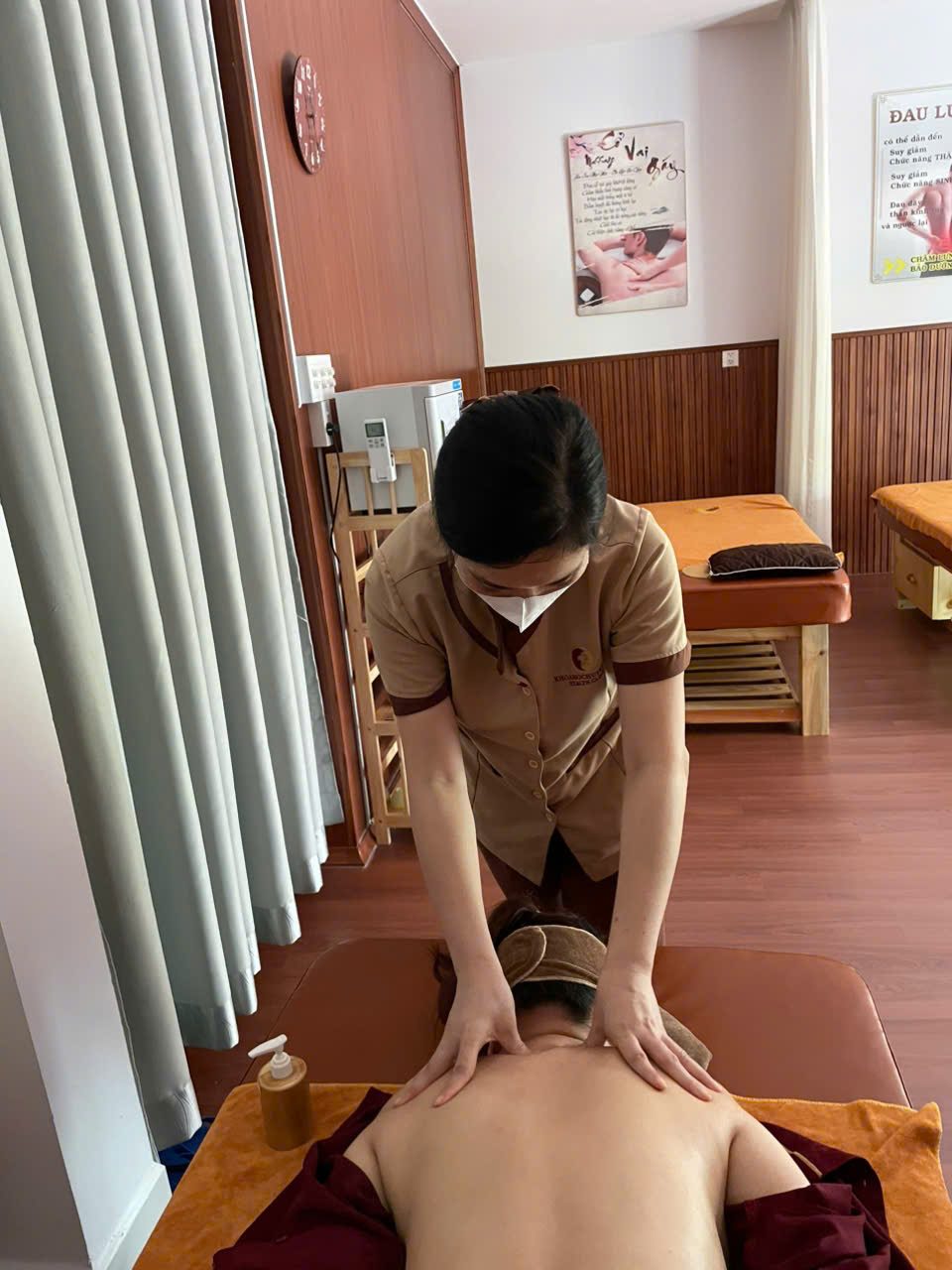
- Have your practice partner lie face down. With the tip of your middle finger, gently trace each spinous process from the nape down to the lower back, imagining a straight line.
- Place both palms on either side of that line, an equal distance apart, at the level of the mid-back.
- Gently push outward at the same time toward the ribs, 5 times. Then push diagonally downward, 5 times.
- Ask your partner which direction feels better and which side feels tighter. Write it down to compare next session.
The exercise uses only level-2 pressure (the whole hand). The goal is to feel the direction, not yet to go deep.
Note: when should you not work near the spine axis?
- Never press directly on the spinous processes and never push force down into the bone.
- A back with a fresh injury, swelling, heat or bruising: do not work.
- Pain spreading down the arms or legs, numbness or tingling, gradual weakness, or a person who has had spinal surgery: stop and advise the client to see a doctor at a medical facility.
- Pregnant women: do not work on the lower back or the sacrum and tailbone area.
Where can you learn this?
Directing force is taught in the therapeutic-style massage for spinal nerve-reflex balancing in the Specialist Course (L3), together with reading the spine by hand, locating the zone, locating the point and setting the force. Mornings are theory and afternoons are hands-on practice on real people, with Lương Y Tống Văn Huynh guiding your hands. See details at learn therapeutic-style massage for spinal reflex balancing. The second pillar is Y Tướng Học (face reading for wellness): reading the face suggests areas that need attention, which are then cross-checked by hand on the spine.
How to register
The Sunday-morning trial class, 9:00–12:00 every week, and the free Sunday Y Tướng Học session are the open schedule for newcomers, at unit T16-21, Manhattan area, Vinhomes Grand Park, Thủ Đức City (Ho Chi Minh City). The course fee is given by a consultant when you register. Register for a trial class or call the training hotline 0917 945 259.
Frequently asked questions
What is directing force along the spine axis? It means choosing whether the hands push, circle or shear on the muscle groups on both sides of the spine, taking the midline of the back (the spinal canal) as the axis of symmetry.
Should you press straight down on the spine? No. Tong Gia does not push force onto the spinous processes; it works on the muscle groups on both sides, comparing right with left.
Why is the back still stiff after a massage with enough force? Usually because the force did not follow the muscle fibres or only one side was worked. Changing direction and comparing both sides across the midline makes the sensation more even.
When should you not massage near the spine? When the back has a fresh injury, swelling or heat, during pregnancy, with pain spreading or numbness and weakness in the arms or legs, or after spinal surgery. Cases of pain and numbness should be checked by a doctor.
Is directing force along the spine axis the same as stretching the spine? No. It is a hand-work principle in therapeutic-style massage: choose to push, circle or shear on the muscle groups on both sides of the spine, taking the midline of the back as the axis of symmetry, without loading force onto the spinous processes.
Related articles
- The 3 “no’s” of the Tong Gia spinal balancing method: no needles, no medicine, no rough force
- How the 33 vertebrae are grouped into regions: the spine map every therapeutic-style massage student must know
- 4 objective factors when reading the spine by hand: let the hands record, not guess
- 5 vertebral patterns (raised, sunken, shifted): reading the spine by hand in the Specialist course
- All articles on learning the trade
Reserve a free Sunday-morning trial class or ask about the learning path: message Zalo 0917 945 259.

Founder of Tong Gia Acupoint Wellness (Huyệt Đạo Tống Gia), with more than 13 years in Eastern wellness practice, Y Tướng Học (face reading for wellness) and spinal nerve-reflex balancing. Lương Y's story
417 customers have reviewed Tong Gia on Google Maps
Reviews are written by customers themselves on Google; tap to read them before you visit.
Huyệt Đạo Tống Gia Quận 12
225 Dương Thị Mười, Phường Tân Chánh Hiệp (District 12, Ho Chi Minh City). 8:00 – 19:00 daily.
See reviews on Google MapsHuyệt Đạo Tống Gia Quận 9
Căn T16-21 khu Manhattan, Vinhomes Grand Park, Phường Long Bình (Thủ Đức City, Ho Chi Minh City). 9:00 – 20:00 daily.
See reviews on Google MapsWant to be observed in person?
A 90-minute session starts with observation, and only then moves on to muscle release and acupressure on the right areas. Two branches: District 12 and Vinhomes Grand Park.