Signs of weak Kidneys in TCM: wellness massage learners read with the eyes and check with the hands
Lương Y (traditional healer) Tống Văn Huynh · Tong Gia Acupoint Wellness (Huyệt Đạo Tống Gia) · 13/11/2026
Signs of weak Kidneys in TCM include a sore lower back and knees, ringing ears, dry, falling or early-grey hair, night urination and feeling cold. The TCM Kidney is a functional system, not just the Western kidney organ. At Tong Gia Acupoint Wellness (Huyệt Đạo Tống Gia) in HCMC, learners check the lower back by hand before speaking to clients.
Questions learners often ask about signs of weak Kidneys in TCM
I do massage in District 9, HCMC. Clients with back pain say "weak kidneys". How do I tell muscle pain from kidney pain?
Most back pain comes from muscles, ligaments or the spine; kidney pain usually sits in the flank with fever or urinary problems. At Tong Gia, learners read the lower-back muscles by hand first and do not mention the Kidneys. With cramping pain spreading to the lower belly, blood in the urine or fever, advise the client to see a doctor.
As a foreigner in HCMC, I've heard ears and hair reveal weak Kidneys. What's the TCM basis, and how is that different from fortune-telling?
It is only a hint, not a conclusion. TCM holds that the Kidneys open into the ears and show in the hair, so thin, soft ear rims and early grey hair are linked to Kidney qi deficiency. Tong Gia uses these signs to ask the right questions, then checks the lower back by hand, and never predicts anyone's fate.
I'm over 40 in Ho Chi Minh City and want to learn Kidney care and lower-back massage for my family. Where, and how much?
Tong Gia teaches the Kidney organ system in the Specialist Course (L3), taught by Lương Y Tống Văn Huynh at căn T16-21 khu Manhattan, Vinhomes Grand Park, TP. Thủ Đức (unit T16-21, Manhattan block, Thu Duc City). Beginners take L1 Foundation (1.500.000₫); staff quote L2–L4 fees at registration. This is wellness care, not a medical profession. Zalo 0917 945 259.
The Kidney class: hands on the lower back
In class at Vinhomes Grand Park, one scene keeps repeating in the Kidney session: a learner presses on a partner's lower back, the partner says it feels sore, and the learner says right away, "must be weak kidneys." Lương Y Tống Văn Huynh stops them, places the learner's hands along the muscle bands on both sides of the spine, and asks the partner how long they sit each day, how many times they get up at night to urinate, and whether their ears ring. Every lesson on signs of weak Kidneys in TCM starts by separating the meanings of the word "Kidney" like this.
The TCM "Kidney" is not just the kidney of Western medicine
Western medicine describes the kidneys as a pair of bean-shaped organs behind the peritoneum, on either side of the spine, roughly level with T12 to L3. Each day they filter about 180 litres of fluid and produce only 1–2 litres of urine; they also release renin to regulate blood pressure and activate vitamin D to keep bones strong.
TCM calls the Kidney the root of prenatal (inborn) constitution: a functional system that stores essence, governs the bones and produces marrow, governs water, receives qi, opens into the ears and shows in the hair. "Kidney deficiency" in TCM means weakened Kidney qi, Kidney yin or Kidney yang; "nephrotic syndrome" in Western medicine is a glomerular disease that causes protein loss. Mixing up these two ideas only worries the client.
The two views meet in a few places: the kidneys retain calcium, so they relate to bone, close to the idea "the Kidney governs the bones"; the kidneys concentrate or dilute urine, close to the idea "the Kidney governs water".
Signs of weak Kidneys in TCM that learners need to remember
- Lower back and knees: aching, cold, tiring quickly when standing; tired, weak knees.
- Ears: ringing in the ears, gradually weaker hearing, dizziness.
- Hair and teeth: dry, falling or early grey hair; loose teeth.
- Night urination: 0–1 times a night is usual; 2 or more times over a long period is worth looking into.
- Body temperature: feeling cold, cold hands and feet, or hot palms and soles, night sweats.
The curriculum divides this into two directions: Kidney yin deficiency leans towards heat (afternoon hot flushes, dry mouth), Kidney yang deficiency leans towards cold (cold lower back and knees, night urination). A single sign on its own says nothing.
How is muscle back pain different from kidney pain?
Tong Gia's curriculum states it clearly: most back pain comes from muscles, ligaments or the spine. Kidney-related pain usually sits in the flank and comes with fever or urinary problems. Muscle pain is usually a dull ache after long sitting or carrying loads; pressing on the muscle band feels stiff, warm and more painful. Read more: lower back pain from long sitting: what massage practitioners should know.
What learners notice with the eyes
- Thin, soft ear rims, a flat mastoid bone behind the ear, stiff fibrous muscle around the ear: the Y Tướng Học (face reading for wellness) curriculum links these to Kidney qi and Kidney yang deficiency.
- A round face of the Water type: the lower back catches cold easily, the skin there feels cold and the lower-back muscles are slack.
- Dry, thin hair that greys early for the person's age.
When learners see these features, they ask more about sleep, night urination, ears and feeling cold; they do not state any conclusion.
Checking the lower back by hand
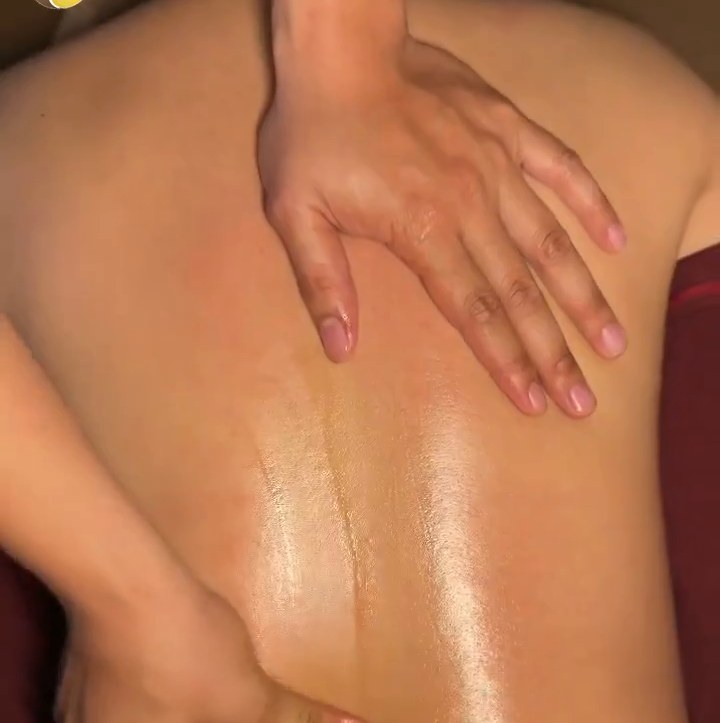
The lower back from L1 to L5 relates to digestion, the kidneys, the urinary tract, the reproductive organs and the legs (see the lower back from L1 to L5). Landmarks to find: Mệnh Môn (GV4, 命门) in the hollow below the L2 spinous process; Thận Du (BL23, 肾俞) 1.5 cun out to the side; Chí Thất (BL52, 志室) 3 cun out to the side. Compare both sides. The side that is stiff, warm and more painful under pressure is an excited area, usually muscular. A cold, slack area with low sensation is an inhibited area: do not work on it directly, only keep it warm.
During the session: what to do and what not to do
- Ask about history: pregnancy, kidney disease, high blood pressure, diabetes, blood-clotting disorders.
- Keep the back, belly and feet warm throughout the session.
- Open the Bladder meridian along both sides of the spine; knead and press Thận Du (BL23, 肾俞), Chí Thất (BL52, 志室) and Mệnh Môn (GV4, 命门) with moderate pressure; on the legs, Thái Khê (KI3, 太溪) and Dũng Tuyền (KI1, 涌泉). Do not use Tam Âm Giao (SP6, 三阴交) on pregnant women.
- Home advice: rub both sides of the lower back until warm, soak the feet in warm water at 38–42°C for 15–20 minutes before bed (people with diabetes should check the temperature carefully), sleep before 11 pm, eat lightly salted food, do not hold in urine.
Do not: do not say "you have kidney deficiency", do not claim massage "detoxes the kidneys" or "tonifies the kidneys and boosts virility", do not press hard on the flank when the client has cramping pain or fever.
Lương Y Tống Văn Huynh teaches learners to read the lower back before saying the word Kidney
With more than 13 years in the craft, Lương Y Tống Văn Huynh reminds the class: "Back pain is not necessarily the Kidney; the hands must first read the muscle and the bone, and only then may the mouth say the word Kidney." Learners practise speaking to clients in the form of questions instead of conclusions.
When to advise the client to see a doctor
Advise the client to see a doctor at a medical facility when there is: blood in the urine; persistently foamy urine; swelling of the face or legs; very little urine or inability to urinate; cramping flank pain spreading to the lower belly; fever with flank pain or burning urination; frequent night urination over a long period. Tong Gia Acupoint Wellness offers wellness and health care, not a medical service.
Which level teaches this?
The Kidney is chapter 5 in the Five Organs wellness part of the Specialist Course (L3), learned together with reading the spine by hand. Beginners start from L1 Foundation (1.500.000₫). Staff quote L2–L4 fees at registration. Read more about the teacher: Lương Y Tống Văn Huynh.
How to sign up
The trial class on Sunday morning, 9:00–12:00, with no fee, and the Sunday Y Tướng Học class are for beginners, at căn T16-21 khu Manhattan, Vinhomes Grand Park, TP. Thủ Đức (unit T16-21, Manhattan block, Thu Duc City). Tong Gia does not promise jobs or income after the course. Book a trial class or call the training hotline 0917 945 259.
Frequently asked questions
What are the signs of weak Kidneys in TCM? Sore lower back and knees; ringing ears, gradually weaker hearing; dry, falling or early grey hair; night urination; feeling cold or having hot palms and soles. A single sign is not enough for a conclusion.
Is TCM Kidney deficiency the same as nephrotic syndrome in Western medicine? No. TCM Kidney deficiency is weakened Kidney qi, Kidney yin or Kidney yang; nephrotic syndrome is a glomerular disease that causes protein loss. They are two different concepts.
Is back pain caused by weak kidneys? Most back pain comes from muscles, ligaments or the spine. Kidney-related pain usually sits in the flank and comes with fever or urinary problems; in that case the person should see a doctor.
Where can I learn about the Kidney organ system? In the Five Organs wellness part of the Specialist Course (L3) at Tong Gia Acupoint Wellness, Vinhomes Grand Park, Thu Duc City. Trial class Sunday morning 9:00–12:00, hotline 0917 945 259.
Related articles
- The 12 main meridians: names, pathway rules and peak hours, an easy table for vocational learners
- Face reading for health: the 3 facial zones in Y Tướng Học, how to divide them and how to read them to care for the body properly
- What are the 8 extraordinary vessels: roles, main pathways and how wellness learners use them
- Yin-Yang and the Five Elements for wellness learners: enough to make the hands work right
- All articles about learning the trade
Reserve a free Sunday-morning trial class or ask about the learning path: message Zalo 0917 945 259.

Founder of Tong Gia Acupoint Wellness (Huyệt Đạo Tống Gia), with more than 13 years in Eastern wellness practice, Y Tướng Học (face reading for wellness) and spinal nerve-reflex balancing. Lương Y's story
417 customers have reviewed Tong Gia on Google Maps
Reviews are written by customers themselves on Google; tap to read them before you visit.
Huyệt Đạo Tống Gia Quận 12
225 Dương Thị Mười, Phường Tân Chánh Hiệp (District 12, Ho Chi Minh City). 8:00 – 19:00 daily.
See reviews on Google MapsHuyệt Đạo Tống Gia Quận 9
Căn T16-21 khu Manhattan, Vinhomes Grand Park, Phường Long Bình (Thủ Đức City, Ho Chi Minh City). 9:00 – 20:00 daily.
See reviews on Google MapsWant to be observed in person?
A 90-minute session starts with observation, and only then moves on to muscle release and acupressure on the right areas. Two branches: District 12 and Vinhomes Grand Park.