Stiff neck after sleeping: what massage students need to know before laying hands on
Lương Y (traditional healer) Tống Văn Huynh · Tong Gia Acupoint Wellness (Huyệt Đạo Tống Gia) · 04/11/2026
Quick summary: When someone wakes up with a stiff neck after sleeping, a student on a massage course in Vietnam needs to know three things: ask carefully before working, work gently on the shoulders and upper back before touching the neck, and recognise the signs that mean advising a doctor visit. Kneading hard or twisting a neck that is already locked up usually makes the muscles tighten even more. In Tong Gia classes in Ho Chi Minh City, Lương Y Tống Văn Huynh teaches this situation as: look first, feel with the hands second, and work from far to near.
Short answer: A stiff neck on waking usually comes from the trapezius and levator scapulae tightening after an awkward sleeping position. Work gently on the shoulders and upper back first and never twist the neck hard; Eastern practice adds the Luozhen point on the hand. Pain with arm numbness or fever means a medical check. Zalo/WhatsApp +84 917 945 259.
A stiff neck after sleeping is the first situation massage students meet
You wake up and cannot turn your head; turning to one side gives a sharp twinge, and you have to turn your whole body to look around. Vietnamese people call it “sái cổ” or “vẹo cổ” (a cricked neck). It is very common in people who sleep on a pillow that is too high, lie on their side in an awkward position, or sleep with a fan or air conditioner blowing straight onto the back of the neck.
New massage students usually meet this situation first, because family members ask right away: “Can you rub my neck for a sec?” That is exactly when students are most likely to get it wrong, because a stiff neck makes them want to knead hard right on the stiff spot.
What massage students need to know: ask first, work second
Before laying hands on, students are taught to ask a few short questions:
- When did the stiffness start? Just this morning, or several days ago?
- Any recent fall, knock or accident?
- Any numbness spreading down the arm, arm weakness, dizziness, severe headache or fever?
- Is it one side or both? Which direction hurts when turning?
Only if the stiffness is on one side, appeared after a night in a bad sleeping position, and none of the signs above are present does the student go ahead, and gently.
Why not knead straight into the stiff spot
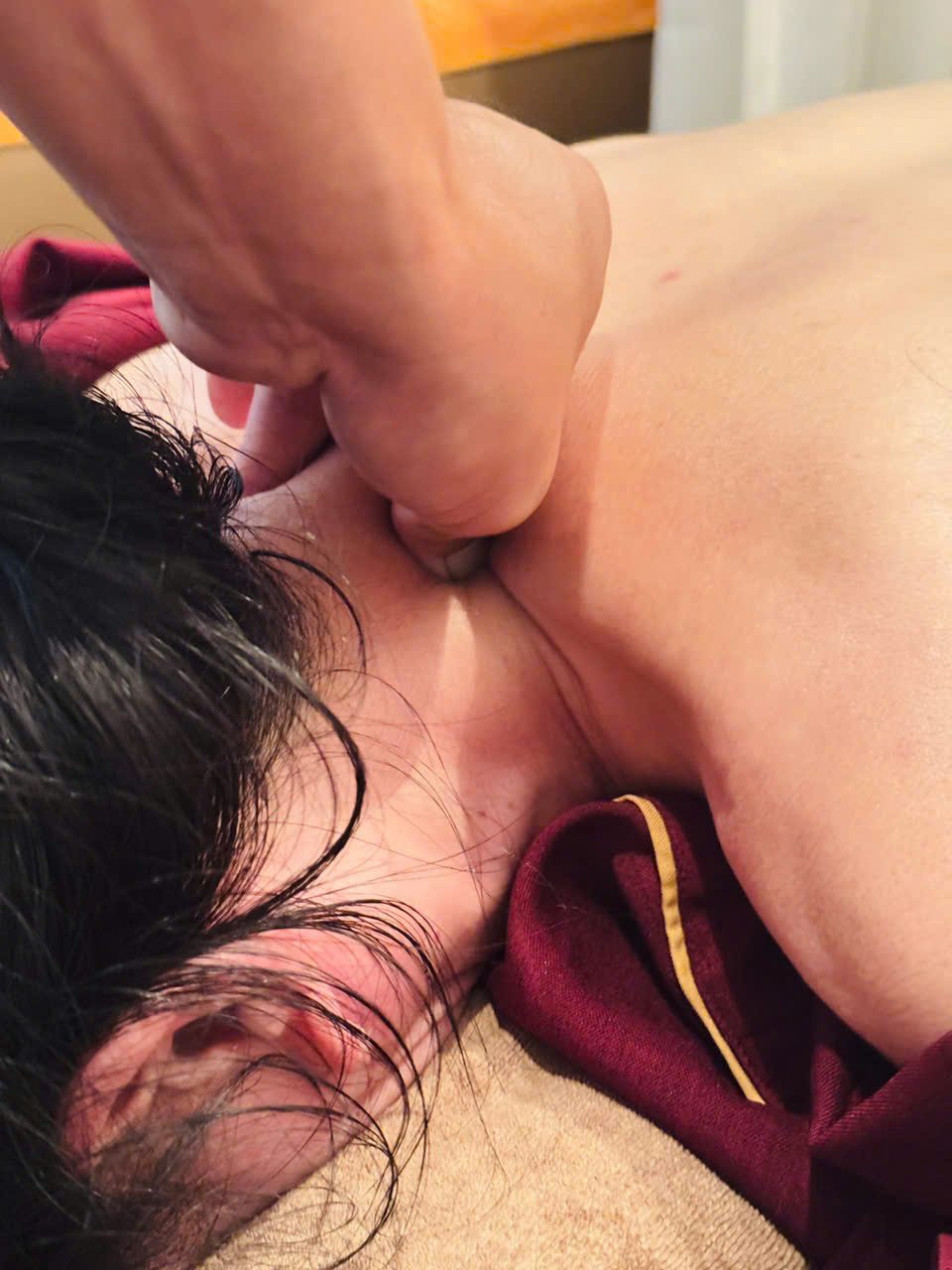
The neck muscles are contracting to protect themselves. Kneading hard, pulling hard or turning the neck suddenly makes them contract more; the person tenses up and it hurts more. At Tong Gia, the principle is to work from far to near:
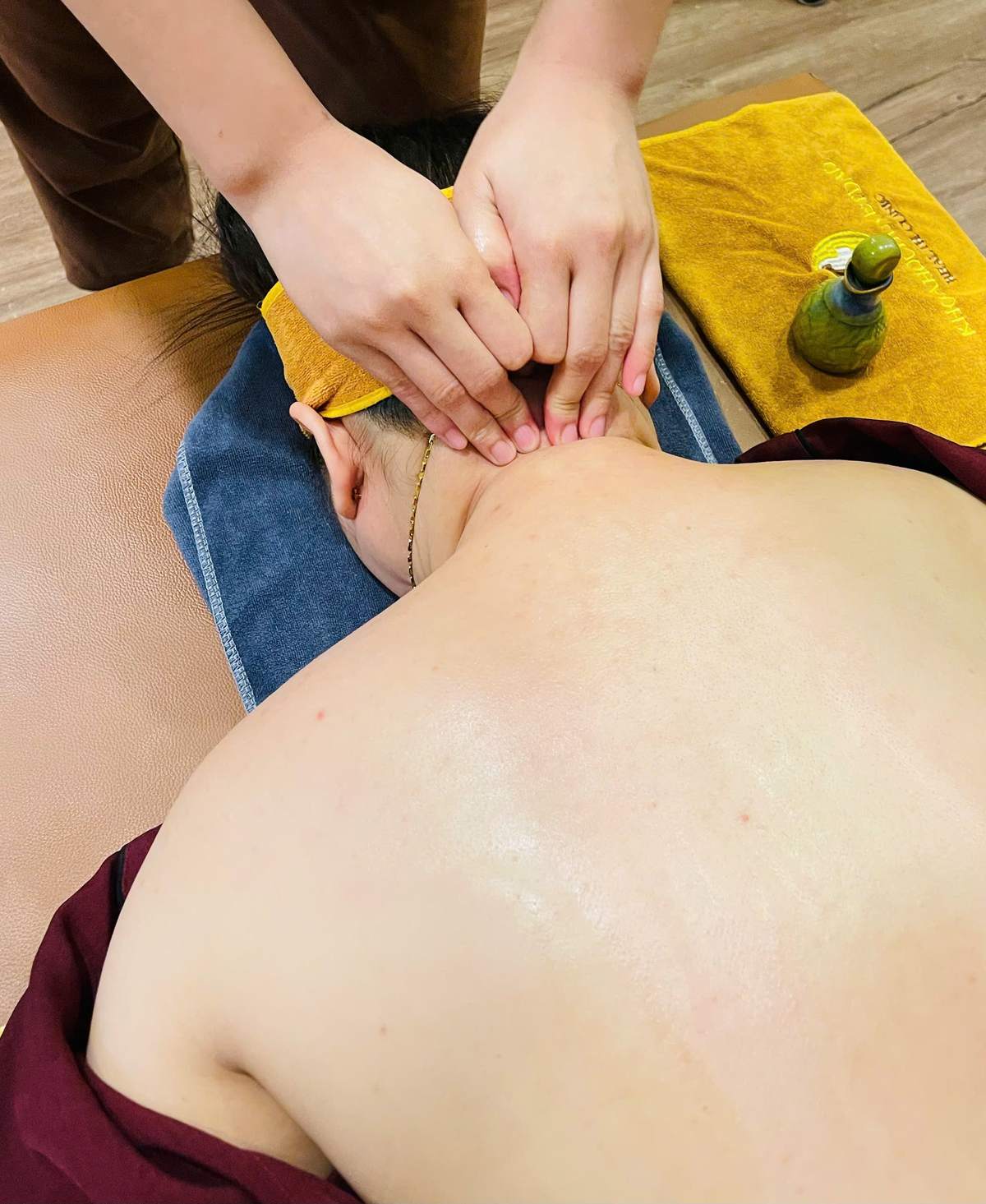
- Warm the shoulders and upper back first: rub and stroke gently over the shoulder blades and both sides of the upper spine so the muscles gradually soften.
- Muscle release for the shoulders and trapezius: moderate pressure, slow, following the person’s breathing.
- Only touch the neck once the muscles have eased: gentle long strokes, no twisting, no cracking.
- Points away from the painful area: students learn a few points on the hand, such as Hậu Khê (SI3, 后溪) and the Lạc Chẩm point (EX-UE8, 落枕) on the back of the hand, pressed gently while the person moves the neck very slowly within a pain-free range.
Step-by-step muscle release for the neck and shoulders is covered in the article learning neck and shoulder muscle release, and the locations of the points in this area are in learning acupressure for the neck and shoulders.
Look before laying hands on: the Y Tướng Học part
In Tong Gia classes, students do not rush in and squeeze. They look at how the person sits, how uneven the shoulders are, the complexion, and how the person holds their head. Someone with a stiff neck usually tilts the head to one side, with the sore-side shoulder sitting higher. A person with a dull, tired complexion and long-term poor sleep is usually dealing with more than one bad night.
Then the student feels along both sides of the cervical spine and upper back, searching for tight spots and cold spots. What the eyes see and what the hands feel must match before deciding what to do. This is how Tong Gia links Y Tướng Học (face reading for wellness) with spinal nerve-reflex balancing. The method uses only the hands: no joint cracking, no machines.
When students must stop and advise seeing a doctor
Anyone learning the trade must know when not to work. Neck stiffness after a knock or accident; numbness or arm weakness; dizziness or nausea; severe headache; fever with a stiff neck; pain lasting several days without easing, or getting worse: these cases need a check-up at a medical facility, not massage. Tong Gia offers hands-on wellness care and is not a medical service.
Aftercare advice for the person after the session
- Keep the back of the neck warm; avoid fans and air conditioners blowing directly on it.
- Check the pillow: just high enough to keep the neck in line with the back when lying on your side.
- Move the neck gently within a pain-free range; do not force it to “crack”.
Which level teaches how to handle this situation
How to ask, how to observe and a few safe self-care points are part of L1 Introduction to Y Tướng Học (1.500.000đ). Muscle release and acupressure for the neck and shoulders, following the standard Tong Gia routine, are in L2 Core Skills. About 70% of class time is hands-on practice on real people, in small classes, with Lương Y Tống Văn Huynh, who has more than 13 years in the trade, coaching each student. Tong Gia does not promise jobs or income after the course.
How to register
The trial class from 9:00–12:00 on Sunday morning and the free Y Tướng Học session on Sunday are two fixed sessions every week, at unit T16-21, Manhattan zone, Vinhomes Grand Park, Phường Long Bình, TP. Thủ Đức (Thu Duc City, Ho Chi Minh City). See the schedule in the free trial class section.
Message Zalo 0917 945 259 with “HỌC THỬ” (trial class) and your name to hold a spot. Read more about the therapeutic-style massage course in Ho Chi Minh City.
Questions learners often ask
Can pressing the Luozhen point on the hand help a stiff neck?
Yes, for a mild stiff neck it is a safe option. Luozhen (EX-UE8) sits on the back of the hand between the second and third metacarpals, just behind the knuckles. Press gently while the person slowly moves the neck within a pain-free range. Neck pain with arm numbness needs a medical check. Huyệt Đạo Tống Gia; Zalo/WhatsApp +84 917 945 259.
Frequently asked questions
Should you massage a stiff neck after sleeping? If the stiffness is only on one side after a night in a bad position, with no arm numbness, dizziness, fever or knock, gentle massage of the shoulders and upper back is fine. No hard kneading, no twisting or cracking the neck.
Which acupressure points help a cricked neck? Students are usually taught to work gently on the shoulders first, then press points away from the painful area on the hand, such as Hậu Khê (SI3, 后溪) and the Lạc Chẩm point (EX-UE8, 落枕), while the neck moves slowly. It is wise to learn the locations in person with someone experienced.
When does a stiff neck need a doctor? When the stiffness follows a knock, or comes with arm numbness or weakness, dizziness, severe headache, fever, or pain lasting several days without easing, you should get checked at a medical facility.
Where can I learn to handle neck and shoulder stiffness in Ho Chi Minh City? Tong Gia teaches this in L1 and L2 at Vinhomes Grand Park, Thu Duc City, with a free trial class on Sunday mornings.
Related articles
- The 3 “no’s” of the Tong Gia spinal balancing method: no needles, no medicine, no rough force
- How the 33 vertebrae are grouped into regions: the spine map every therapeutic-style massage student must know
- 4 objective factors when reading the spine by hand: let the hands record, not guess
- 5 vertebral patterns (raised, sunken, shifted): reading the spine by hand in the Specialist course
- All articles on learning the trade
To reserve a free Sunday-morning trial session or ask about the learning pathway: message Zalo 0917 945 259.

Founder of Tong Gia Acupoint Wellness (Huyệt Đạo Tống Gia), with more than 13 years in Eastern wellness practice, Y Tướng Học and spinal nerve-reflex balancing. The Lương Y's story
417 customers have reviewed Tong Gia on Google Maps
Reviews are written by customers themselves on Google; tap to read them before you visit.
Huyệt Đạo Tống Gia Quận 12
225 Dương Thị Mười, Phường Tân Chánh Hiệp. 8:00 – 19:00 daily.
See reviews on Google MapsHuyệt Đạo Tống Gia Quận 9
Unit T16-21, Manhattan zone, Vinhomes Grand Park, Phường Long Bình. 9:00 – 20:00 daily.
See reviews on Google MapsWant to be assessed in person?
The 90-minute session starts with observation, and only then moves to muscle release and acupressure on the right areas. Two branches: Quận 12 and Vinhomes Grand Park.